 Akshay Dinesh
The International Space Station is a laboratory, a home, and a machine that must keep running every minute of every day. Its life-support equipment, communications systems, computers, pumps, experiments, and heaters all depend on electricity. Sunlight is abundant in orbit, but the station’s oldest solar wings have been working for more than two decades. Like any photovoltaic system, they gradually produce less power as radiation, temperature swings, and normal aging take their toll.
That is why a newer kind of panel now sits in front of several original wings. The International Space Station Roll-Out Solar Array, usually shortened to IROSA, arrives tightly packed, travels to its mounting point with help from astronauts and a robotic arm, and then unfurls into a 60-foot-long power plant. NASA plans to install the seventh and eighth arrays during spacewalks on October 29 and November 5, 2026. When the pair is operating, the eight-array upgrade is expected to raise the station’s available power by as much as 30 percent, from about 160 kilowatts to roughly 215 kilowatts.
Why the original solar wings need help
The station’s large golden-orange solar wings were remarkable machines when the first pair was deployed in 2000. Each wing contains two flexible blankets of solar cells extending from a central mast. Rotating joints and smaller gimbals keep the cells pointed toward the Sun as the station circles Earth. The wings were designed with the knowledge that their output would decline, but the station has operated longer and supported more research than planners could confidently predict when the hardware was built.
Solar cells in low Earth orbit face conditions that rooftop panels do not. High-energy particles can damage their semiconductor structure. Atomic oxygen can erode exposed materials. The station moves from sunlight into darkness and back again about every 90 minutes, repeatedly heating and cooling its exterior. Micrometeoroids and tiny pieces of orbital debris add another hazard. None of these effects has to destroy a wing to matter; a small loss repeated across thousands of cells gradually reduces the electricity available to the station.
Replacing every original wing would have been a massive job. Engineers instead designed an addition that uses hardware already in place. Each IROSA is mounted at an angle in front of an older array and connected to the same electrical channel. The new panel shades part of the original blanket, but the unshaded cells keep working. The two generations of solar hardware then supply electricity together, producing more power than the aging wing could provide on its own.
How a solar array can unroll without a motor
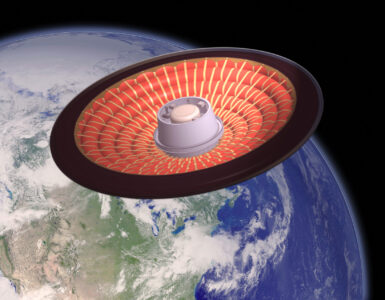
A conventional rigid panel needs hinges, frames, and a deployment mechanism. Those parts add mass and occupy valuable room inside a launch vehicle. A roll-out array takes a different approach. Its photovoltaic cells are attached to a thin, flexible blanket supported by two long composite booms. Before launch, the blanket and booms are wound around a cylinder, making the array compact enough to ride to orbit on a cargo spacecraft.
The clever part is stored elastic energy. Each support boom has a curved cross-section a little like a carpenter’s tape measure. Rolling it onto the cylinder forces the composite material out of its preferred shape. When astronauts release the restraints in orbit, the booms naturally return to their straight form and carry the solar blanket outward. The structure supplies its own deployment force, so it does not need a long powered mast or a motor to pull the entire blanket open.
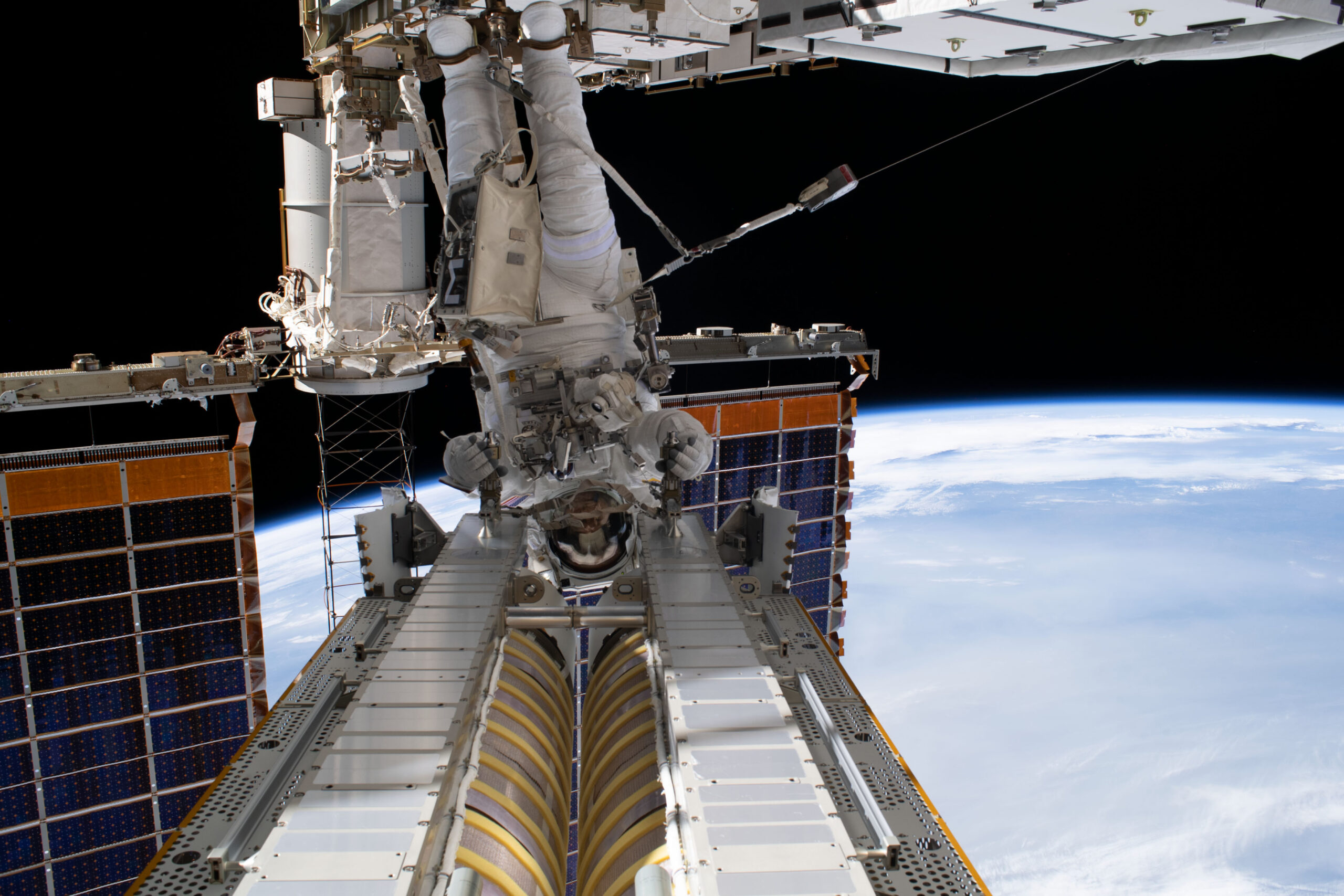
Once deployed, an IROSA measures about 60 feet by 20 feet, or 18.2 meters by 6 meters. NASA reported that each of the first six units could produce more than 20 kilowatts. The exact contribution to the station changes with the Sun angle, operating conditions, and the output of the older cells behind it, but the scale is easier to grasp through an everyday comparison: 20 kilowatts is enough to run hundreds of laptop computers at once.
The flexible design is not merely a trick for the space station. Launch vehicles charge dearly for mass and volume, and large spacecraft need more generating area than rigid panels can always provide conveniently. A power system that launches as a compact roll and opens into a broad, lightweight surface offers a useful model for future spacecraft that need substantial electrical power far from a ground connection.
Why installation still requires a spacewalk
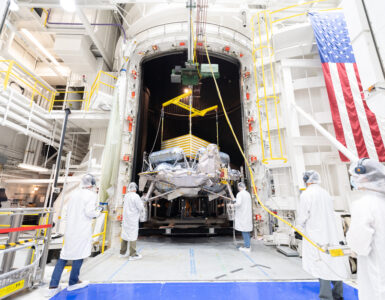
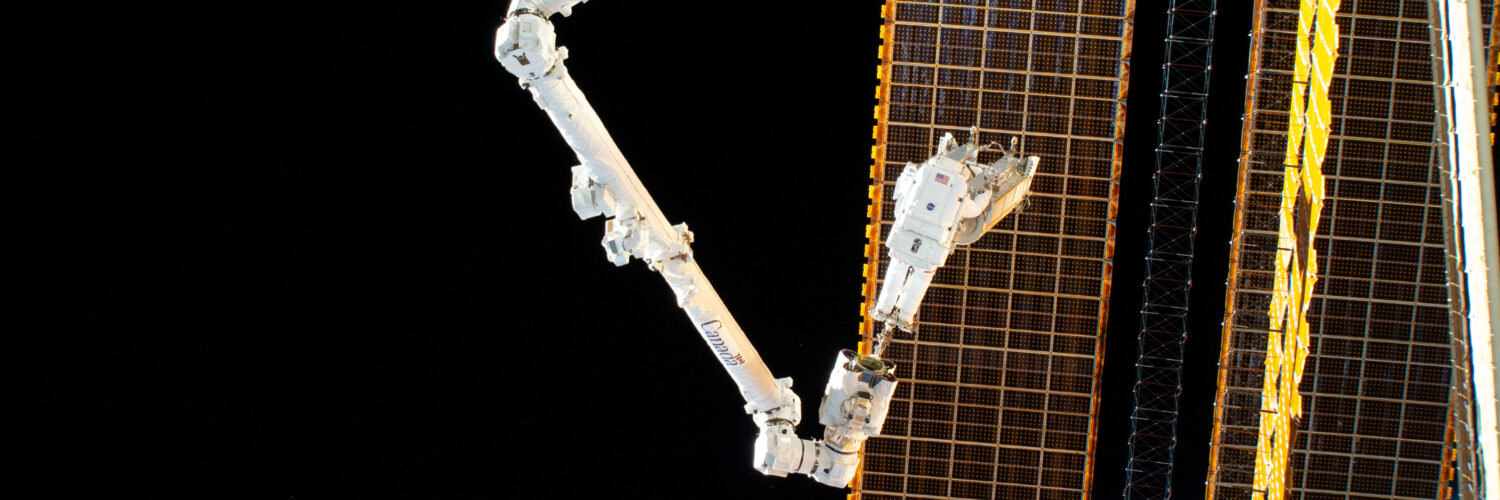
Compact deployment does not make the installation automatic. The rolled array reaches the station on a cargo vehicle and must be moved across the exterior to the correct power channel. During earlier installations, one astronaut rode on the end of Canadarm2 while carrying the folded array, as another crew member and robotic operators helped position the hardware. The job combines human judgment with the reach and steadiness of the station’s Canadian-built robotic arm.
Preparation begins long before the array arrives. Astronauts first install a modification kit on the old solar-wing structure. This bracket gives the new array a secure mechanical connection and provides the path for its electrical cables. On installation day, the spacewalkers remove the folded array from its carrier, maneuver it to the bracket, bolt it into place, connect its power leads, and prepare it to deploy. Every tool and loose component must remain tethered, and every movement must account for the bulky pressure suit.
Working around a power system raises special concerns. The station’s arrays can generate high voltages whenever sunlight reaches them, and electrical channels cannot simply be treated like harmless construction materials. Mission controllers plan the station’s orientation, power configuration, robotic movements, and crew sequence as one coordinated operation. The astronauts also have limited time outside because their suits carry finite oxygen, battery power, and cooling water.
Those constraints explain why installation may be spread across several outings. In March 2026, astronauts Jessica Meir and Chris Williams installed a modification kit and routed cables for the 2A channel. NASA’s October plan assigns Anil Menon and Canadian Space Agency astronaut Joshua Kutryk to install the seventh IROSA on that prepared channel. A second outing is planned for the 3B channel, completing a power upgrade that began with the first IROSA deployment in 2021.
Where the electricity goes after sunlight hits the cells
Solar cells convert light directly into direct-current electricity. Photons arriving from the Sun transfer energy to electrons in the cell’s semiconductor material, allowing an electric current to flow through an external circuit. Thousands of cells connected across an array provide useful voltage and current, but the raw output still has to be controlled before equipment throughout the station can use it.
The station’s electrical power system regulates that energy, routes it among several channels, and converts voltage for different users. Some electricity runs equipment immediately. Some charges lithium-ion batteries. Those batteries become essential each time the station passes through Earth’s shadow, when the solar arrays cannot generate power. An orbital sunset therefore does not switch off the lights or stop an experiment; stored energy takes over until the arrays return to sunlight.
The arrays also need to follow the Sun. Large rotating joints turn the station’s power-producing truss sections, while beta gimbals adjust individual wings for seasonal changes in the Sun’s angle. The newer arrays take advantage of that existing pointing machinery. This reuse is a quiet strength of the design: the upgrade adds modern generating surfaces without demanding an entirely separate tracking and distribution system.
What the final two arrays make possible
The last pair matters because electrical power sets a practical limit on what the station can do. More power supports scientific instruments, air circulation, thermal control, communications, computing, and visiting vehicles. It also gives operators greater flexibility when older equipment is unavailable or when several demanding activities occur at once. NASA has specifically said the additional electricity will support critical station operations, including the systems needed for a safe, controlled deorbit at the end of the station’s service.
The upgrade also shows what engineers can accomplish by adding new technology to an aging structure rather than replacing everything around it. The IROSAs share pointing hardware, electrical channels, and physical space with the original wings. That creates compromises, including deliberate shading, yet the combined system delivers a large net gain. It is an example of engineering as adaptation: understand what the existing machine can still do, then add only what it needs.
From Earth, a roll-out array can look like one more rectangular panel against an already complicated station. Its real story is more interesting. A flexible blanket survives launch while wrapped around a cylinder, straightens through energy stored in composite booms, joins a decades-old power network, and keeps a laboratory alive through repeated orbital nights. The final installations will close one chapter of station assembly, but the design principle will travel farther: pack a large working surface into a small space, deploy it with as few moving parts as possible, and make new hardware cooperate with what is already there.