 Akshay Dinesh
A car can have a powerful engine, all-wheel drive, and excellent brakes, yet every move it makes still passes through four patches of rubber roughly the size of a hand. In winter, those contact patches must work on surfaces that are loose, polished, wet, or changing from one wheel rotation to the next. Ordinary tread can spin on snow or slide across ice because the rubber and the road no longer meet in the way they do on warm, dry pavement.
Winter tires create more usable friction through a combination of material and shape. Their tread compound stays responsive in the cold, their blocks carry many small cuts called sipes, and their grooves make room for snow and slush. None of those features makes ice harmless. Together, though, they help the tire conform to tiny surface irregularities, produce more biting edges, and manage the thin layers of water that make winter roads so slippery.
Cold changes the rubber before the car even moves
Tire rubber is not a single substance. It is a carefully mixed composite of polymers, reinforcing fillers, oils, sulfur compounds, and other ingredients. Engineers adjust that recipe so the tread bends and recovers within a chosen temperature range. As rubber gets colder, molecular movement slows and the material becomes stiffer. Move far enough toward its glass-transition region and it responds less like an elastic tread and more like a hard plastic.
A stiff tread cannot wrap itself around the microscopic bumps in pavement or snow as effectively. That reduces the real contact area and weakens one source of rubber friction: energy loss as the material repeatedly deforms over a rough surface. Winter compounds are formulated to remain more compliant at low temperatures than typical summer compounds. Silica, flexible polymer blends, and specialized oils can help preserve that cold-weather response, although the exact recipes are closely guarded by manufacturers.
The aim is not simply to make the softest possible tire. A tread that bends too easily can feel vague, wear quickly, and move excessively under braking on warm pavement. Winter-tire design is a temperature-specific compromise. It gives up some warm, dry-road sharpness so that the tread can keep working when a summer-oriented compound has hardened.
Tread blocks, grooves, and sipes do different jobs
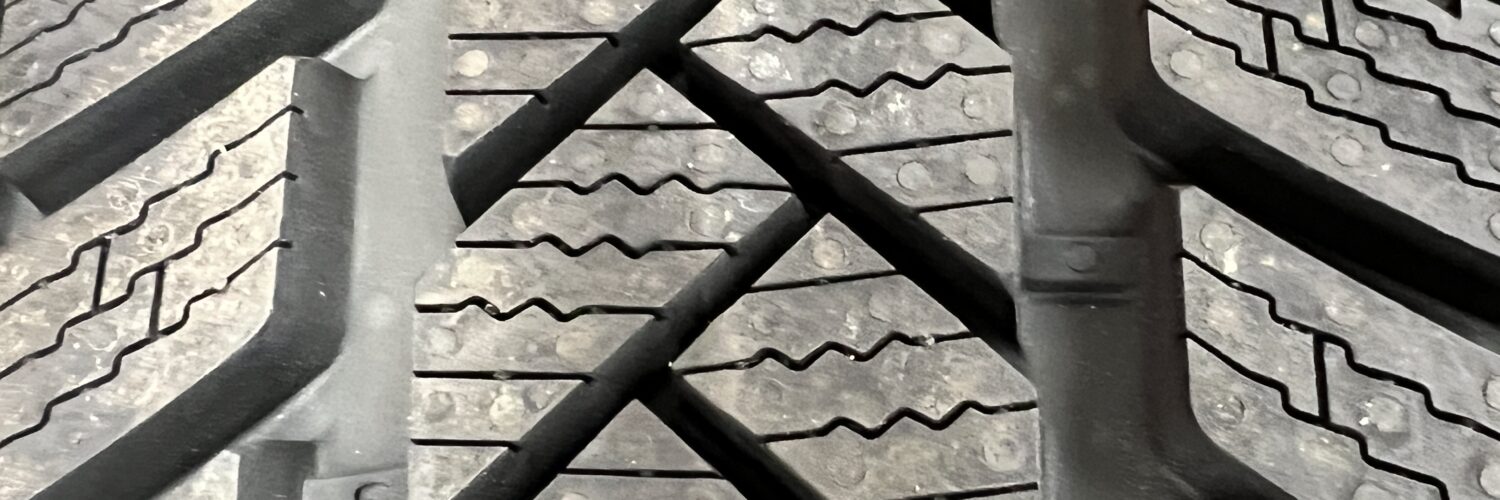
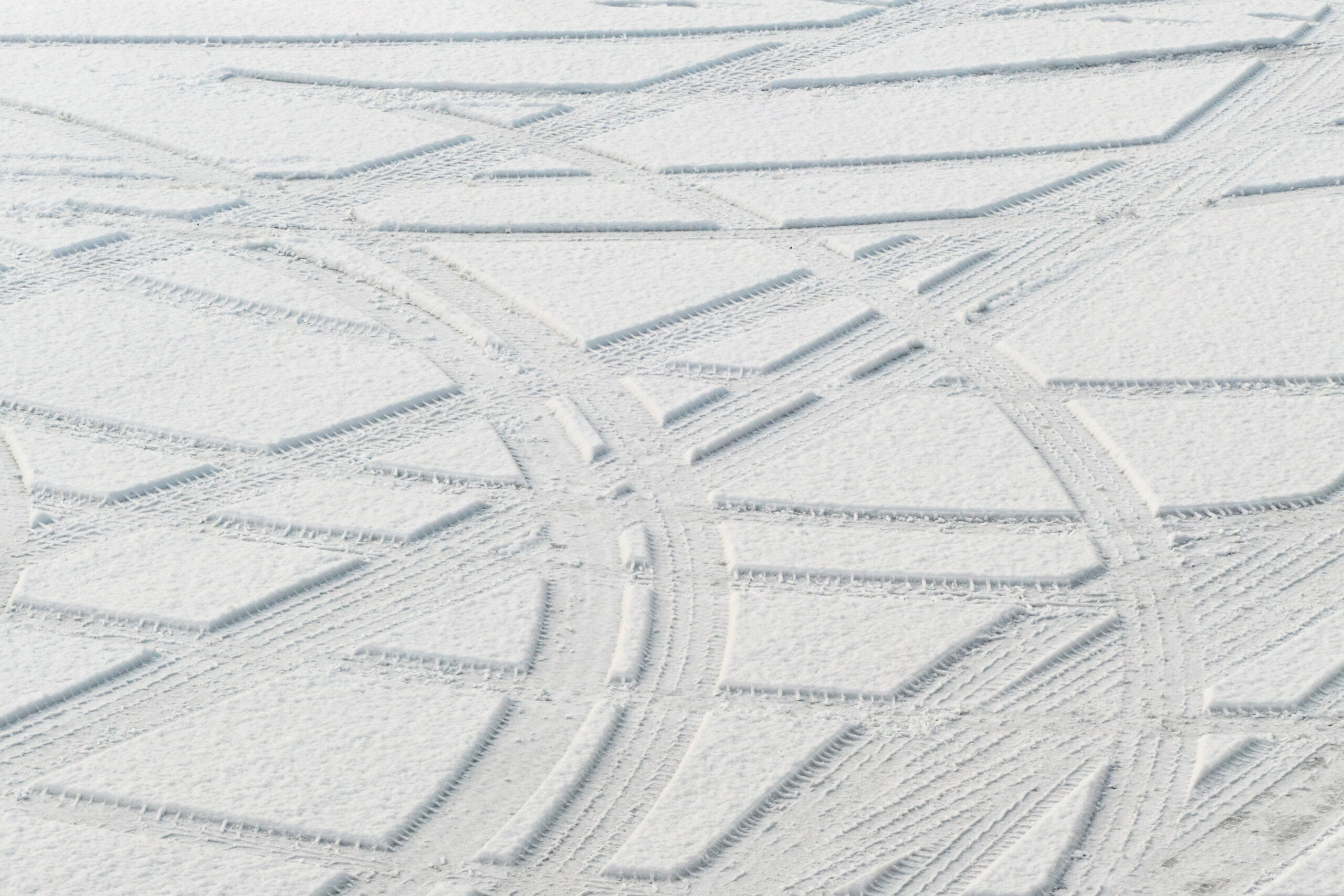
The bold channels visible across a winter tire are only part of its traction system. Large grooves create paths for loose snow, slush, and water to leave the contact patch. The raised tread blocks press into the surface and generate edges that can plow through packed snow. Within those blocks are many fine slits called sipes. As a block enters the contact patch, the slits open slightly and expose additional edges; as it leaves, they close again.
Those edges matter because snow is not a flat, rigid road. It is a collection of ice grains whose bonds can be broken, compressed, and rearranged. Laboratory work by researchers at the University of Edinburgh found that siped rubber blocks produced more friction than unsiped blocks on compacted artificial snow at higher sliding speeds, partly through a plowing action. The same experiments showed that more compliant compounds produced better snow friction under the tested conditions.
Sipes also divide a large tread block into smaller sections that can flex and follow local changes in the surface. Designers must control that motion carefully. Too little movement limits conformity; too much makes the block unstable. Modern sipes often have interlocking three-dimensional walls below the visible opening, allowing their edges to work while helping the block resist excessive squirm during braking and cornering.
Why snow in the tread can improve traction
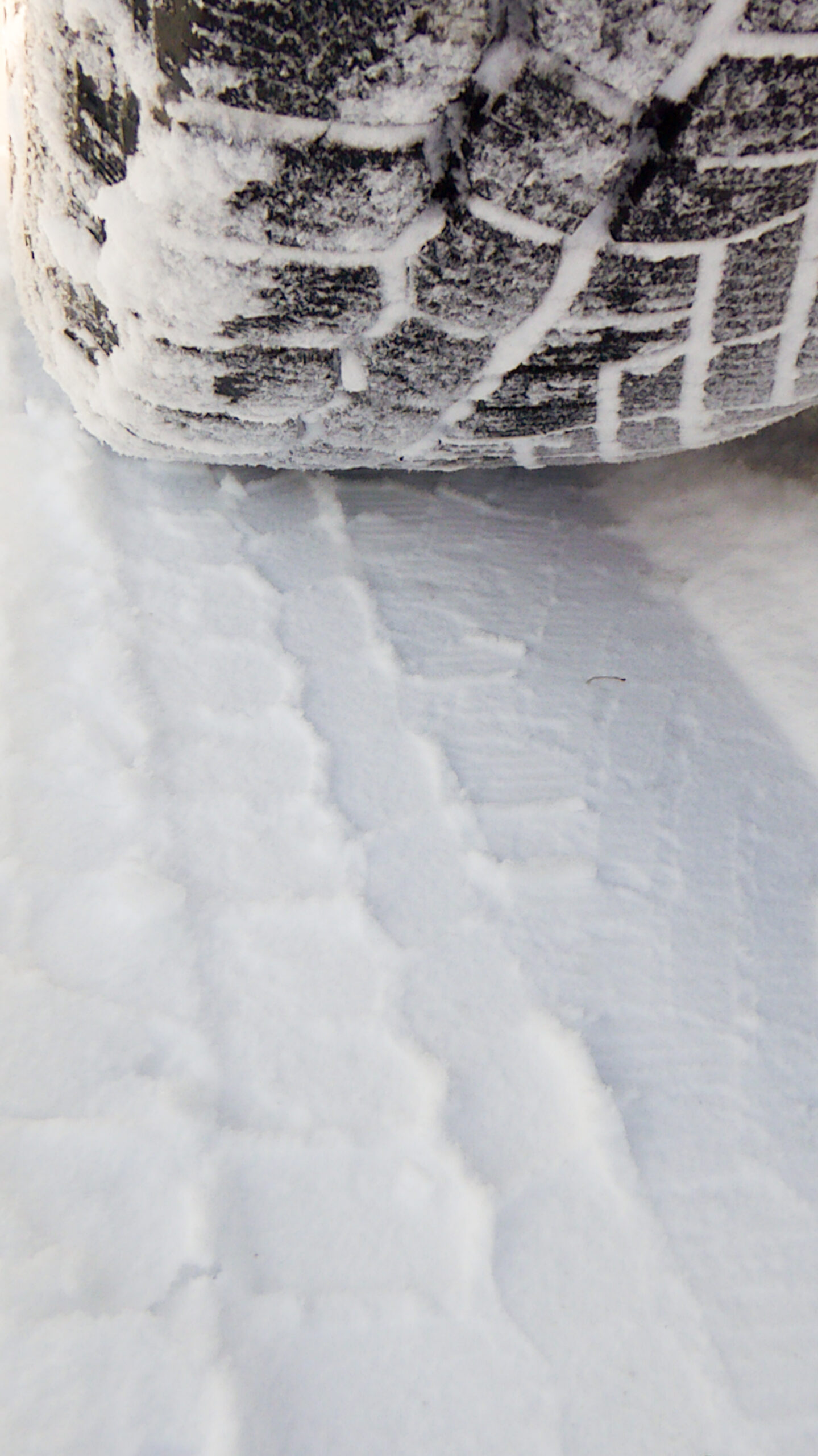
A good winter tread does not always try to throw out every grain immediately. Snow can adhere strongly to other snow, which is why a snowball holds together. When tread cavities capture and compact snow, the trapped material can press against the snow on the road and add snow-on-snow shear resistance. The tire still needs open channels to prevent the tread from becoming completely packed, so block shape and void space must balance retention with clearing.
Conditions change that balance. Dry powder behaves differently from wet, heavy snow. A thin layer over pavement offers a different foundation from deep accumulation, and repeated traffic can polish packed snow into a much harder surface. Temperature matters too: near freezing, pressure and friction can contribute to a lubricating water film, while very cold snow is generally drier and more abrasive. There is no single tread pattern that interacts identically with all of them.
Slush creates another problem. A tire has to push the water-and-ice mixture aside before the tread can reach a firmer surface. Wide circumferential and lateral channels give that mixture somewhere to go. If speed is too high for the grooves to move it, the tire can lose contact and slide over the layer, much as a tire can hydroplane on rainwater.
Ice is the harder surface to solve
Bare ice usually offers less grip than packed snow because it provides few features for tread blocks to penetrate. Its surface can also carry a microscopically thin water layer. That layer may come from temperature, pressure, frictional heating, or a combination of effects, and it acts as a lubricant between rubber and ice. The closer conditions are to melting, the more troublesome that film can become.
A compliant winter compound can follow the ice’s fine roughness better than a hardened warm-weather compound, while dense siping creates more edges that can disturb or squeeze through surface water. Studless winter tires may also use porous or particle-filled compounds intended to manage the interface. The result is an improvement, not dry-pavement grip. Stopping distances can still grow dramatically, and a tire that performs strongly on snow is not automatically the best performer on glare ice.
Metal studs take a more direct approach by scratching and indenting the ice. They can add grip in particular icy conditions, but they also increase noise, can reduce performance on bare pavement, and wear road surfaces. Their use is restricted by season or prohibited in many places. Snow chains provide even more aggressive mechanical engagement when conditions and local rules call for them, but they require correct sizing, installation, and low driving speeds.
What the mountain-and-snowflake mark actually proves
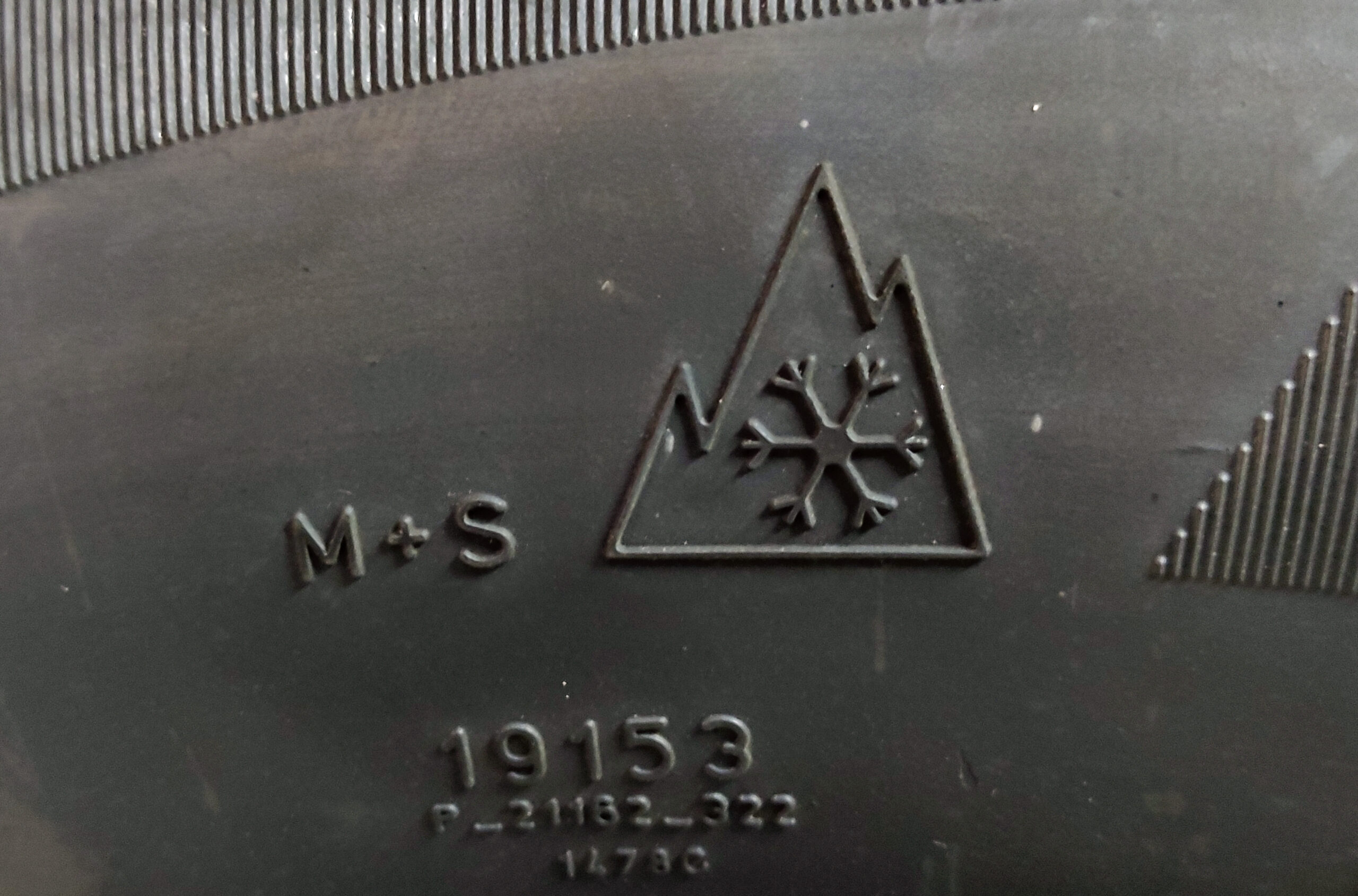
The letters M+S, meaning mud and snow, are common on all-season and all-terrain tires. In the United States, that marking has historically been tied largely to tread geometry rather than a demanding winter performance test. It can indicate more open tread than a conventional road tire, but it does not by itself show how well the compound, sipes, and complete tire work in severe snow.
The Three-Peak Mountain Snowflake symbol, often shortened to 3PMSF, has a more specific meaning. Under the U.S. Tire Manufacturers Association definition, a passenger or light-truck tire earns the mark by reaching a snow-traction index of at least 110 compared with a standard reference tire in a prescribed medium-packed-snow test. In plain language, it must demonstrate at least 10 percent better acceleration traction in that test.
That is useful evidence, but the symbol is not a complete winter report card. The standard does not directly certify ice braking, wet-road stopping, cornering, noise, wear, or performance in every kind of snow. Two tires carrying the same mark can behave differently outside the test. Newer ice-grip markings exist in some markets, but drivers still need to match the tire to the weather they actually face.
Traction is a budget, not a guarantee
All-wheel drive can distribute engine torque among more wheels and help a vehicle start moving, but it cannot create extra friction at the road. Braking and turning still depend on the tires. A four-wheel-drive vehicle on unsuitable tires can therefore accelerate confidently and then struggle to stop. The National Highway Traffic Safety Administration describes winter tires as more effective than all-season tires in deep snow and advises drivers to consider snow tires for winter conditions.
Fitting only two winter tires creates another imbalance. If the better-gripping pair is on the front, the rear may slide first in a turn; if it is on the rear, steering and braking behavior can still differ sharply between axles. Tire-industry safety guidance recommends winter tires at all wheel positions, and a matched set of four gives stability systems more predictable grip to work with.
Tread depth, inflation, and age remain important after installation. Worn grooves cannot manage as much snow or slush, and cold weather lowers inflation pressure. The correct pressure is the vehicle manufacturer’s figure on the door label or in the owner’s manual, not the maximum molded into the tire sidewall. Pressures should be checked when the tires are cold, before driving has warmed the air inside them.
Most of all, a winter tire does not rewrite the physics of stopping. The available friction must be shared among acceleration, braking, and turning. Asking for too much of more than one at once can overwhelm even a well-designed tire. Lower speed, gentle control inputs, and a long following distance leave more of the traction budget available for the unexpected.
Good winter grip comes from several small advantages
There is no hidden claw inside a winter tire. Its advantage comes from many modest mechanisms working together: rubber that stays responsive, tread blocks that press into snow, sipes that multiply edges, grooves that move slush, and cavities that sometimes use snow itself as a gripping material. The 3PMSF mark confirms one part of that performance under a defined test, while the tire’s condition and the driver’s choices determine how much of it reaches the road.
That layered design explains why a winter tire can look busy. Every cut and compound choice is an attempt to preserve contact on a surface that keeps changing. The result is valuable extra control, not permission to ignore the weather. On snow and ice, the safest traction is still the traction a driver does not need to use all at once.