
 Akshay Dinesh
Many of the most familiar technologies in daily life depend on materials most people never see. A phone vibrates, headphones turn electrical signals into sound, a hybrid car motor spins, and a wind turbine generator converts motion into electricity. Hidden inside many of those systems are rare earth elements: a group of metals with chemical and magnetic properties that make small, powerful devices possible.
The name can be misleading. Rare earth elements are not all extremely rare in the crust of the Earth. The U.S. Geological Survey describes them as a group of 17 elements: scandium, yttrium, and the 15 lanthanides on the periodic table. Some, such as cerium, are more abundant than familiar metals like copper. The hard part is that they are usually spread through minerals in low concentrations, mixed with one another, and difficult to separate into pure usable materials. That difference between abundance and accessibility is why these elements matter so much in science, manufacturing, and global trade.
What Rare Earth Elements Are
Rare earth elements sit mostly in the lanthanide row of the periodic table, the row often pulled out and shown beneath the main block of elements. They include names that may sound unfamiliar at first: neodymium, praseodymium, dysprosium, terbium, europium, cerium, lanthanum, samarium, gadolinium, and others. Scandium and yttrium are usually grouped with them because they tend to occur in similar mineral deposits and behave in related ways in industrial chemistry.
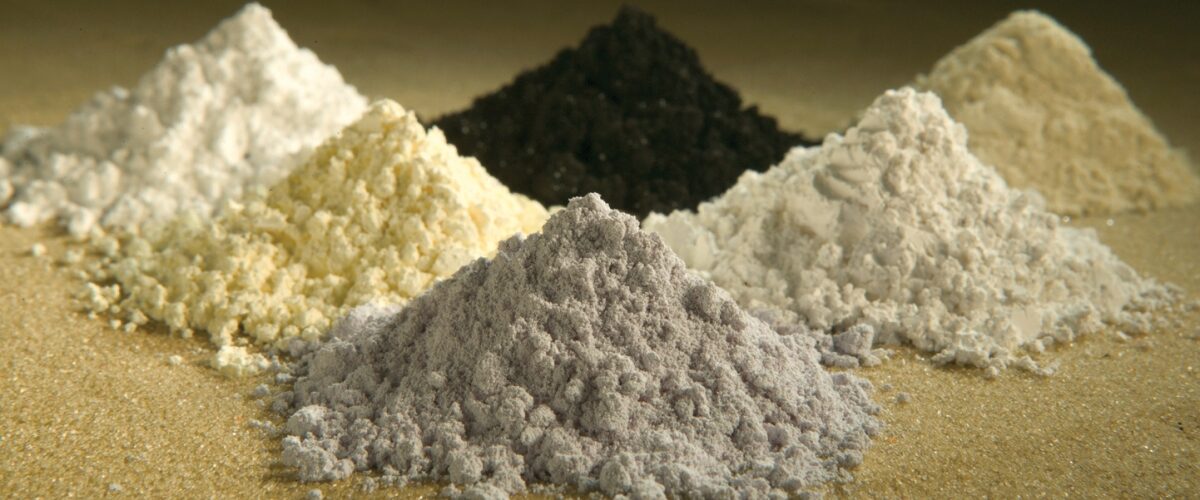
These elements are metals, but they are not usually used in everyday products as big visible chunks of metal. More often, they appear in compounds, alloys, magnets, catalysts, polishing powders, phosphors, or carefully engineered components. Neodymium and praseodymium can help make exceptionally strong permanent magnets. Europium and terbium have been important in producing certain red and green colors in displays and lighting. Cerium is used in polishing glass and in catalysts. The value of rare earths comes less from one dramatic property and more from a collection of useful behaviors that engineers can tune with precision.
Chemically, many rare earth elements are similar to one another because their outer electrons behave in related ways. That similarity is part of their usefulness, but it is also a processing problem. If several rare earths are locked together in one mineral ore, separating them is not like picking stones out of sand. It requires repeated chemical steps that exploit small differences in how each ion reacts, dissolves, or attaches to other compounds. A material can be geologically available and still be expensive or slow to turn into a usable product.
Why Their Magnets Are So Useful
The most famous rare-earth use is the powerful permanent magnet. A permanent magnet keeps its magnetic field without needing a steady electric current. Ordinary refrigerator magnets are useful, but they are weak compared with magnets made from rare-earth alloys. Neodymium-iron-boron magnets, often called neodymium magnets, can produce a strong magnetic field in a compact size. Samarium-cobalt magnets are another rare-earth type, valued especially where heat resistance matters.
That strength changes how machines can be designed. A stronger magnet can help a motor or generator become smaller, lighter, or more efficient. In a speaker or earbud, a compact magnet helps move a tiny diaphragm to produce sound. In a computer hard drive, magnets help position moving parts with precision. In an electric vehicle motor, rare-earth magnets can help turn electrical energy into rotation with high power density. In some wind turbine generators, they help convert large, slow mechanical motion into electricity without relying on the same design tradeoffs as older generator systems.

The International Energy Agency has pointed to rare earth elements as essential for the permanent magnets used in wind turbines and electric vehicle motors. That does not mean every clean-energy technology uses rare earths in the same way. Solar panels, batteries, transmission lines, and motors all depend on different material recipes. It does mean that rare earths occupy a strategic place in the wider materials system that supports modern energy and transportation.
Why “Rare” Does Not Mean Impossible to Find
The word rare originally came from the difficulty of finding and isolating these substances in concentrated mineral forms, not from a simple count of atoms in the ground. The USGS notes that rare earths range from relatively common cerium to much less abundant thulium and lutetium. Even when an element is present in the crust, a mineable deposit needs enough concentration, the right mineral form, access to infrastructure, and a way to process the material safely and economically.
Several minerals can host rare earth elements, including bastnaesite, monazite, loparite, and certain ion-adsorption clays. Different deposits contain different mixes. Light rare earth elements, such as cerium, lanthanum, neodymium, and praseodymium, are often more available than heavy rare earth elements, such as dysprosium and terbium. Heavy rare earths can be especially important when magnets must keep working under high temperatures, which is why a small amount of one element can matter far beyond its weight.
Mining is only the beginning. Ore must be crushed, concentrated, chemically treated, separated, purified, and converted into forms manufacturers can use. Each step has cost, energy, water, waste, and permitting challenges. A country may have rare-earth deposits but still depend on another country for refining, separation, magnet making, or final component manufacturing. That is why rare earth discussions often focus on supply chains rather than only on mines.

The Supply Chain Challenge
Rare earth elements have become a useful case study in how science connects to economics and geography. The chemistry explains why the elements are hard to separate. Manufacturing explains why precise materials are needed. Trade explains why a disruption in one part of the chain can affect products made far away.
The IEA reported in its 2025 critical minerals work that refining and processing for several key minerals, including magnet rare earths, remains highly concentrated. It noted that the average market share of the top three refining nations for selected critical minerals rose to 86 percent in 2024, with China the leading supplier for several of those processing chains. For a learner, the important idea is not simply that one country matters. It is that modern technology often depends on many hidden steps, and those steps may be clustered in a small number of places.
This concentration creates several concerns. Manufacturers want dependable prices and reliable material quality. Governments worry about defense systems, medical equipment, power infrastructure, and transportation. Communities near mines and processing plants care about land use, water quality, waste, and worker safety. A better rare-earth system is not just a matter of digging more holes. It also means cleaner processing, recycling, substitutes where possible, careful design, and more diversified supply chains.
Why Recycling and Substitutes Are Difficult
Recycling rare earths sounds simple until the products are taken apart. A phone, motor, hard drive, or speaker may contain only a tiny amount of a valuable element. That material may be glued into a component, mixed with other metals, coated for protection, or spread through millions of discarded devices. Collecting enough material, separating it cleanly, and doing it at a competitive cost can be harder than the word recycling suggests.
Still, recycling matters. The U.S. Department of Energy has described growing interest in recovering rare earth elements from end-of-life products and secondary sources, including coal and coal byproducts. Those approaches are not magic replacements for mining, but they show a key scientific idea: waste is sometimes a resource in the wrong form. If chemists and engineers can find lower-cost, lower-impact ways to recover useful elements, the supply chain becomes less dependent on a single source of newly mined ore.
Substitution is also possible in some places, but not everywhere. Engineers may design a motor that uses fewer rare earths, avoids certain heavy rare earths, or uses a different technology entirely. The tradeoff may be size, weight, efficiency, heat tolerance, cost, or performance. A material is called critical not because it is magical, but because replacing it can be difficult when a product needs a very specific combination of properties.
What Rare Earths Teach About Modern Materials
Rare earth elements are a reminder that technology is not only software, design, or electricity. It is also chemistry. The smooth surface of a phone, the small size of earbuds, the efficiency of a motor, and the brightness of a display all depend on atoms arranged and processed in exact ways. A product can feel simple to use while depending on geology, mining, refining, manufacturing, shipping, and materials science.
They also show why learning the periodic table is more than memorizing symbols. Elements have patterns. Some form ions of similar charge. Some hold magnetic behavior in unusually useful ways. Some absorb and emit light with special colors. When scientists understand those properties, engineers can turn them into tools. When society depends on those tools, questions about supply, cost, recycling, and environmental impact become part of the same story.
The rare-earth lesson is not that every technology is fragile or that every solution is obvious. It is that small amounts of the right material can carry enormous importance. A few grams inside a device may connect a classroom concept in chemistry to a mine in California, a refining plant overseas, a wind turbine, an electric car, and a discarded hard drive waiting to be recycled. Modern technology works because the materials behind it are carefully chosen, and rare earth elements are among the clearest examples of why those choices matter.





Add comment