

 Akshay Dinesh
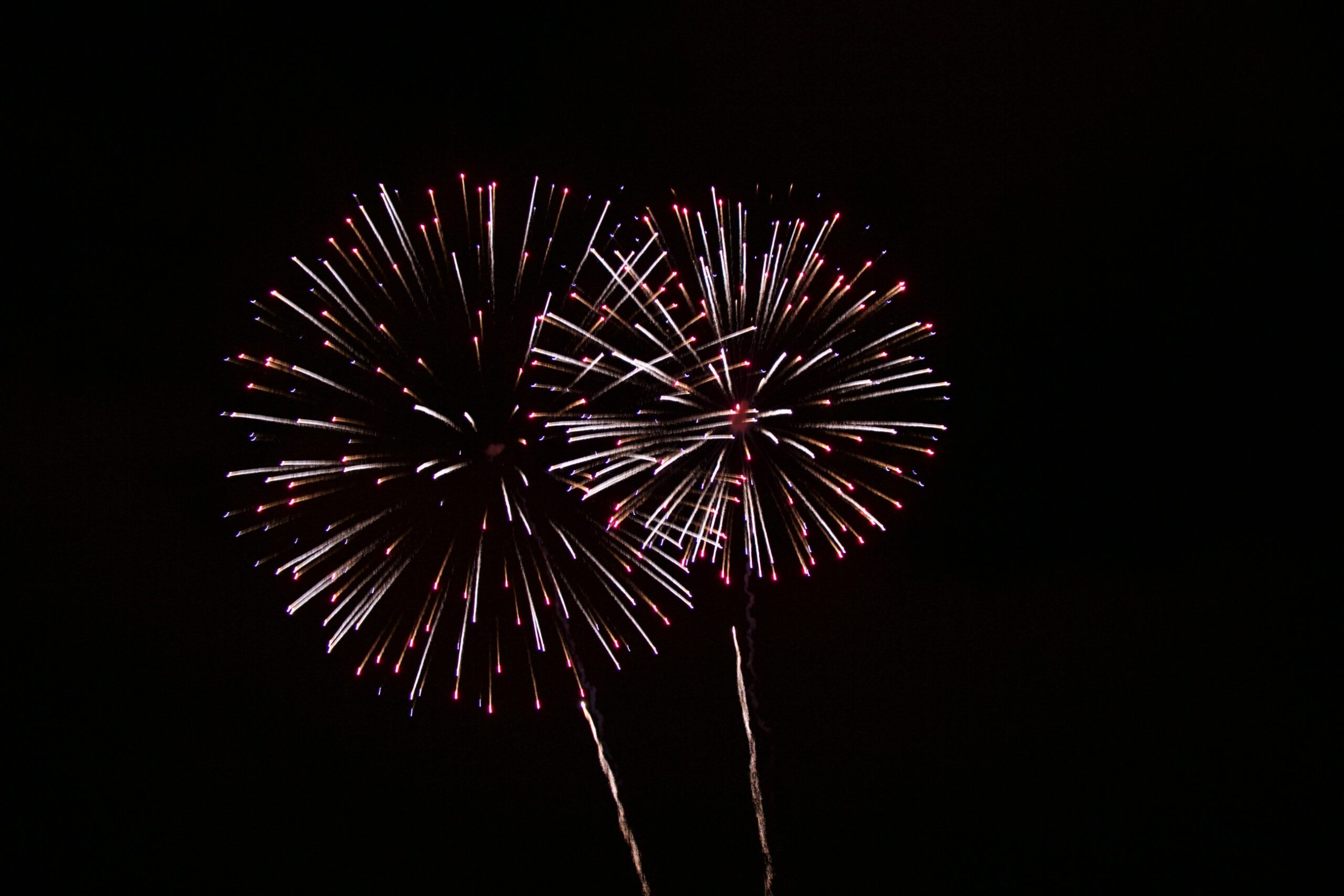
A bright firework looks almost magical from the ground: red blooms, green rings, gold crackles, blue stars, and white flashes all opening against the night sky in a few seconds. The effect feels artistic, but the color is not random. It comes from chemistry, especially from the way certain elements release light when they are heated.
Professional fireworks are built so that heat, fuel, oxygen-rich compounds, and color-producing materials work together at exactly the right moment. The same display that looks like a painted sky is also a fast sequence of energy changes inside atoms. That is why fireworks are such a memorable example of chemistry in everyday life: they turn invisible atomic behavior into something large enough for a crowd to see.
The Color Starts Inside Tiny Firework Stars
The colorful part of an aerial firework usually comes from small pellets often called stars. These are not stars in the astronomical sense. They are compact mixtures placed inside a shell, and when the shell bursts, the stars fly outward while burning. Each star carries ingredients that help it ignite, burn at the right rate, and produce a specific color or sparkle.
The color-making ingredients are often metal salts. A salt, in chemistry, is an ionic compound made from positively and negatively charged particles. Table salt, sodium chloride, is one familiar example, but fireworks use many different compounds. The useful part for color is often the metal element in the compound, such as strontium, sodium, barium, copper, calcium, magnesium, or titanium.
The U.S. Geological Survey describes the basic color pattern clearly: strontium is linked with deep reds, sodium with yellow, barium with green, copper with blue, and combinations of elements can create colors such as orange or purple. White and silver effects often come from very hot glowing metals such as magnesium, aluminum, titanium, or zirconium rather than from the same kind of pure color glow.
Heat Pushes Electrons Into an Excited State
To understand why different elements make different colors, it helps to picture an atom as having electrons arranged at certain energy levels. In normal conditions, many of those electrons sit in lower-energy arrangements. When a firework star burns, it releases intense heat. That energy can push electrons in the metal atoms into higher-energy positions.
Those excited electrons do not stay there for long. They quickly fall back toward lower-energy states, and when they do, they release energy as light. The color of that light depends on how much energy is released. Higher-energy light appears closer to the blue and violet side of the visible spectrum; lower-energy visible light appears closer to red and orange.
This is why each element can act a little like a chemical fingerprint. Sodium gives off a strong yellow light, which is why sodium street lamps used to have such a recognizable yellow-orange glow. Strontium compounds are prized for reds, while copper compounds can produce blue. In chemistry labs, a flame test uses the same principle: certain ions can be identified by the color they produce in a flame.
The American Chemical Society’s ChemMatters explanation of fireworks describes this process as electrons absorbing heat energy, moving into an excited state, and then emitting light as they return to lower energy. The fireworks display is the dramatic version of a principle that also appears in spectroscopy, astronomy, and the analysis of unknown materials.
Why Blue Fireworks Are Especially Difficult
Blue is often one of the hardest firework colors to produce well. The challenge is not that copper cannot make blue light. Copper compounds can. The problem is that the chemistry has to stay in a narrow comfort zone. If the flame is not hot enough, the color may be weak. If it is too hot, some copper-containing color compounds can break apart or shift toward less vivid colors.
That makes blue fireworks less forgiving than many reds, yellows, and greens. Sodium is so good at producing yellow that even a small amount can overwhelm other colors. Strontium reds and barium greens are more reliable in many mixtures. A strong, clean blue needs a formula and burn temperature that protect the copper chemistry long enough for the color to appear brightly.
This also explains why purple fireworks are not simply a basic color by themselves. Purple is usually made by combining red-producing and blue-producing chemistry. If the blue is weak or the red is too strong, the result may look pink, lavender, or washed out instead of a balanced purple. The audience sees a single burst, but the designer is balancing competing chemical signals.
Brightness, Sparkle, and Shape Come From More Than Color
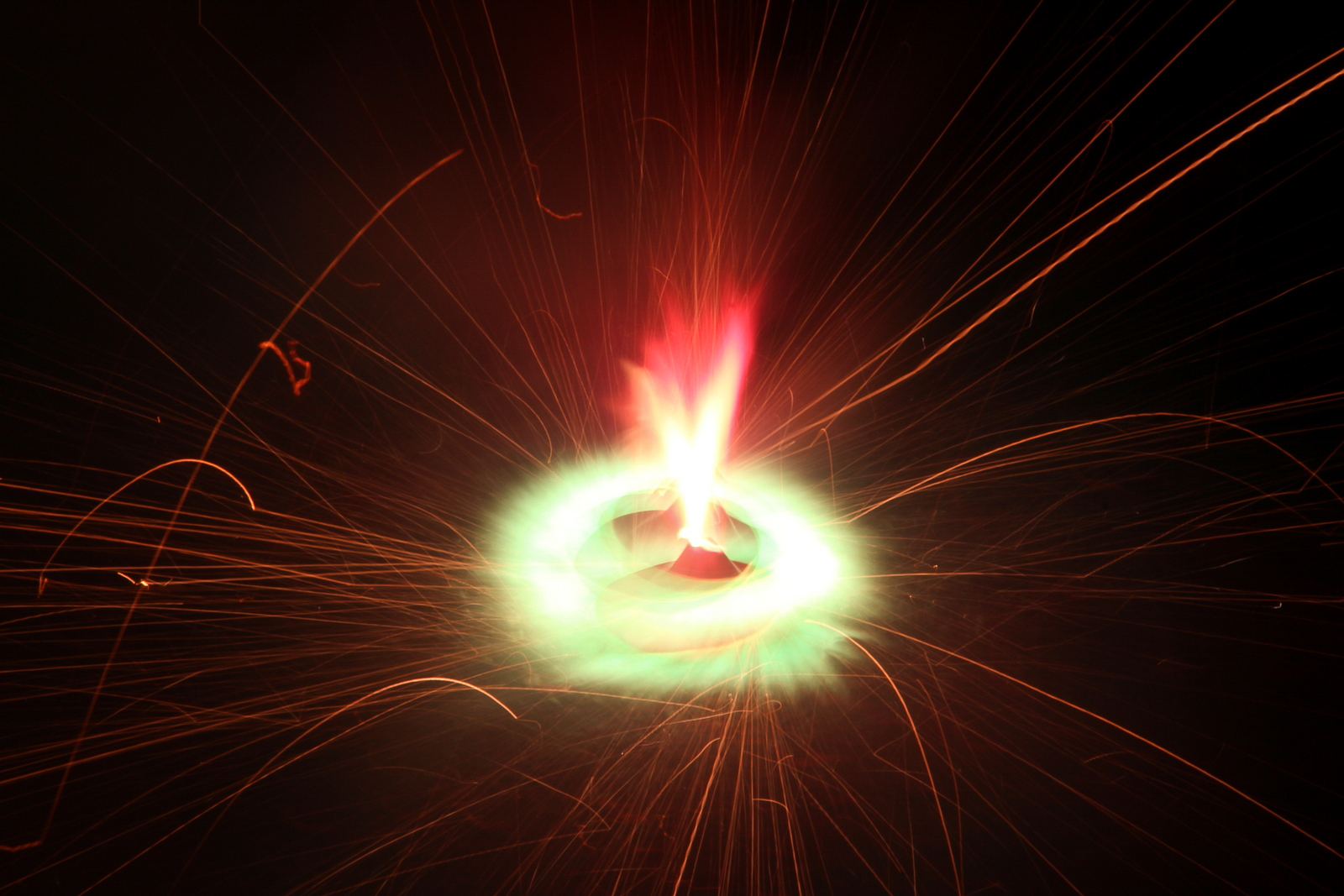
Color is only one part of a firework. The same burst may also have glittering sparks, trailing comets, crackling points, or a sharp white flash. These effects often come from metals and fuels that burn very hot or break into glowing particles. Aluminum and magnesium can make brilliant white light. Iron filings or charcoal can help create warm gold sparks. Titanium can produce bright white sparks that look sharp and energetic.
The size and movement of the sparks depend on how the burning material behaves in the air. Some particles burn quickly and vanish; others stay hot long enough to leave trails. A long-exposure photograph of fireworks often shows these trails as graceful arcs, but in real time they are bits of hot material moving outward while cooling and burning.
The shape of a firework is also planned before launch. If stars are arranged in a ring inside the shell, the burst can open as a circle. If different groups of stars contain different color mixtures, the firework can change color as it burns or form layered patterns. A red center with a green outer ring is partly an artistic choice and partly a careful arrangement of chemical pellets inside the shell.
Timing matters too. Some stars are designed to ignite immediately when the shell bursts. Others have coatings or compositions that delay their color change by a fraction of a second. That is how a burst can start white, turn red, and then finish with gold sparks. From the ground, it looks like choreography. Inside the shell, it is controlled combustion.
The Same Chemistry Connects Fireworks to Real Science
Fireworks are entertaining, but the chemistry behind them points toward serious scientific tools. When elements release characteristic colors of light, scientists can use those patterns to identify substances. Spectroscopy studies light by separating it into wavelengths, and it has helped researchers learn what stars are made of, what gases are present in distant objects, and what materials appear in laboratory samples.
The connection is not accidental. If sodium can reveal itself with strong yellow light in a flame, then other elements can reveal themselves through their own spectral patterns. Astronomers use related principles when they study light from stars and galaxies. Chemists and materials scientists use light patterns to analyze samples. The firework is the public, spectacular version of a much broader idea: matter can announce its identity through light.
There is also a materials story hidden in the colors. Some of the elements that make fireworks vivid have uses far beyond celebrations. Copper is central to electrical wiring and electronics. Titanium appears in strong lightweight alloys and white pigments. Strontium and barium compounds have specialized industrial uses. The colors in the sky are tied to real minerals, mining, manufacturing, and materials science.

A Display of Energy Becoming Light
The simplest way to read a fireworks display is as energy becoming light. Chemical energy stored in the firework turns into heat. Heat excites atoms and makes particles glow. Different elements release different colors because their electrons move between different energy levels. The result is a night sky filled with visible evidence of atomic structure.
That does not make fireworks any less beautiful. If anything, the science adds another layer to the experience. A red burst is not just red; it is likely strontium chemistry briefly glowing above the crowd. A yellow flash may carry sodium’s unmistakable signature. A blue star shows a more delicate copper-based color working under difficult conditions.
Fireworks last only a few seconds, but each burst is a compact lesson in elements, energy, and light. The next time the sky opens in color, the display can be seen both ways at once: as a celebration and as chemistry made visible.




Add comment