
 Rishay Dinesh
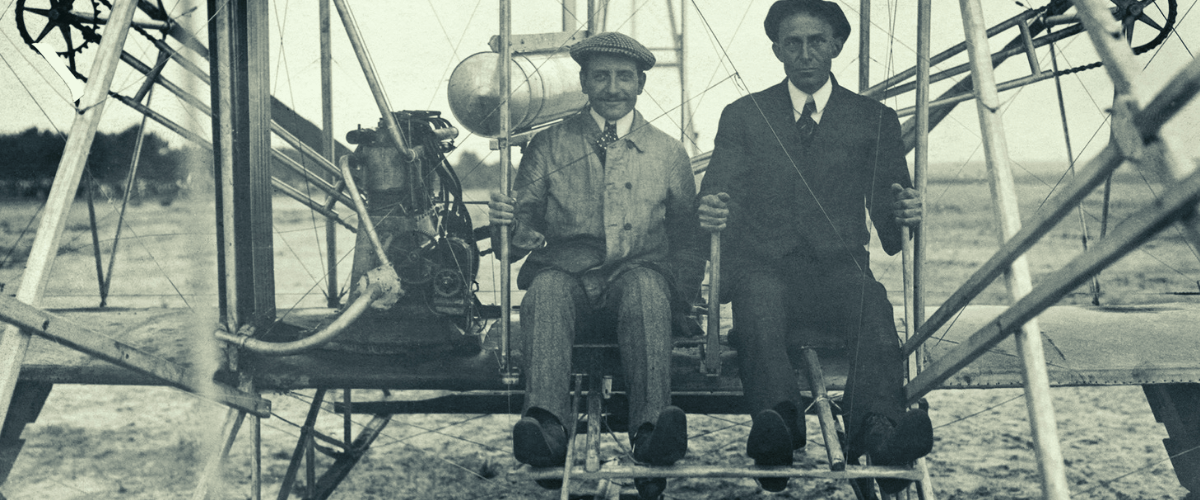
On December 17, 1903, a fragile-looking machine lifted from a wooden rail at Kill Devil Hills, North Carolina. Orville Wright stayed in the air for 12 seconds and traveled 120 feet while Wilbur ran beside the wing. The distance was shorter than a modern airliner, yet the flight solved a problem that had defeated inventors for generations: a pilot had taken off under engine power, controlled the machine in the air, and landed at roughly the same height. The achievement belonged not to one lucky morning but to four years of testing, measurement, failure, and redesign.
Wilbur and Orville Wright are often described simply as the inventors of the airplane. Their deeper contribution was a practical system for developing and controlling one. They treated flight as several connected engineering problems rather than a race to attach the strongest engine to a set of wings. That decision shaped the 1903 Flyer and helped establish methods that aeronautical engineers still recognize today.
From a Bicycle Shop to a Flight Laboratory
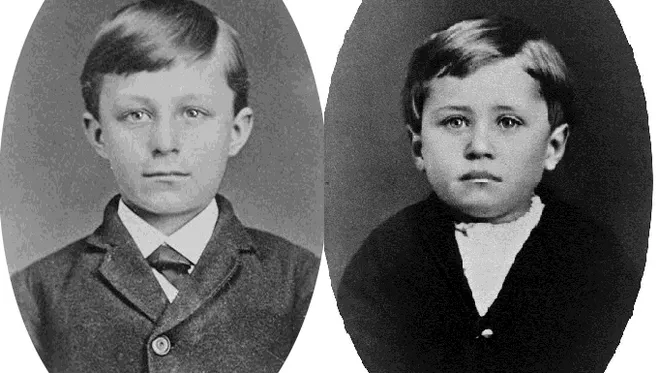
Wilbur was born in 1867 and Orville in 1871. The brothers grew up in a family that valued reading and debate, and both became skilled mechanics without earning college degrees. They operated a printing business and later built and sold bicycles in Dayton, Ohio. The bicycle shop supplied tools, workshop space, income, and daily experience with light structures, careful adjustment, and machines that depend on a rider’s control.
By the late 1890s, glider experiments by Otto Lilienthal, Octave Chanute, and others had shown that human flight was possible, but the risks were severe. Lilienthal died after a glider crash in 1896. The Wrights studied the work of earlier experimenters and wrote to the Smithsonian Institution for information. They concluded that the central challenge was not simply producing lift or power; a successful airplane had to let its pilot balance and steer it in three dimensions.
How the Wrights Solved Control
The brothers divided aircraft movement into three axes. An elevator controlled pitch, raising or lowering the nose. Wing warping changed the lift on opposite sides to control roll, while a movable vertical rudder controlled yaw. Linking roll and yaw helped the aircraft turn without slipping sideways. Modern airplanes use different mechanisms, especially ailerons instead of flexible wing warping, but pilots still manage the same three basic motions.
Finding a workable control system was only part of the job. Tests of the Wrights’ 1900 and 1901 gliders produced less lift than their calculations predicted, so they questioned the published aerodynamic tables on which they had relied. In the fall of 1901, they built a small wind tunnel and instruments that compared the lift and drag of many wing shapes. The resulting data guided a redesigned 1902 glider. According to the Smithsonian’s National Air and Space Museum, the brothers made between 700 and 1,000 flights with that machine, turning it into a reliable test platform and themselves into experienced pilots.
The 1902 glider brought the control system together: wing warping for roll, a forward elevator for pitch, and a movable rear rudder coordinated with the wings. Its success gave the brothers confidence to add power. Their mechanic Charles Taylor helped build a lightweight four-cylinder gasoline engine. The brothers also designed the propellers as rotating wings, using aerodynamic reasoning to turn engine power into thrust.
The Four Flights of December 17, 1903
Kitty Hawk and nearby Kill Devil Hills offered open sand, strong winds, and relative privacy. The Wrights first traveled there in 1900 after consulting U.S. Weather Bureau records. On December 14, 1903, Wilbur made an unsuccessful powered attempt; the Flyer climbed too steeply, stalled, and was damaged. After repairs and a wait for suitable weather, the brothers tried again three days later.
Orville piloted the first successful flight at 10:35 a.m. on December 17. Three more flights followed, with the brothers alternating at the controls. Wilbur made the fourth and longest, covering 852 feet in 59 seconds. The Library of Congress preserves both Orville’s diary account and the famous photograph taken by John T. Daniels at the instant of the first takeoff.
The figures matter, but so does what the machine demonstrated. The 1903 Flyer was powered, heavier than air, piloted, and controllable. A gust damaged it after the fourth flight, so it never flew again, but the experiment had proved the complete system. The brothers then returned to Ohio to make the airplane practical rather than merely possible.
From Experiment to Practical Airplane
At Huffman Prairie outside Dayton, the Wrights learned to take off, turn, circle, and remain airborne for longer periods. Their 1905 Wright Flyer III could fly repeatedly under control and is widely regarded as the first practical airplane. The brothers paused public flying while seeking patents and contracts, which contributed to skepticism about what they had accomplished. Public demonstrations in the United States and France in 1908 finally made their achievement difficult to dismiss.
That year also includes an often-misreported milestone. On May 14, Wilbur carried mechanic Charles Furnas near Kitty Hawk in the first flight with two people aboard an airplane; Orville later flew with Furnas as well. Months later at Fort Myer, Virginia, Orville crashed during an Army demonstration. His passenger, Lieutenant Thomas Selfridge, became the first person to die in a powered-airplane crash, while Orville survived with serious injuries. The accident exposed aviation’s dangers but did not end military interest in the technology.
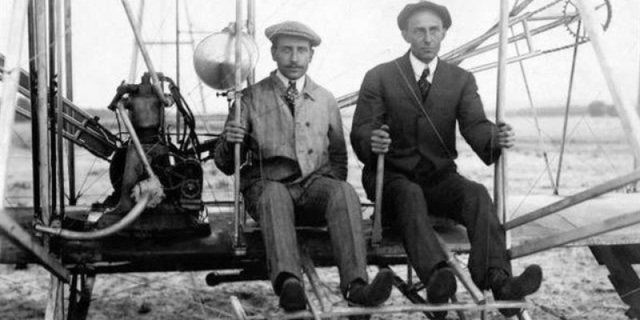
The Wrights received a U.S. patent in 1906 for their flying-machine control system. Protecting that patent led to long disputes with rival aircraft makers, especially Glenn Curtiss. Those battles sometimes slowed cooperation during a period of rapid technical change, but they also show how strongly the brothers understood the value of controlled flight as their central invention. By 1909, the U.S. Army had accepted a Wright airplane, and the brothers had established a company to build aircraft.
Why Their Method Still Matters
The 1903 flight did not create modern aviation overnight. Aircraft designers soon adopted new structures, engines, and control surfaces, and inventors in several countries contributed to the field’s rapid growth. The Wrights’ lasting importance rests on how they connected theory, controlled experiments, piloting skill, and repeated testing. The Smithsonian describes the Flyer as the result of a sophisticated research-and-development program, not a single inspired construction project.
Wilbur died of typhoid fever in 1912 at age 45. Orville sold his interest in the Wright Company in 1915 but remained involved in aviation and lived until 1948, long enough to see airplanes cross oceans and reshape travel and war. In one lifetime, flight moved from short glides over sand to a global technology.
The first flight is memorable because it crossed a clear historical boundary, but the work before it carries the more useful lesson. When published figures failed, the brothers measured again. When a glider performed poorly, they redesigned it. When power alone could not make an aircraft safe, they made control the heart of the machine. Their breakthrough was an airplane, but it was also a disciplined way of solving a problem no one yet knew how to solve.


 Akshay Dinesh


Add comment