
 Akshay Dinesh
Carl Sagan became one of the most recognizable scientists of the twentieth century, but television fame was only the visible edge of his work. He studied planetary atmospheres, helped interpret robotic missions across the solar system, argued for a rigorous search for life beyond Earth, and found unusually clear ways to explain why those questions mattered. Born on November 9, 1934, he spent much of his career moving between research teams and the wider public.
That combination made Sagan influential in two different directions. He helped planetary science grow during the first age of interplanetary exploration, when spacecraft replaced speculation with measurements. At the same time, he showed that wonder and skepticism could belong in the same conversation: an exciting possibility deserved attention, but evidence still had to decide whether it was true.
From a Brooklyn childhood to planetary science
Sagan grew up in Brooklyn, New York, and traced his early fascination with astronomy to childhood visits to the 1939 New York World’s Fair and the public library. The stars offered scale and possibility, while science offered a method for finding out what was actually there. He entered the University of Chicago at sixteen and completed degrees in physics before earning a doctorate in astronomy and astrophysics in 1960 under planetary scientist Gerard Kuiper.
Planetary science was still a small field. Telescopes could reveal changing patches on Mars or the cloud-covered disk of Venus, but researchers had little direct information about the surfaces and atmospheres beneath. Sagan learned to combine physics, chemistry, astronomy, and biology because no single discipline could answer questions about how a planet formed, why its climate behaved as it did, or whether it could support life.
After research appointments at Berkeley and Stanford and a faculty position at Harvard, Sagan joined Cornell University in 1968. He remained there for the rest of his career, eventually becoming the David Duncan Professor of Astronomy and Space Sciences and directing the Laboratory for Planetary Studies. Cornell’s faculty memorial credits him with more than 600 scientific publications, a record that is easy to overlook when his public work receives most of the attention.
Using spacecraft to turn distant worlds into testable places
Sagan’s research often began with an apparent puzzle. Venus was hidden beneath bright clouds, yet radio measurements suggested a surface hot enough to melt lead. Sagan was among the researchers who explained that a dense carbon dioxide atmosphere could trap heat through an extreme greenhouse effect. On Mars, he helped show that some seasonal color changes once attributed to vegetation could be explained by windblown dust. He also studied the chemistry of Titan, Saturn’s haze-covered moon, long before a spacecraft descended through its atmosphere.
Those ideas were tested and refined as robotic exploration advanced. Sagan worked with NASA missions including Mariner 2 at Venus, Mariner 9 at Mars, the Viking landers, the two Voyagers, and Galileo at Jupiter. He did not build every instrument or control every observation. His strength was connecting measurements to large questions: what an atmosphere reveals about a planet’s history, how organic molecules can form, and what evidence would count as a sign of life.
Viking made that last problem especially difficult. Its 1976 landers performed experiments intended to detect biological activity in Martian soil, and some results were initially provocative. Sagan supported the search but resisted treating an ambiguous signal as proof. Mars had to be understood as a chemical environment first. That caution captured a principle he repeated throughout his career: an extraordinary claim becomes persuasive through stronger evidence, not stronger enthusiasm.
Messages for strangers and experiments about life
Sagan treated the possibility of extraterrestrial intelligence as a serious scientific question, even though no confirmed signal had been found. He worked with Frank Drake and others on the plaques carried by Pioneer 10 and 11 and chaired the committee that assembled the Voyager Golden Record. Each Voyager carries a gold-plated copper disc with sounds, greetings, music, and images intended to describe Earth to any finder capable of decoding it.
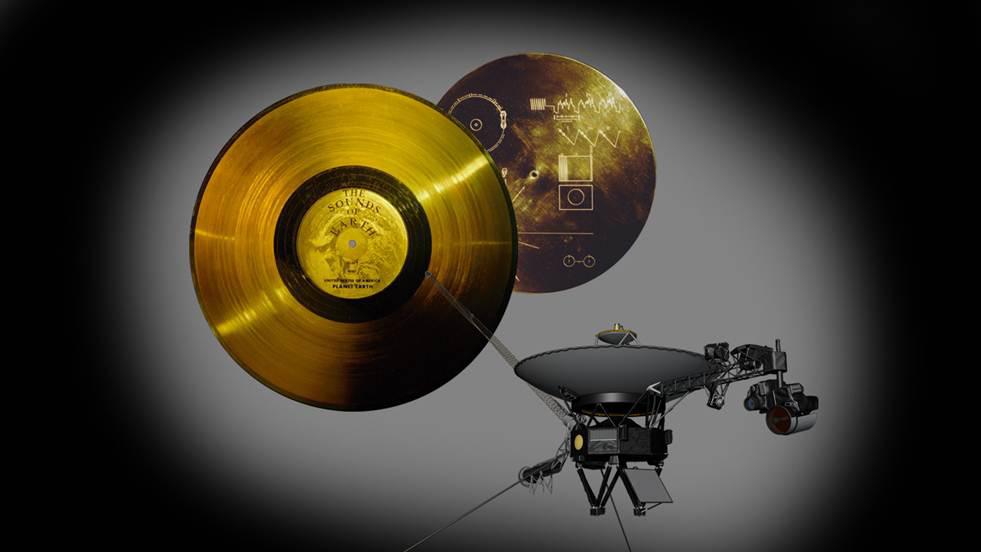
The chance that another civilization will ever recover a Voyager record is extremely small. Its immediate audience was human. Choosing what to send forced the team to ask how one species might describe its planet without assuming a shared language or culture. The record turned a remote scientific possibility into a practical exercise in perspective.
A later experiment reversed the question. During Galileo’s 1990 Earth flyby, Sagan led a study that asked whether a spacecraft designed to explore another planet could recognize life on our own. Galileo detected oxygen and methane together in the atmosphere, a surface pigment consistent with widespread vegetation, and narrow-band radio transmissions unlike natural emissions. The 1993 paper did not merely announce that Earth was inhabited. It established a disciplined way to think about combinations of evidence, an approach that still influences the search for biosignatures on exoplanets.
The camera turn that made Earth almost disappear
Sagan understood that a scientifically modest image could carry an important idea. As Voyager 1 moved beyond the outer planets, he urged mission planners to turn its camera back toward the solar system. The proposal took years to approve because pointing near the Sun could damage the camera and because the tiny planets would offer little new scientific detail. On February 14, 1990, Voyager finally made a family portrait of six planets from roughly 3.7 billion miles away.

Earth occupied only a fraction of a pixel, caught inside a ray of scattered sunlight. The picture did not show continents, oceans, borders, or people. That absence was the point. Sagan later used the image in his 1994 book Pale Blue Dot, asking readers to reconsider human conflict and responsibility from a distance at which every life and every society shared the same nearly invisible point. His compact description, “That’s here. That’s home. That’s us,” gave the photograph its enduring voice.
The image also demonstrates how science can change scale without changing facts. Seen from the ground, Earth fills the horizon. Seen from Voyager, it nearly vanishes. Both views are accurate, but the second makes planetary fragility difficult to ignore. Sagan’s contribution was not just requesting the photograph. He recognized the lesson hidden inside its lack of detail.
Why Cosmos changed science communication
When Cosmos: A Personal Voyage aired in 1980, science television often treated the presenter as a distant authority. Sagan, working closely with writer and producer Ann Druyan and astronomer Steven Soter, used a different approach. The thirteen-part series moved through astronomy, evolution, history, and the human consequences of technology while showing how evidence is gathered and how ideas change. Sagan spoke to viewers as participants in the inquiry, not spectators outside it.
That style could make large subjects feel intimate, yet it did not remove uncertainty. Sagan explained what scientists knew, how they knew it, and where the evidence stopped. He also brought scientific reasoning into public questions. He co-founded the Planetary Society in 1980 to broaden participation in space exploration, supported the search for extraterrestrial intelligence, and helped research the possible climatic effects of nuclear war. Whether discussing Mars or policy, he argued that decisions should be proportionate to evidence and consequences.
Sagan died in 1996, but the questions around his work have become more central. Space telescopes now study exoplanet atmospheres. Rovers examine ancient Martian environments. Researchers design missions to ocean worlds and continue to debate which chemical combinations would make a convincing biosignature. The Carl Sagan Institute at Cornell carries those problems forward through interdisciplinary research on potentially habitable worlds.
His lasting achievement was a way of thinking as much as a list of discoveries. Curiosity supplied the questions; skepticism kept the answers honest; imagination made the stakes visible. The scientist behind the Pale Blue Dot helped people see planets as physical worlds, Earth as one of them, and careful evidence as the best route between wonder and understanding.