
 Akshay Dinesh
Benjamin Banneker built his reputation with numbers that other people could check. He calculated the movements of the Sun, Moon, and planets, prepared tables for widely read almanacs, and used astronomical observations while helping define the boundaries of the new federal district. In 1791, he placed that record of work before Secretary of State Thomas Jefferson and asked him to confront a contradiction: a nation speaking the language of liberty while holding hundreds of thousands of people in slavery.
That combination of science and argument makes Banneker more than a collection of inspirational firsts. His calculations gave him public authority in a society that routinely denied Black intellectual ability. Yet parts of his story have also accumulated claims that outrun the evidence. The clearest picture is both more precise and more interesting: a largely self-educated Maryland farmer who became an astronomer, author, surveyor’s assistant, and forceful critic of racial prejudice.
From a Maryland farm to the night sky
Banneker was born free on November 9, 1731, in Baltimore County, Maryland, and spent most of his life on his family’s farm near the Patapsco River. His formal schooling was limited, but he developed unusual skill in mathematics and mechanics. Accounts from people who knew him credit the young Banneker with constructing a wooden striking clock after studying a pocket watch. The clock reportedly kept time for decades, although no clock survives and many familiar details come from recollections written after his death.
That distinction matters. The clock is credible evidence of mechanical ability, but calling it the first clock made in America is difficult to prove. Banneker’s later work is documented much more firmly. Through the Ellicott family, whose mills stood nearby, he gained access to books and instruments for advanced astronomy. He learned to make observations and to work through the long calculations needed to predict celestial positions and events.
Astronomy in the late eighteenth century was practical as well as theoretical. Accurate positions of stars helped surveyors establish direction and location. Tables of sunrise, sunset, lunar phases, eclipses, and planetary motion helped readers organize work, travel, and timekeeping. Banneker did not simply watch the sky; he translated observations and mathematical rules into information that people could use.
Almanacs made his mathematics public
In 1791, Banneker completed an ephemeris for the following year. An ephemeris is a table showing where celestial bodies are expected to appear at particular times. Publishers William Goddard and James Angell used his calculations in Benjamin Banneker’s Pennsylvania, Delaware, Maryland and Virginia Almanack and Ephemeris, for the Year of Our Lord 1792. The title page carried his name into homes and farms across the region.
The mathematical tables were the almanac’s technical core, but readers found much more between its covers. Almanacs combined calendars and astronomical data with weather predictions, tide information, medical advice, essays, verse, and practical reference material. They were compact annual handbooks for people who might own few other books. Banneker prepared calculations for a run of almanacs covering 1792 through 1797, with editions printed in several cities.
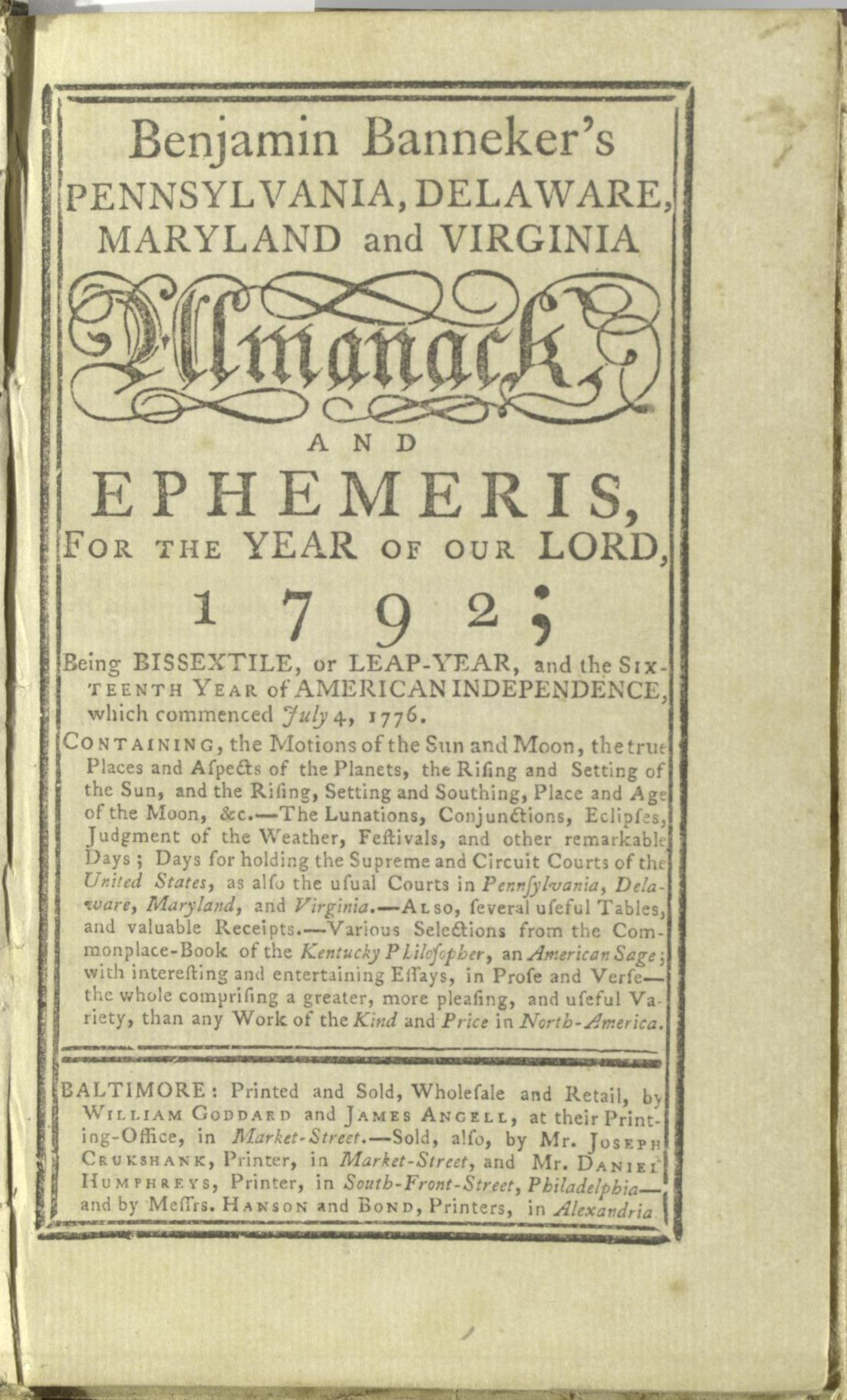
The achievement carried political weight because publishers openly presented Banneker’s work as evidence against racist assumptions. The editors of the 1792 edition described the ephemeris as an accurate work that demonstrated intellectual ability was not limited by skin color. White patrons helped bring the manuscript to press, but the calculations that made the publication distinctive were Banneker’s. His authorship turned a familiar household object into a public rebuttal to claims of Black inferiority.
What Banneker actually did in the survey of Washington
Before the first almanac appeared, Andrew Ellicott recruited Banneker for the 1791 survey of the territory chosen as the permanent seat of the federal government. The assignment was to establish the boundaries of a ten-mile square spanning land in Maryland and Virginia. At the team’s base camp at Jones Point, Banneker made astronomical observations and calculations that helped Ellicott fix the survey’s starting position and direction.
The work demanded precision. Surveyors used instruments to measure angles and distances across uneven ground, then marked the perimeter with stones placed at one-mile intervals. Nighttime observations connected their measurements to the sky rather than to an unreliable local landmark. Banneker served for several months early in the project before returning to his farm and almanac calculations; Ellicott’s team continued the boundary work into 1792.
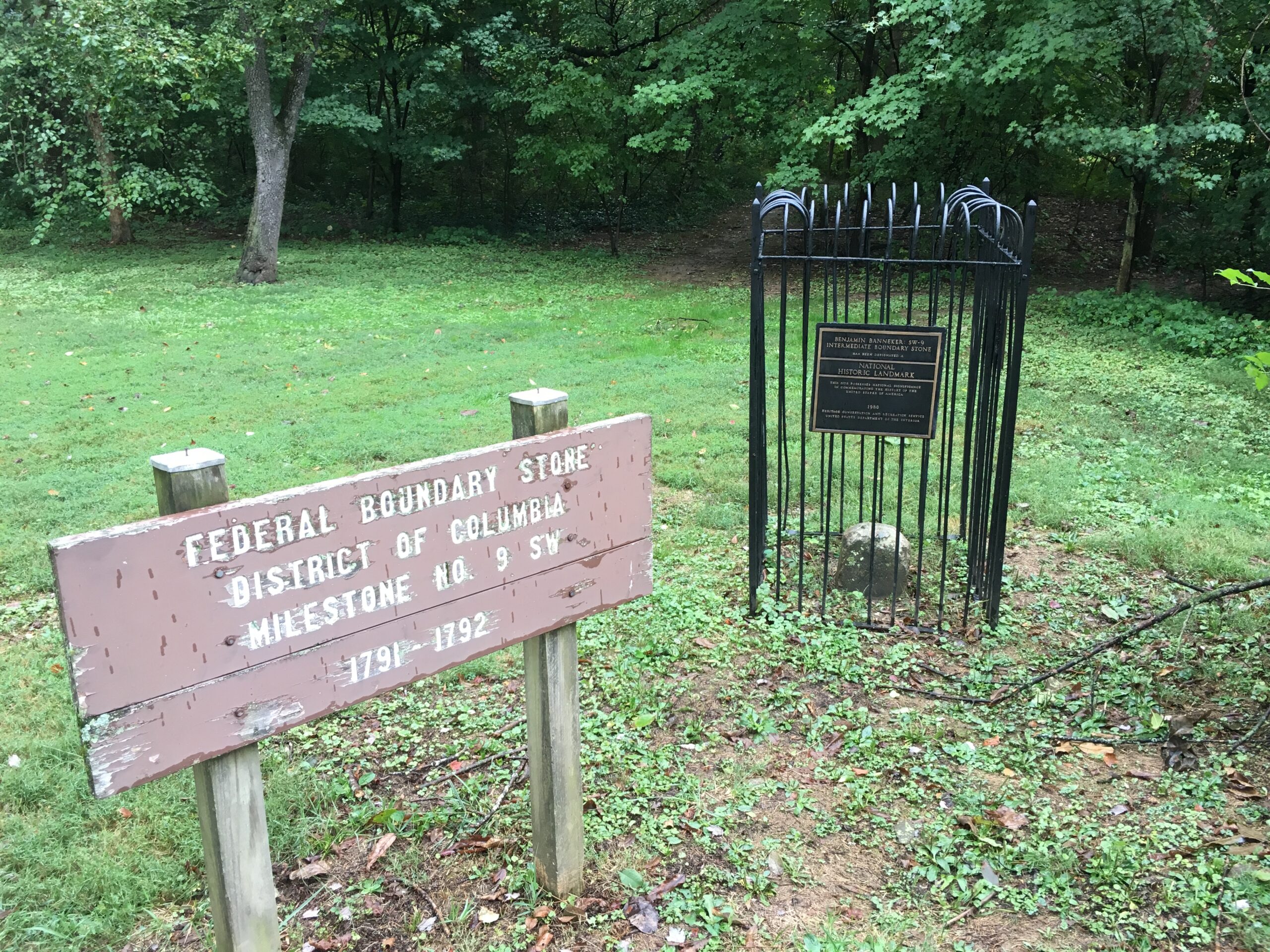
This is not the same as designing Washington, D.C. Pierre Charles L’Enfant produced the famous street plan for the federal city, while Ellicott later revised and completed work on that plan. Banneker helped survey the larger federal district’s boundary. The popular story that he reconstructed L’Enfant’s entire plan from memory after the French designer departed is not supported by contemporary records. Correcting that legend does not diminish Banneker’s role. His documented astronomical work on a nationally important survey was remarkable in its own right, especially for a free Black man working in a slaveholding society.
The almanac became an argument to Jefferson
On August 19, 1791, Banneker sent Jefferson a manuscript copy of his forthcoming almanac. His accompanying letter was courteous, but it was not timid. He reminded Jefferson of the principles Americans had invoked against British rule and asked how those principles could coexist with slavery and the widespread belief that Black people were naturally inferior.
Banneker’s strategy was carefully chosen. He did not send only an abstract appeal. He sent mathematical work that had already been examined by knowledgeable supporters and accepted for publication. The almanac made his case tangible: its eclipse calculations and astronomical tables could be tested. He asked Jefferson to use his influence to help end what Banneker called the “absurd and false ideas and opinions” used to justify racial oppression.
Jefferson replied on August 30. He thanked Banneker for the almanac, wrote that he wished to see evidence of equal natural talents, and said he had forwarded the manuscript to the Marquis de Condorcet at the French Academy of Sciences. The response was polite, yet limited. Jefferson did not accept Banneker’s challenge to act decisively against slavery, and his wording treated one man’s achievement as evidence that Black intellectual ability needed to be proved.
The exchange is revealing precisely because it does not resolve neatly. Banneker used the Declaration’s logic against one of its authors, while Jefferson answered without confronting his own slaveholding or the institution’s violence. Publishers later printed the correspondence alongside Banneker’s work, giving his antislavery argument an audience far beyond a private letter.
A legacy stronger than the legends
Much of Banneker’s personal record disappeared when his cabin burned on the day of his funeral in 1806. No verified portrait made during his life is known, his wooden clock is gone, and many of his papers did not survive. Those losses help explain why later admirers filled gaps with stories that were memorable but not always well documented.
The surviving evidence is substantial. Copies of his almanacs preserve his name and calculations. The Library of Congress holds Jefferson’s reply and other printed records of the exchange. National Park Service sites preserve and interpret boundary stones from the federal-district survey. These sources show a working intellectual life built from repeated observation, computation, publication, and public argument.
Banneker’s importance also lies in how he used expertise. He understood that a correct table of celestial positions could do more than predict an eclipse or a sunrise. In a culture organized to exclude Black voices, demonstrable scientific work could create room for a political claim that powerful readers would otherwise dismiss. He made that opening and then spoke plainly through it.
The most respectful way to remember Benjamin Banneker is not to enlarge every legend. It is to see the scale of what the record already shows: a farmer who mastered demanding mathematics, an astronomer whose tables reached thousands of readers, a surveyor’s assistant who helped mark the nation’s capital territory, and a writer who asked the author of the Declaration of Independence to live by its words.