

 Akshay Dinesh
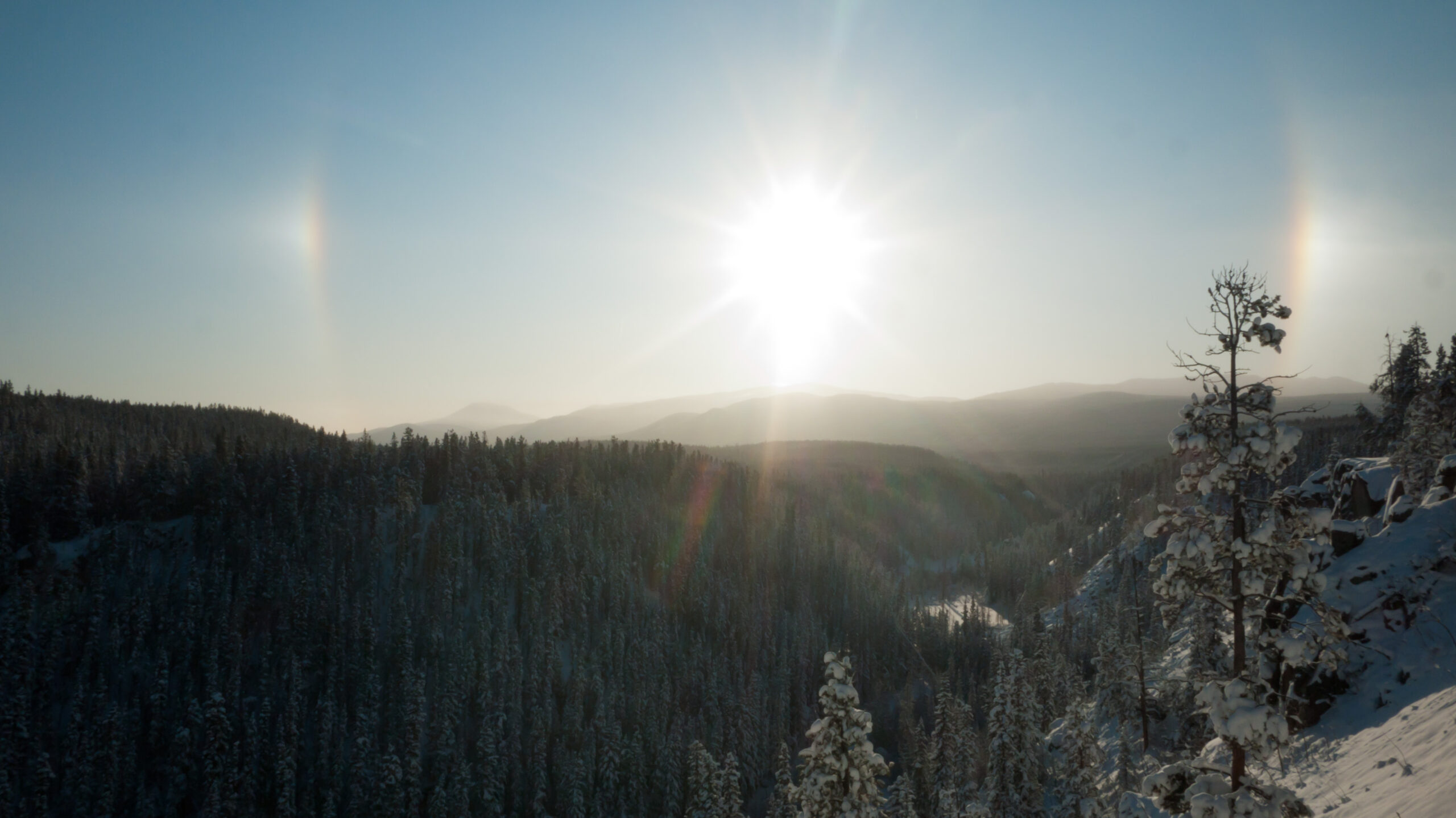
A bright patch appears beside the low winter sun, sometimes with a second patch on the other side. It can look like a fragment of a rainbow or even a pair of extra suns. These spots are called sun dogs, or parhelia, and they form when sunlight passes through tiny ice crystals in the air. They are not pieces of the sun or reflections in your glasses: they are a pattern of light produced in the atmosphere.
Sun dogs often show red on the side closest to the sun, fading outward through paler colors. They can occur in any season, but a low sun and thin, icy clouds make them especially rewarding to look for on a clear-looking winter day. Understanding their shape starts with a surprisingly small prism.
How ice crystals make a sun dog
Many sun dogs form in high, thin cirrus or cirrostratus clouds. Although the air at ground level may be well above freezing, the air where these clouds form can be cold enough for ice crystals. A particularly useful shape is a flat, six-sided plate. As such crystals fall through the air, their broad faces tend to settle roughly horizontal, rather like tiny plates drifting downward.
Sunlight entering one side face slows and bends as it moves from air into ice. It bends again as it leaves through another side face. This change in direction is called refraction. The two faces are inclined at 60 degrees to one another, so together they act like a prism. Millions of suitably oriented crystals can send light toward an observer from a similar direction, producing a concentrated bright patch.
White sunlight contains many colors, and ice bends them by slightly different amounts. Red light is deflected less than blue, putting red toward the sunward edge of the patch. Farther out, colors overlap and often look washed out rather than forming a neat rainbow. NASA’s Earth Observatory describes both the plate-shaped crystals and this ordering of colors in its account of sun dogs.
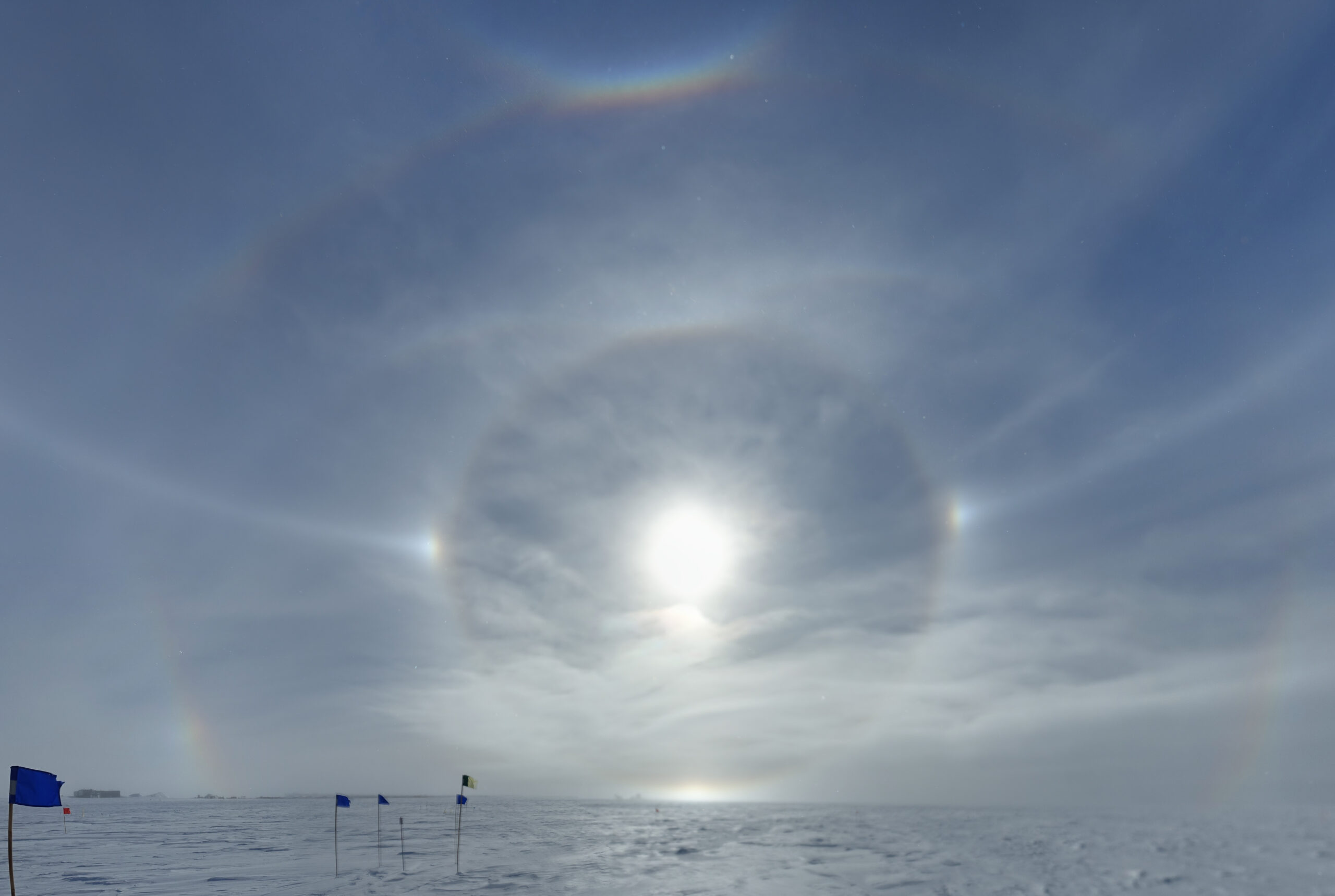
Where to look, and why the position changes
Look to the left and right of the sun, at about the same height above the horizon. When the sun is low, a sun dog commonly appears roughly 22 degrees away from it: about the width of an outstretched hand at arm’s length, though hands vary. You may see only one, because the right crystals and enough sunlight need to be present in the right part of the sky. A thin cloud can hide or reveal a patch as it moves.
The 22-degree figure is a useful starting point, not a fixed rule for every sun dog. As the sun climbs higher, the light travels through the aligned plates at a different angle, and the sun dogs can move farther from the sun. They also tend to be easier to notice when the sun is low. Atmospheric optics researcher Les Cowley’s explanation of sun dogs and solar altitude illustrates this changing geometry.
Protect your eyes: never stare directly at the sun, even when it is low or partly hidden by cloud. Block the sun completely with a building, tree, or another solid object while looking at the nearby sky. Ordinary sunglasses are not a safe way to look directly at it, and a camera or binoculars must not be pointed at the sun without proper solar equipment.
Sun dog, halo, or rainbow?
A sun dog is a localized bright patch beside the sun. A common 22-degree halo is a ring, or part of one, centered on the sun or moon. Both can result from light passing through six-sided ice crystals, but the crystals’ orientations help determine the pattern: aligned plates favor concentrated sun dogs, while crystals in many orientations can contribute to a ring. The two displays can appear together, especially when the sun is low, but you do not need to see a complete halo to see a sun dog.
A rainbow is different. Its familiar arc appears in the part of the sky opposite the sun and involves sunlight entering and reflecting inside water droplets before leaving them. Sun dogs appear on the sun’s side of the sky and are produced by ice crystals. A vertical sun pillar is different again: it is mainly produced by light reflecting from relatively flat ice-crystal surfaces. The National Weather Service compares these related displays.
Does a sun dog predict a storm?
A sun dog tells you that appropriately shaped ice crystals are present along the path of the light. It does not, on its own, tell you when rain or snow will arrive. High, thin clouds can sometimes precede an approaching weather system, but they also occur without a storm following at your location. A forecast based on changing pressure, moisture, winds, and other observations is far more useful than a single patch of color.
Cold weather at the ground is not required either. High clouds can contain ice above a mild landscape, so sun dogs are possible in summer as well as winter. In very cold places, crystals suspended closer to the ground can also produce striking displays. Their appearance depends on the crystals, the light, and the observer’s position, not a particular date on the calendar.
The next time a thin veil of cloud crosses a low sun, shade your eyes and look to either side. A bright red-edged patch may be enough to reveal an enormous collection of nearly invisible ice crystals, each bending a little sunlight into the same patch of sky.
Featured image: Taigne Hammock / Wikimedia Commons, CC0.




Add comment