

 Akshay Dinesh
A glass of water can look perfectly clear while still carrying dissolved minerals, salts, metals, or other substances too small to see. Ordinary strainers and many simple filters catch visible particles, but dissolved substances behave differently. They are mixed into the water at the molecular or ionic level, so separating them takes more than a screen.
Reverse osmosis is one of the most widely used ways to do that separation. It pushes water through a semipermeable membrane, a thin barrier that lets water molecules pass more easily than many dissolved substances. The result is not magic and not a guarantee of perfect water. It is a physical process built around pressure, membrane pores, water chemistry, maintenance, and testing.
Interest in reverse osmosis has grown as more families ask practical questions about drinking water, including lead, nitrate, arsenic, salty taste, and PFAS. The U.S. Environmental Protection Agency lists reverse osmosis as one type of point-of-use treatment that can greatly reduce PFAS when the system is properly certified and maintained. To understand what that means, it helps to start with the natural process reverse osmosis is named after.
Osmosis Moves Water Toward the More Concentrated Side
Osmosis happens when water sits on both sides of a membrane that allows water through but blocks at least some dissolved substances. If one side has a low concentration of dissolved material and the other side has a higher concentration, water naturally tends to move toward the more concentrated side. That movement helps even out the concentration difference.
A simple way to picture it is to imagine two solutions separated by a very selective barrier. Water molecules are small enough to move through the barrier. Many dissolved ions, larger molecules, and particles are not. Because the concentrated side has less available water relative to dissolved material, water moves in that direction until pressure or concentration changes slow the movement.
The pressure connected with that natural movement is called osmotic pressure. It is not something most people notice in daily life, but it matters in biology, food preservation, desalination, and home water treatment. Plant roots, human cells, and membranes in water systems all depend on the same basic idea: water does not simply sit still when a selective barrier and a concentration difference are present.
Reverse osmosis turns that natural tendency around. Instead of allowing water to drift toward the more concentrated side, the system applies pressure to the untreated water. If the pressure is strong enough, water is forced through the membrane in the opposite direction, leaving many dissolved substances behind.
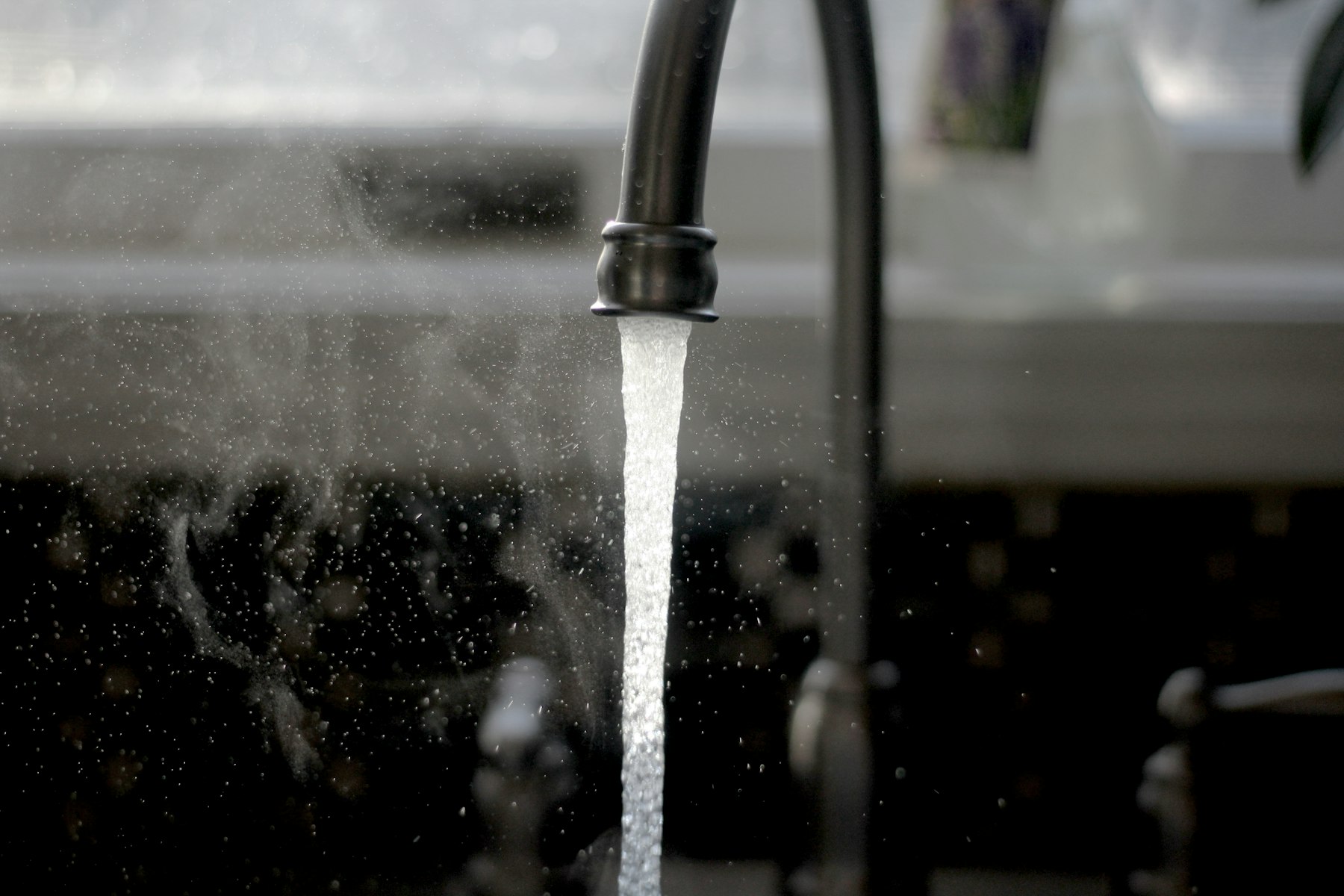
Pressure Forces Water Through a Selective Membrane
In a household reverse osmosis system, incoming water usually passes through one or more prefilters before it reaches the membrane. A sediment filter may catch silt or grit that could clog the system. A carbon filter may reduce chlorine and certain organic chemicals, especially because chlorine can damage some common membrane materials. The membrane is the central part, but it rarely works alone.
The reverse osmosis membrane is often described as semipermeable because it is selective rather than simply open or closed. Water molecules can pass through more readily than many dissolved ions and larger molecules. The rejected material stays on the concentrated side of the membrane, where moving water carries it away as a waste stream.
That waste stream is one of the tradeoffs of reverse osmosis. The treated water goes to a storage tank or faucet, while the more concentrated water is sent down a drain. EPA consumer guidance for PFAS filters notes that reverse osmosis systems can send about a gallon of untreated water to the drain for every gallon treated, though actual efficiency varies by design, pressure, temperature, and maintenance.
University of Nebraska-Lincoln Extension explains reverse osmosis performance using two useful ideas: recovery rate and rejection rate. Recovery rate describes how much of the incoming water becomes treated water. Rejection rate describes how much of a particular contaminant the membrane keeps from passing through. Both numbers matter, because a system can make water slowly, waste too much, or fail to reduce a substance enough if the conditions are wrong.
The concentration of the incoming water matters too. If nitrate, arsenic, or another contaminant begins at a high level, a strong percentage reduction may still leave more than the desired amount in the treated water. That is why reverse osmosis should be chosen after water testing, not just because the term sounds powerful.
What Reverse Osmosis Can Reduce Well
Reverse osmosis is especially useful for many dissolved ions and small inorganic contaminants that ordinary particle filters cannot handle well. University extension guidance lists nitrate, arsenic, lead, fluoride, sodium, sulfate, radium, uranium, and several other ions or metals among substances that household reverse osmosis units may reduce effectively. It can also reduce total dissolved solids, the broad measure behind salty, mineral-heavy water.
This is why reverse osmosis appears in conversations about private wells as well as municipal tap water. A private well may have naturally occurring arsenic, high nitrate from nearby land use, or a salty taste from dissolved minerals. A public water customer might be more interested in taste, certified PFAS reduction, or an extra point-of-use barrier at the kitchen sink. The same technology can be discussed in both settings, but the reason for using it should be specific.
Reverse osmosis is also different from water softening. A softener mainly exchanges calcium and magnesium ions for sodium or potassium ions, reducing hardness that causes scale. Reverse osmosis removes a broader range of dissolved material, but it is usually slower and more water-intensive. For a home with hard water, a softener may protect plumbing and appliances, while reverse osmosis may be used only at a drinking-water faucet.
Some systems combine reverse osmosis with activated carbon. That combination matters because carbon is better at certain taste, odor, chlorine, and organic-chemical problems than the membrane alone. A multi-stage system may use sediment filtration, carbon filtration, the membrane, a storage tank, and a post-filter before water reaches the drinking faucet.
No single treatment system removes every possible contaminant. Reverse osmosis can be very effective for many dissolved substances, but it should not be treated as a universal shield. Dissolved gases, some volatile organic chemicals, and certain microbial risks may require different treatment or additional steps.
Certification Matters More Than Marketing Claims
The most useful question is not simply whether a product says reverse osmosis on the box. The better question is whether it is independently certified for the substance a household is trying to reduce. NSF explains that NSF/ANSI 58 applies to reverse osmosis systems and that certified systems are tested for specific safety and performance requirements. The standard number is not a ranking; it tells buyers what kind of treatment claim is being evaluated.
EPA gives similar advice for PFAS. It recommends looking for certification under NSF/ANSI 53 or NSF/ANSI 58 for PFAS reduction and checking whether the product is certified for the particular reduction claim. That detail matters because a filter certified for one purpose is not automatically certified for every contaminant people worry about.
Certification also helps separate tested performance from vague reassurance. A product can look technical, use impressive language, and still lack the certification needed for a specific concern. Independent certification does not mean the system removes everything, but it gives a clearer basis for comparing claims.
Water testing should come before equipment choice whenever the concern is health-related. Public water systems publish Consumer Confidence Reports that list detected contaminants and treatment information. Private well owners have more direct responsibility because private wells are not monitored the same way public systems are. Testing tells a household what problem exists, how serious it is, and whether reverse osmosis is the right tool.
Maintenance Is Part of the Chemistry
A reverse osmosis unit is not a set-it-and-forget-it appliance. Its performance depends on the condition of the filters, the membrane, the storage tank, water pressure, temperature, and the quality of the incoming water. A clogged prefilter can reduce flow. A worn membrane can allow more dissolved material through. A neglected storage tank or old post-filter can affect taste and quality after the membrane has done its job.
Membranes can foul when particles, scale, biological growth, or concentrated contaminants build up on the surface. Pretreatment helps slow that process. Sediment filters protect the membrane from particles, while carbon filters may remove chlorine before it reaches chlorine-sensitive membrane materials. In hard-water areas, pretreatment can also help reduce scaling that shortens membrane life.
Temperature changes can matter more than people expect. Colder water moves more slowly through a membrane, so a system may produce less treated water in winter or when groundwater is naturally cold. Lower pressure can also reduce performance because reverse osmosis depends on pressure overcoming osmotic pressure and pushing water through the membrane.
Maintenance schedules should be followed closely because a filter that has reached the end of its useful life may no longer perform as certified. EPA warns that filters are only effective when maintained according to the manufacturer’s instructions. Replacing cartridges, checking the membrane, sanitizing when directed, and periodically testing treated water are not extras. They are part of making the system work as intended.
Why Reverse Osmosis Is Useful but Not Perfect
Reverse osmosis is powerful because it deals with substances that are invisible and dissolved. It can reduce many contaminants that slip past simpler particle filters, and it gives households a point-of-use option for drinking and cooking water. In places with specific well-water problems or certified PFAS concerns, that can be meaningful.
Its limits are just as important. The system costs money, requires replacement parts, uses water to flush rejected contaminants, and may work slowly compared with an ordinary faucet. It can reduce minerals that affect taste, which some people like and others do not. It can also create a false sense of security if buyers skip water testing or assume every reverse osmosis product has the same certifications.
The best way to think about reverse osmosis is as a precise tool, not a general promise. The membrane uses pressure to separate water from many dissolved substances. The prefilters and post-filters support that work. Testing identifies the problem. Certification shows whether the product has been evaluated for that problem. Maintenance keeps the system from drifting away from its intended performance.
Clear water is not always simple water. Reverse osmosis helps reveal the hidden chemistry behind a kitchen faucet: molecules, membranes, pressure, and the practical choices that turn treatment technology into safer, better-tasting drinking water.






Add comment