
 Akshay Dinesh
Two bright planets will seem to approach each other in the predawn sky on November 15 and 16, 2026. Mars will appear as a reddish point beside much brighter Jupiter, with only about 1.2 degrees separating them. That is a little more than the apparent width of two full Moons placed side by side. The sight is called a planetary conjunction, but the planets are not actually meeting. It is a temporary alignment created by our moving viewpoint on Earth.
This pairing is easy to observe because both planets are visible without a telescope. It also offers something a photograph cannot quite capture: if you watch on several mornings, you can see the geometry of the solar system changing in real time. Mars and Jupiter draw together, reach their closest apparent spacing, and then separate again as each world continues along its orbit.
When and where to look
NASA recommends looking toward the southeastern sky before sunrise on the mornings of November 15 and 16. Exact clock times depend on location, so the useful landmark is the sky itself: begin when the planets have risen but the horizon is still dark enough for them to stand out. A clear view toward the southeast matters more than finding a perfectly dark site. Buildings, trees, and hills near the horizon are more likely to hide the planets than ordinary city light.
Jupiter will be the easier object to identify. It should look like a steady, very bright point of pale light. Mars will sit nearby and appear dimmer, with a warmer orange-red color. Stars can twinkle strongly as turbulent air bends their light, while planets often look steadier because their tiny disks average out some of that distortion. Near the horizon, however, even a planet may shimmer or change color as its light passes through more atmosphere.
- Check the weather and choose a place with an open southeastern horizon.
- Go outside early enough to let your eyes adjust before dawn brightens the sky.
- Find bright Jupiter first, then look for reddish Mars close beside it.
- Use binoculars if you have them, but begin with your unaided eyes.
- Observe on more than one morning to notice the planets change position.
You do not need to judge 1.2 degrees precisely. At arm’s length, the width of a little finger is roughly one degree for many people, though hand sizes vary. The planets should therefore fit comfortably within the field of ordinary binoculars. Never sweep binoculars near the rising Sun; finish observing once daylight makes the Sun’s location uncertain.
Why two distant worlds appear side by side
A conjunction describes closeness in the sky, not closeness in space. Astronomers map an object’s apparent position on the celestial sphere, an imaginary globe surrounding Earth. When two objects have nearly the same celestial longitude, they are said to be in conjunction. From our viewpoint, they lie along almost the same direction even when one is far beyond the other.
Mars and Jupiter orbit the Sun at very different distances and speeds. Mars, the fourth planet from the Sun, takes about 687 Earth days to complete an orbit. Jupiter, the fifth planet, needs almost 12 Earth years. Earth is moving too, completing its own orbit in one year. The changing sightline produced by all three motions is what makes Mars appear to pass Jupiter against the background stars.
The planets usually remain near a narrow band across the sky because the major planets formed from the same flattened disk of material around the young Sun. Their orbital planes are not identical, but they are tilted by only modest amounts relative to Earth’s orbital plane. We see that shared plane projected onto the sky as the ecliptic. The Sun follows the ecliptic through the year, and the Moon and planets remain near it. That is why planetary meetings happen in a recognizable corridor rather than at random points across the sky.
The word alignment can be misleading here. Mars, Jupiter, and Earth will not form a perfectly straight line in three-dimensional space. A small angular separation only tells us that two sightlines are close together. Imagine two streetlights at very different distances that appear side by side from one window. A few steps to another window change their apparent spacing even though the lights themselves have not moved. Earth’s orbit supplies the changing window.
What your eyes and binoculars can reveal
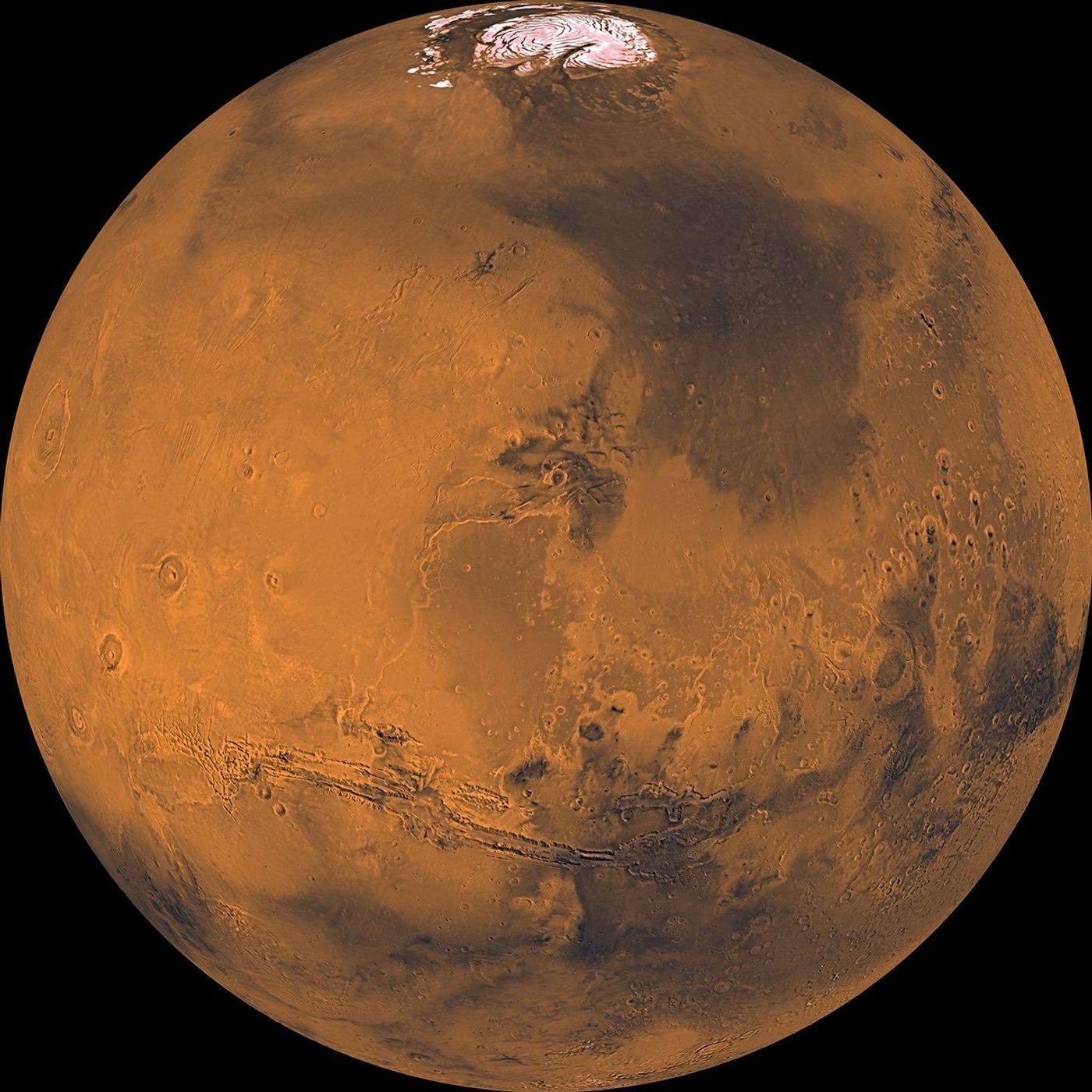
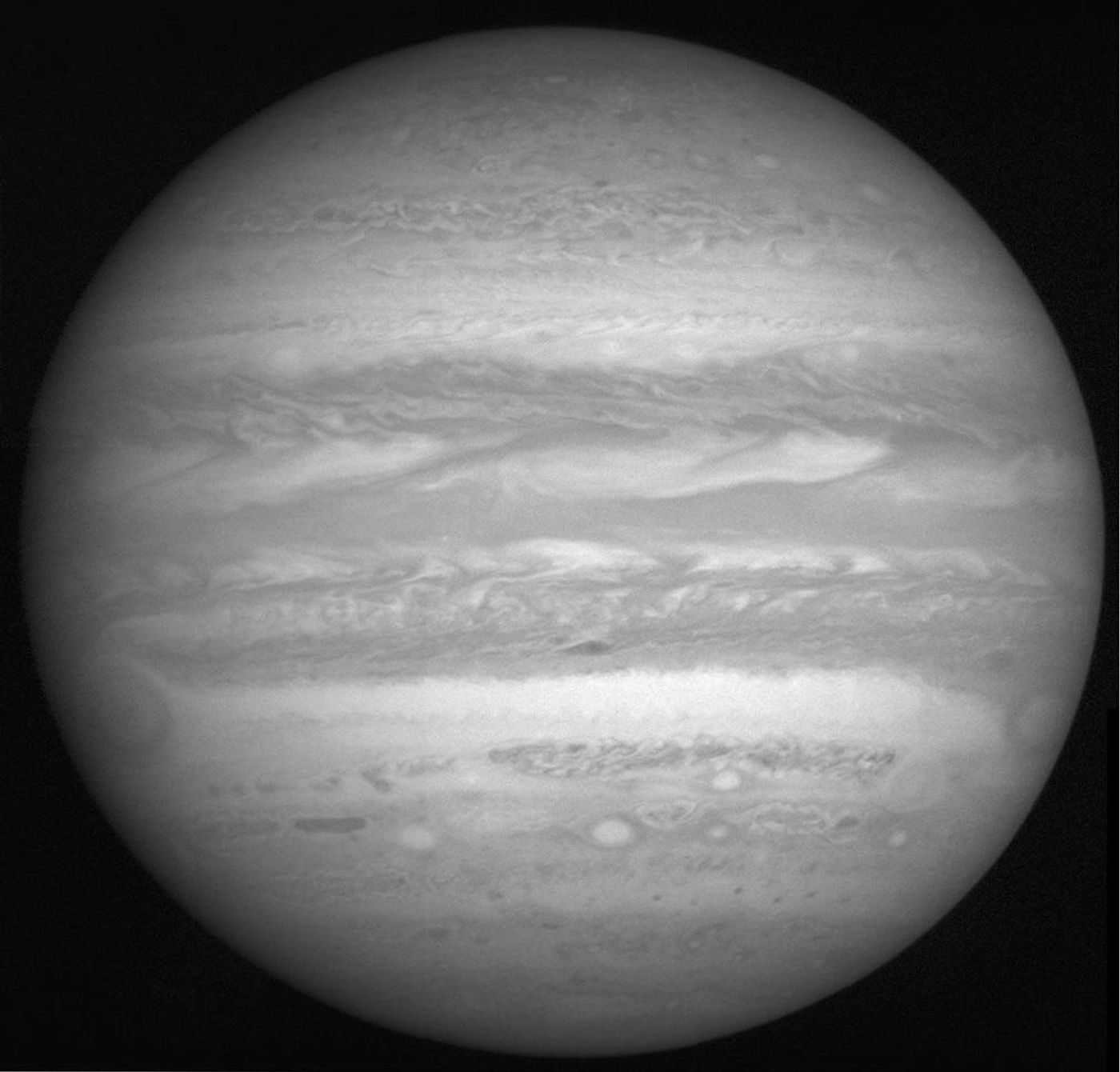
To the unaided eye, color and brightness are the main clues. Mars looks reddish because iron-bearing minerals on its surface have oxidized, giving its dust and rocks their familiar rusty tones. Jupiter is much larger and is covered by bright clouds that reflect sunlight efficiently. Although it is farther from Earth than Mars, its size and reflective atmosphere help make it the dominant point in the pairing.
Binoculars will separate the planets cleanly and may reveal more than expected. With steady 7x or 10x binoculars, Jupiter can appear as a tiny disk rather than a pinpoint. Its four largest moons may show up as small dots arranged near the planet, depending on their positions and the brightness of the dawn sky. These are Io, Europa, Ganymede, and Callisto, the satellites Galileo observed in 1610. Resting the binoculars on a railing or using a tripod makes faint details easier to hold steady.
Mars will remain much smaller in binoculars. A modest backyard telescope can show it as a disk, but visible surface detail depends heavily on its distance from Earth, atmospheric steadiness, and the telescope’s aperture. The conjunction is therefore best treated as a wide-field event. The pleasure comes from seeing two very different worlds together in one view, not from expecting spacecraft-like detail through small optics.
How apparent motion reshapes the view
A single morning shows a pleasing pair. Several mornings reveal the mechanism. Make a quick sketch at the same local time each day, placing Mars, Jupiter, and one or two nearby bright stars on the page. The stars provide a relatively fixed background over such a short interval. Mars changes its position against that background more noticeably, while Jupiter’s shift is slower because of its longer orbit.
This is apparent angular motion, measured across the sky rather than in kilometers. The familiar daily sweep from east to west is mainly caused by Earth’s rotation. The smaller night-to-night changes among the planets reflect orbital motion. Keeping those two motions separate helps explain why the whole scene rises and moves together during one morning, yet its internal arrangement changes from one date to the next.
The closest-looking moment also depends slightly on how an event is defined. Astronomical tables may list a precise instant of conjunction based on celestial coordinates, while observers care more about the mornings when both planets are above the horizon in a dark sky. The best visual opportunity can therefore occur before or after the calculated instant. Weather and horizon conditions often matter more than a few hours of geometric difference.
Photography can record the change, but it does not require specialized equipment. A phone held steady against a solid support may capture the bright pair during blue hour. Keep the field wide enough to include the horizon, which gives the image scale and direction. Avoid excessive digital zoom; it enlarges blur without revealing planetary detail. A sequence made from the same position on consecutive mornings will communicate orbital motion better than one heavily magnified frame.
A moving solar system in plain sight
Conjunctions once helped astronomers test tables of planetary motion, and they still offer a simple way to learn the sky. They show the difference between angle and distance, explain why planets gather near the ecliptic, and make orbital motion visible without calculations. The event is not rare because the planets nearly collide; it recurs because moving worlds repeatedly share the same line of sight.
The November 2026 pairing is especially approachable: Jupiter is unmistakably bright, Mars contributes its distinctive color, and both fit into one binocular view. Look southeast before sunrise on November 15 or 16, then return on another morning if the weather allows. The changing gap between the planets is the real observation. In that small shift, the solar system stops looking like a static diagram and becomes what it is: a set of worlds continuously moving around the Sun.