

 Akshay Dinesh
The 2026 Geminid meteor shower is expected to peak on the night of December 13–14, with a thin waxing crescent Moon leaving much of the night dark. From a clear, dark location, viewers can watch without a telescope: settle in, let your eyes adjust, and look across a wide stretch of sky. The shower is visible from both hemispheres, though observers north of the equator generally have the advantage.
The Geminids are active for days on either side of the peak, so one cloudy night need not end the opportunity. They also offer an unusually good reason to look up before midnight. Understanding where the meteors appear and what a forecast rate actually means can make a cold night outdoors much more rewarding.
When to watch the Geminids in 2026
The American Meteor Society lists December 13–14 as the peak night and December 4–17 as the shower’s active period. That means Sunday evening, December 13, through Monday morning, December 14, is a sensible first choice in North America. Activity builds and fades rather than switching on at a single instant, and nearby nights can still be worthwhile if the weather is better.
The International Meteor Organization predicts a broad maximum centered on December 14 at 14:00 UTC. That is 9 a.m. Eastern Standard Time and 6 a.m. Pacific Standard Time, when daylight or dawn will limit viewing in much of North America. The prediction is not an appointment at which all meteors appear: the hours before dawn on December 14 and the following night are useful opportunities around the broad maximum. Local darkness, cloud cover, and the Moon’s actual setting time still matter.
The American Meteor Society describes the Moon as a 15-percent-lit waxing crescent on peak night. Once it has set, its light will no longer wash out faint meteors. Check a local moonset time and cloud forecast before choosing your observing window; both depend on where you live.
Where to look and what to bring
From mid-northern latitudes, Gemini rises in the eastern sky during the evening. The shower can produce meteors by roughly 9 or 10 p.m., while the radiant climbs higher later in the night. Around 2 a.m. local time it is high in the sky for many observers, giving a better view of meteors that would otherwise be hidden below the horizon. In the Southern Hemisphere, Gemini rises later and stays lower, so rates are usually lower and the middle of the night is a better bet.
You do not need to stare at Gemini. A meteor’s path can appear anywhere in the sky, and those seen away from the radiant often leave longer-looking trails. Choose a wide, open view away from bright lamps and let your gaze take in as much sky as possible. A reclining chair or blanket helps you look upward comfortably; binoculars and telescopes restrict the field of view and are not useful for watching a shower.
Give your eyes about 30 minutes to adapt to darkness, as NASA recommends, and avoid bright phone screens. Dress for the actual conditions, with warm layers and a dry place to sit, and choose a safe, permitted location. Clouds, haze, nearby lights, trees, and buildings can all reduce what you see. If the peak night is overcast, a clear neighboring night may be the better choice.
How many meteors might you see?
Headlines sometimes quote 120 or 150 meteors an hour, but those numbers describe exceptional or standardized conditions, not a guaranteed count for a person looking up from a backyard. The International Meteor Organization’s 2026 calendar gives a zenithal hourly rate of 150. That standardized rate assumes a very dark sky and a radiant directly overhead, among other ideal conditions. It is a way to compare showers, not a personal forecast.
NASA’s Geminid guide gives a more practical expectation of about 40 to 50 meteors per hour under dark skies. Even that is not assured: the time of night, your latitude, weather and light pollution all affect the result. Meteors also arrive irregularly. Ten quiet minutes followed by several streaks does not mean the shower has suddenly started.
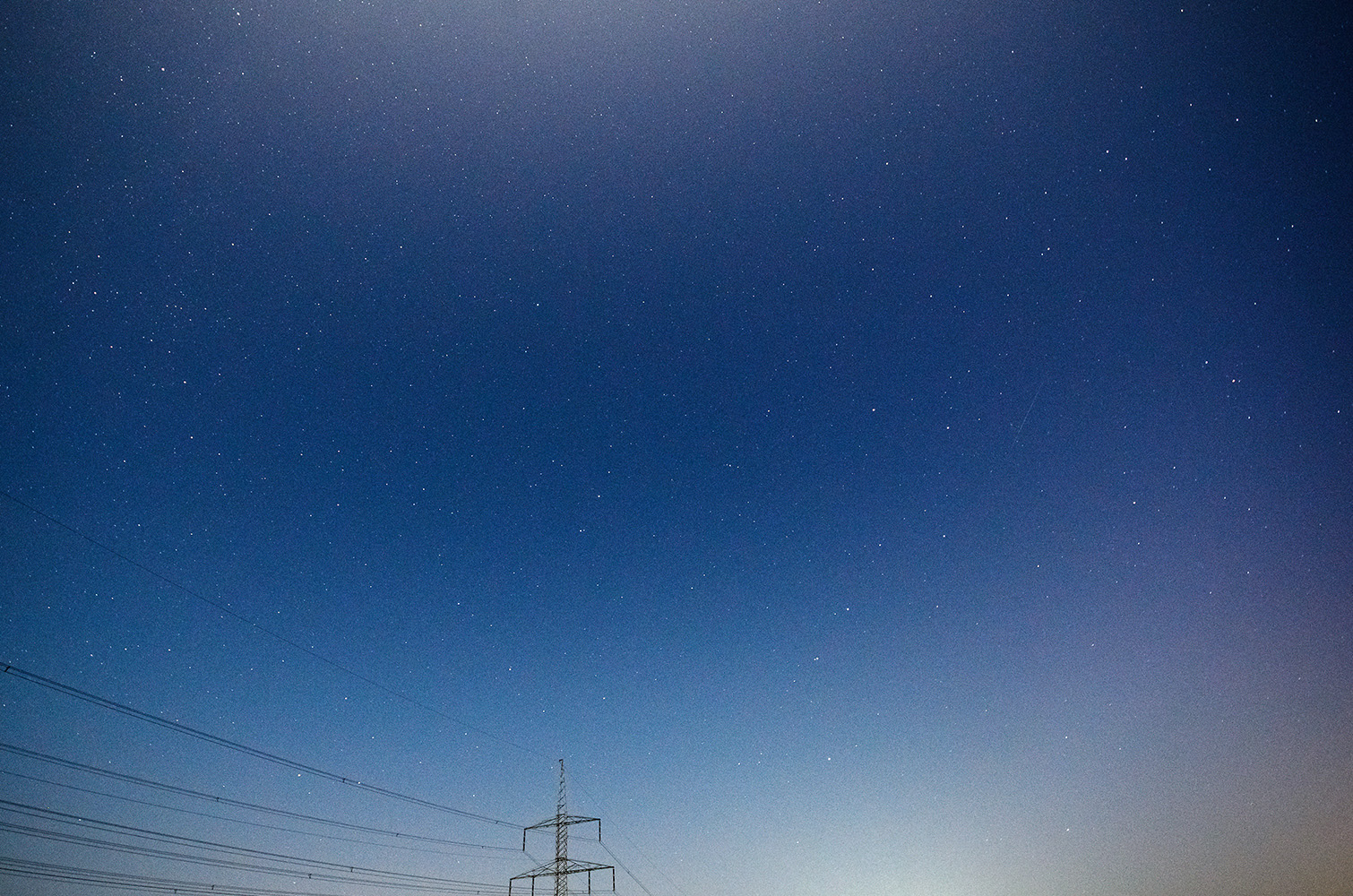
Pictures can create another misleading expectation. Many spectacular shower photographs combine exposures taken over a long period; they do not show what an observer saw all at once. Allow at least half an hour, and preferably longer, to appreciate the display.
Why the meteors seem to come from Gemini
If you trace the paths of several Geminids backward, they appear to converge near the constellation Gemini. That apparent origin is called the radiant. It is a perspective effect: the particles travel on roughly parallel paths, just as parallel railway tracks seem to meet in the distance. Gemini supplies the shower’s name, but the stars in the constellation are not the source of the particles.
The debris is associated with 3200 Phaethon, an unusual asteroid that follows a stretched orbit close to the Sun. Every December, Earth crosses the stream of material associated with it. Small particles enter the atmosphere at about 35 kilometers per second, compressing and heating the air around them and producing the brief luminous streaks we call meteors. Scientists continue to study how Phaethon produced the stream; it is not necessary to imagine the asteroid itself passing close to Earth during the shower.
A single streak may last only a moment, but its backward path connects it to a stream of debris encountered year after year. Pick a clear night, give the sky time, and the Geminids turn that invisible crossing into something you can see for yourself.
Featured image: Geminids over Kitt Peak in 2023, a composite made from images captured over two hours. R. Sparks/NSF NOIRLab, CC BY 4.0; original image.



Add comment