 Akshay Dinesh
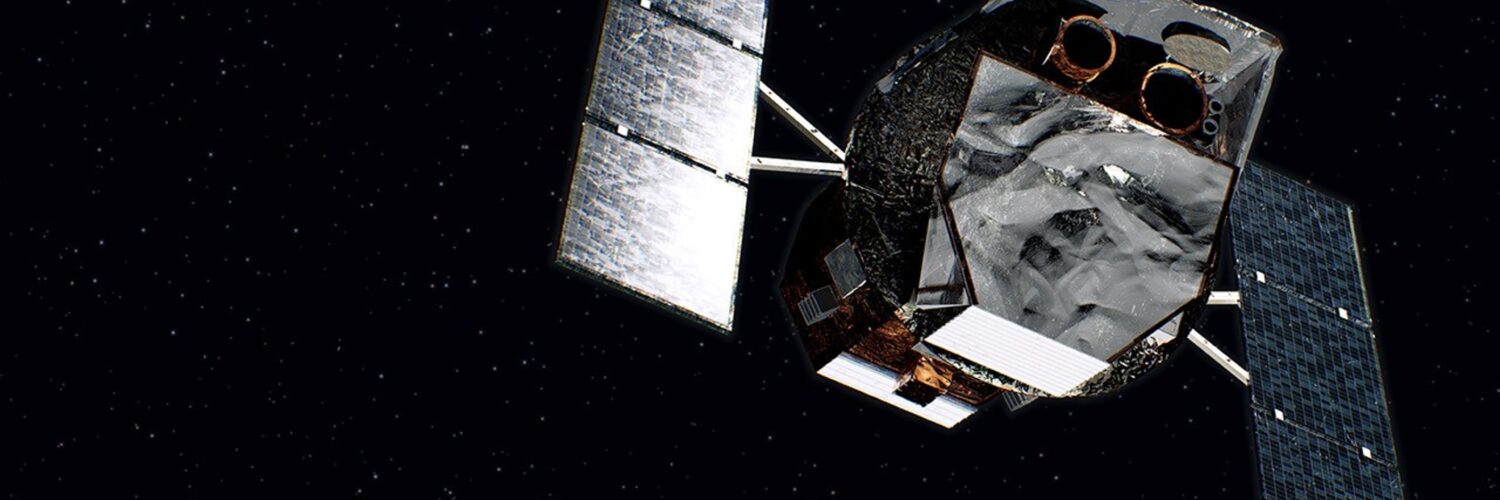
A gamma-ray burst can blaze and begin fading before most telescopes know where to look. These flashes are among the most energetic explosions known, yet their brightest phase may last only seconds. NASA’s Neil Gehrels Swift Observatory was built around that mismatch between cosmic power and human reaction time. It could notice a burst, calculate its position, alert astronomers, and turn its own narrower telescopes toward the afterglow in roughly a minute.
Swift made its final observation on October 20, 2026, after almost 22 years in orbit. Atmospheric drag had pulled the spacecraft below 275 kilometers, where it could no longer hold its telescopes steadily on a target. The mission had been planned for two years. By the time operations ended, NASA reported more than 2,000 gamma-ray bursts, more than 1,400 supernovae, about 7,000 scientific papers, and an archive that will remain useful long after the spacecraft re-enters the atmosphere.
Why fading light creates an astronomy problem
Gamma-ray bursts, often shortened to GRBs, arrive from far beyond the Milky Way. Long bursts are usually linked to the collapse of massive stars and the birth of black holes. Short bursts, whose intense gamma-ray emission peaks for less than two seconds, are associated with collisions involving neutron stars. In either case, narrow jets can send radiation racing outward at nearly the speed of light. A burst is visible from Earth when one of those jets points roughly in our direction.
The initial gamma rays reveal that something extraordinary happened, but they do not tell the whole story. After the prompt flash, expanding material continues to glow in X-rays, ultraviolet light, visible light, infrared light, and radio waves. That afterglow can identify the host galaxy, show how the blast interacts with surrounding gas, and help astronomers estimate distance and energy. It is also a rapidly changing target: wait too long, and the evidence becomes much harder to measure.
Before Swift, high-energy detectors could discover bursts without quickly giving other observatories a precise enough location. Large telescopes might receive a broad search area only after the most informative phase had passed. The engineering challenge was therefore not simply to build a more sensitive telescope. Astronomers needed an observing system that could move information and hardware fast enough to keep up with a fading explosion.
Three instruments worked as one rapid-response system
Swift solved the problem with three co-aligned instruments that divided the work. The Burst Alert Telescope, or BAT, watched a large portion of the sky for sudden high-energy flashes. Instead of using conventional focusing optics, it placed a patterned mask of roughly 52,000 lead tiles above its detectors. Gamma rays passing through the openings cast a distinctive shadow. A computer could reconstruct that pattern to determine where the burst came from, usually to within about three arcminutes.
The spacecraft then sent the rough position to the ground within about 20 seconds through the General Coordinates Network, the alert system used by observatories around the world. At the same time, Swift turned autonomously. NASA says the observatory typically brought the burst into the fields of its X-Ray Telescope and Ultraviolet/Optical Telescope 20 to 100 seconds after detection. The X-ray instrument could refine a source position to a few arcseconds, while the ultraviolet and optical instrument could sharpen it further and record light that never reaches ground-based telescopes because Earth’s atmosphere absorbs most ultraviolet radiation.
This sequence made Swift more than three telescopes sharing a spacecraft. It was a scientific relay: detect broadly, locate quickly, turn, refine, notify, and keep watching. Ground observatories could join the chase using coordinates that improved as new measurements arrived. A flash that once vanished anonymously could become a well-observed event with a host galaxy, a distance, a changing spectrum, and a physical explanation.
Speed turned brief flashes into physical evidence
One early result showed exactly why the design mattered. On May 9, 2005, Swift detected GRB 050509B, a short burst that lasted only 0.03 seconds. It turned quickly enough for its X-Ray Telescope to record an afterglow consisting of just 11 photons. That may sound like almost nothing, but locating the faint X-ray source made it possible to connect the event with its surroundings. The observation supplied some of the first direct support for the idea that short bursts arise from merging neutron stars rather than from the collapse of single massive stars.
Swift also used bursts as beacons from the early universe. In 2009 it detected GRB 090423, produced when the universe was about 630 million years old, less than five percent of its present age. The explosion itself was brief, but its light crossed more than 13 billion years of cosmic history before reaching the observatory. Studying such afterglows lets astronomers probe early stars and the material between young galaxies at distances where ordinary galaxies can be difficult to examine.
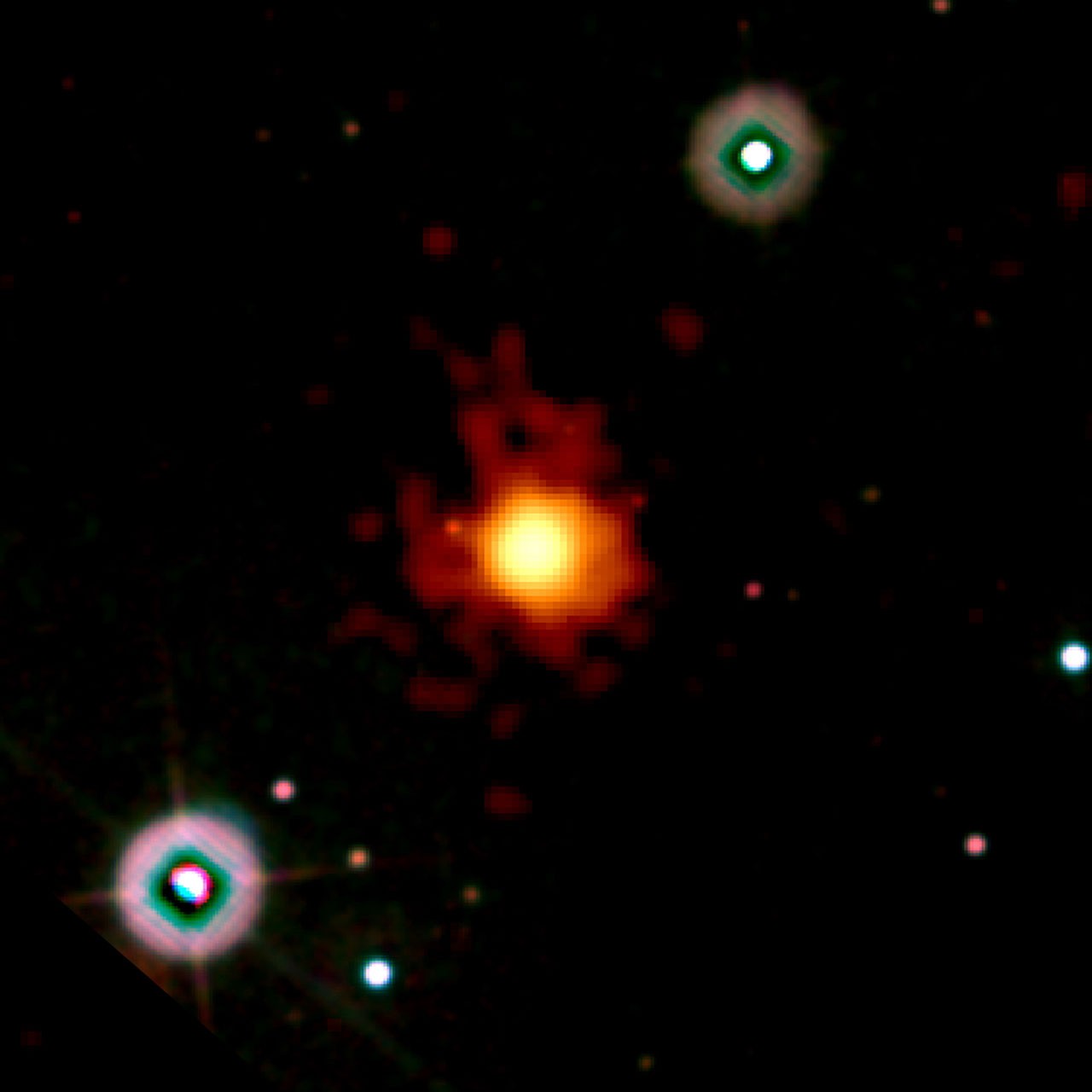
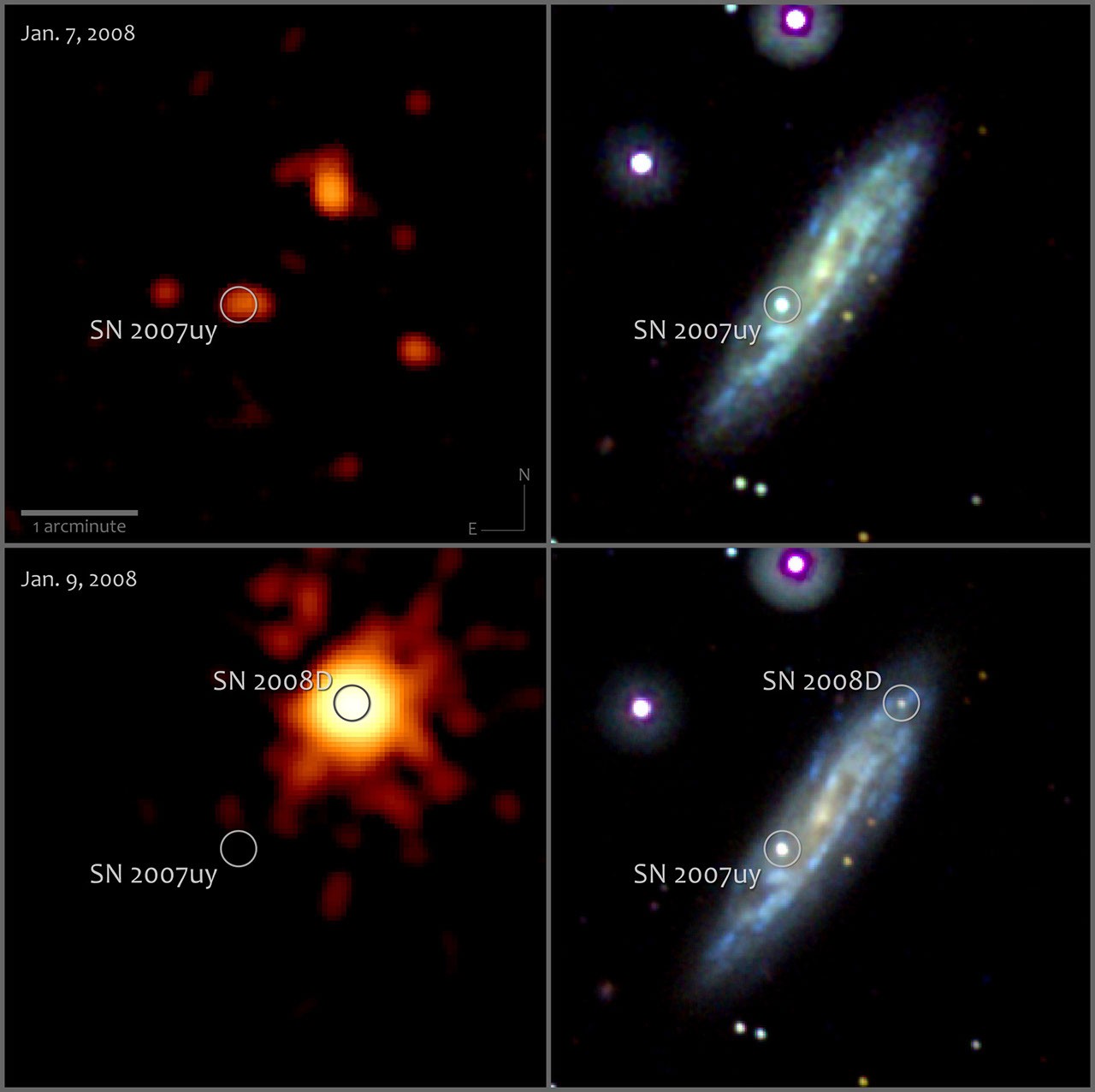
Not every important discovery began with a gamma-ray alert. In January 2008, Swift happened to be observing the spiral galaxy NGC 2770 when it recorded a sudden X-ray flash from a star. Follow-up observations showed supernova SN 2008D unfolding almost from the beginning. Astronomers had seen thousands of supernovae after their visible fireworks were underway; Swift caught the breakout signal that appeared as the explosion’s shock reached the star’s surface.
A burst hunter became an astronomical multitool
Swift’s ability to interrupt a schedule and turn toward a new target proved useful far beyond GRBs. Astronomers could request a target-of-opportunity observation from the ground in a matter of minutes, while longer monitoring programs followed an object for weeks or months. The system could schedule as many as 75 independent targets in a day. That flexibility helped scientists study stellar flares, novae, active galaxies, comets, asteroids, and stars being torn apart by supermassive black holes.
The mission also arrived as astronomy was becoming more focused on change. Traditional sky surveys often emphasized stable maps and deep exposures. Time-domain astronomy asks a different set of questions: What appeared tonight? What brightened, faded, pulsed, or moved? Swift demonstrated that the scientific response can be part of the instrument itself. Its automated alerts and rapid slews treated time as evidence rather than as a scheduling inconvenience.
That approach became even more powerful in multimessenger astronomy, which combines light with signals such as gravitational waves or neutrinos. When gravitational-wave detectors announced the neutron-star merger GW170817 in 2017, Swift joined a worldwide observing campaign that followed the event’s kilonova and afterglow. It did not detect the initial gamma-ray burst, but its later measurements helped connect different stages of the merger. The important lesson was collective: no single observatory sees every wavelength or every messenger, so fast coordination can reveal more than any one instrument.
What remains after Swift stops observing
Swift’s end was caused by orbital physics, not by a lack of useful science. Even hundreds of kilometers above Earth, traces of atmosphere create drag. Solar activity heats and expands the upper atmosphere, increasing the number of particles encountered by low-orbiting spacecraft. As Swift sank, the drag grew stronger. At its final altitude the observatory could no longer compensate well enough to keep astronomical sources steady in its field of view.
The loss leaves a real gap in rapid, multiwavelength follow-up. Other missions can detect high-energy transients, and observatories on Earth and in space can respond to alerts, but Swift combined a wide-field burst detector, autonomous turning, X-ray localization, and ultraviolet and visible imaging on one platform. NASA says it is examining ways to strengthen rapid response using existing telescopes, commercial capabilities, and future missions. The next system will inherit a demanding benchmark: not merely seeing an explosion, but turning that first signal into usable coordinates before the light disappears.
Meanwhile, the mission’s observations are still active scientific material. NASA estimates that the public archive contains nearly 22 years of brightness measurements, spectra, and more than 1.5 million ultraviolet and optical images, totaling about 12 terabytes. Researchers can reanalyze old events with new methods, compare them with discoveries from newer observatories, or search the long record for behavior no one thought to examine at the time.
Swift changed astronomy by making reaction speed a central part of discovery. Its legacy is not only a catalog of spectacular explosions. It is a way of working: watch widely, respond automatically, share positions quickly, and gather several kinds of light before the universe changes the scene. The spacecraft’s observing run is over, but that rapid-response model now shapes how astronomers prepare for the next flash.