Akshay Dinesh
A telescope mirror nearly 40 metres wide cannot be cast, polished, transported, or safely supported as one slab of glass. The European Southern Observatory’s Extremely Large Telescope solves that problem by dividing its primary mirror into 798 hexagonal segments. Each segment is a substantial optical instrument in its own right, yet the finished array must reflect starlight as though every piece belonged to one continuous surface.
That is harder than fitting together a giant mosaic. A tiny height difference between neighbouring segments changes the distance that light travels, so the returning waves no longer line up. Wind, temperature, gravity, and the telescope’s own motion keep trying to disturb the surface. The mirror therefore depends on a continuous loop of measurement and correction, with sensors finding minute errors and motors moving the glass back into place.
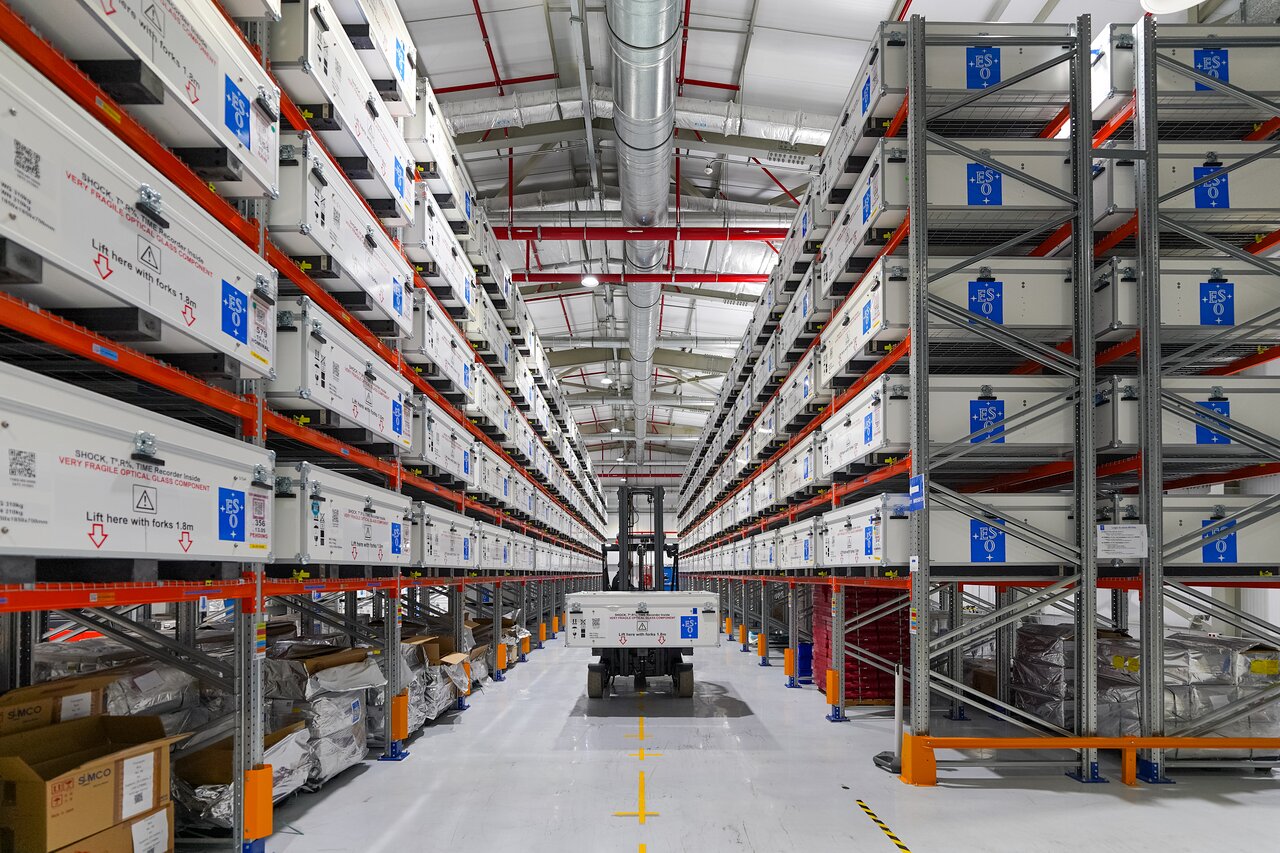
The project reached a visible milestone in October 2026, when ESO reported that nearly 500 primary-mirror segments had arrived at its technical facility in Chile. The final segment had also entered production. Behind that shipment lies one of modern astronomy’s most demanding exercises in optics, precision control, and long-term maintenance.
Why the mirror has to be built in pieces
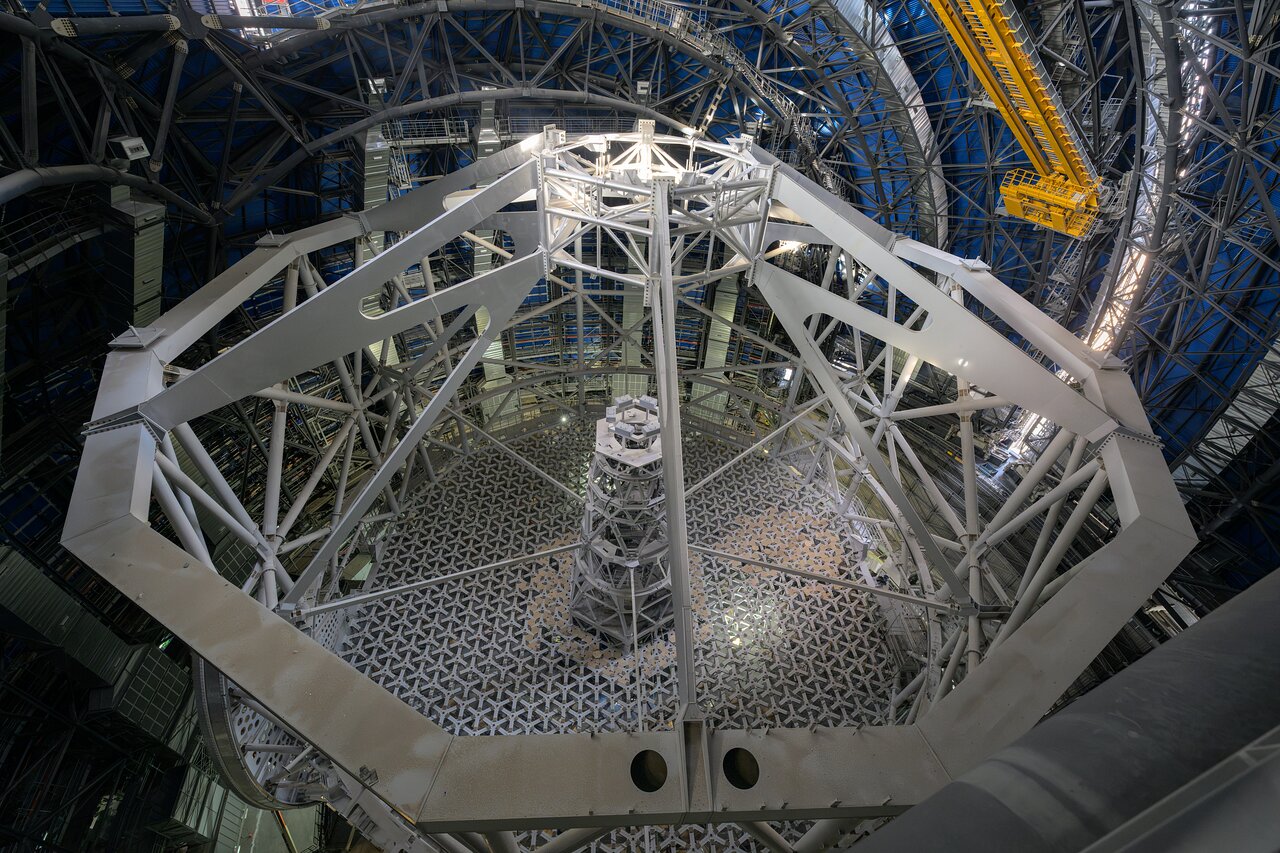
The amount of light a telescope collects depends mainly on the area of its opening. A wider mirror gathers more photons from faint galaxies, exoplanets, and other distant targets. It can also separate finer details when the atmosphere and the rest of the optical system do not blur the view. ESO’s primary mirror, called M1, will span 39 metres and provide about 978 square metres of light-collecting area.
Simply scaling up a conventional one-piece mirror would create several problems at once. A single blank would be exceptionally difficult to manufacture without internal flaws, too large for existing roads and ships, and enormously heavy. Its own weight would bend the reflecting surface as the telescope tilted toward different parts of the sky. Even a minute deformation matters when the goal is to control a surface to a small fraction of the wavelength of light.
Segmenting the mirror changes the problem from making one impossible object to coordinating hundreds of manageable ones. Each ELT segment is about 1.45 metres across and roughly five centimetres thick. Including its support, a segment assembly weighs about 250 kilograms. Those dimensions are still demanding, but a segment can be polished, tested, transported, coated, installed, and eventually replaced with industrial equipment.
How separate segments form one optical surface
A mirror forms a sharp image when light from different parts of its surface arrives at the focus with the correct timing. If one segment sits slightly higher than its neighbours, tilts by the wrong amount, or shifts sideways, it changes the reflected wavefront. Instead of reinforcing one clean image, parts of the light interfere in the wrong places. Stars can acquire distorted patterns, and fine astronomical detail disappears.
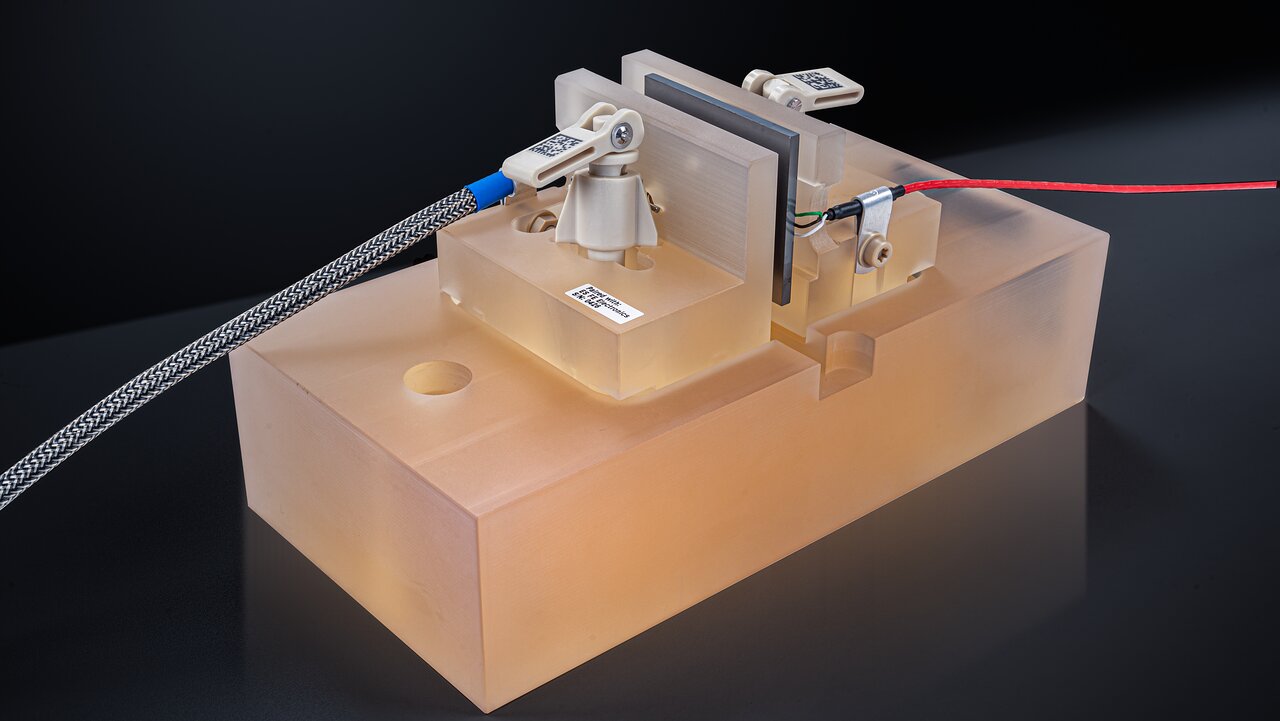
Keeping the segments in step is called phasing. Each M1 assembly has three position actuators that control its height and its tip and tilt. Edge sensors compare neighbouring segments, allowing the control system to detect changes in their relative positions. ESO lists 4,608 of these sensors across the mirror. The target alignment is measured in tens of nanometres across the full 39-metre surface, far below what the eye could see as a physical step.
The edge sensors provide rapid, local information, but they do not settle the entire problem forever. Electronic measurements can drift, and the telescope structure changes subtly with temperature and orientation. The ELT’s phasing and diagnostic system will periodically inspect starlight itself. A wavefront sensor can recognize diffraction patterns caused by steps between segments, calculate the position errors, and supply corrections to the segment controls.
This creates a layered feedback system. The optical measurement establishes what the whole mirror should be doing. Edge sensors track the relationships between nearby pieces, and actuators make the mechanical adjustments. The result is not a rigid mirror that happens to have seams; it is an actively maintained surface whose shape is repeatedly measured and restored.
Why the pieces are hexagons, but not truly identical
Hexagons cover a broad area without leaving triangular or square gaps, and each tile has six neighbours that help create a regular control pattern. Circular segments would waste too much space. Squares could tile a surface, but they do not approximate a large circular aperture as naturally and offer fewer neighbouring edges for distributing the structure. The familiar honeycomb layout is therefore a practical meeting point between optical coverage and repeatable engineering.
The pattern can make the segments look interchangeable. Optically, they are not. M1 is a curved, aspherical surface, so a piece near the centre does not have exactly the same prescription as one nearer the rim. The mirror is arranged in six matching sectors, each containing 133 different segment types. A segment at one position has counterparts in the same position in the other five sectors, but it cannot be moved to any arbitrary opening.
Every segment also rests on a support that spreads its load across 27 points. A warping system can make tiny, slow changes to the segment’s shape to compensate for effects such as gravity and temperature. The three position actuators then place that shaped segment correctly relative to the rest of the array. Shape control and position control are related, but they solve different errors.
The gaps do not vanish. ESO specifies roughly four millimetres between segments, leaving thin dark lines across the primary mirror. Those gaps slightly change the diffraction pattern and reduce the collecting surface by a small amount, but they do not prevent the array from focusing light. What matters most is that the reflecting areas on either side meet the intended optical surface with the correct height, angle, and curvature.
Phasing is not the same as adaptive optics
Two correction systems are often folded into one explanation, although they address different sources of blur. Phasing makes the segmented primary mirror behave like a single correctly shaped mirror. Adaptive optics tackles the moving distortion introduced after starlight enters Earth’s atmosphere. Turbulent pockets of air bend the light in constantly changing ways, which is why stars appear to twinkle.
The ELT sends light through a five-mirror path. After the 39-metre M1 gathers the light, the next curved mirrors relay it toward M4, a thin, deformable mirror 2.4 metres across. More than 5,000 actuators can reshape M4 up to 1,000 times per second. Measurements of the disturbed wavefront tell the system how to counter the atmosphere’s moment-to-moment effects. A fifth mirror makes rapid tip-and-tilt corrections that stabilize the image before instruments record it.
A useful comparison is a tiled floor seen through rippling water. Phasing keeps the tiles level and aligned with one another. Adaptive optics corrects the wavering view caused by the water above them. A telescope needs both: a perfectly phased primary mirror would still see through turbulent air, while excellent atmospheric correction could not rescue a primary mirror whose segments were pointing in different directions.
A mirror designed for maintenance, not just first light
The coating that makes a telescope mirror reflective gradually loses performance as it encounters dust and the environment. With 798 working segments, recoating cannot be treated as an occasional shutdown project. ESO plans to remove, clean, recoat, and replace about two segments per day. Each segment is expected to need fresh coating roughly every 18 months.
That requirement shaped the mirror’s inventory. The six installed sectors contain 798 segments, while a seventh set of 133 provides one spare for every optical type. In total, 931 segments are being made. When one installed piece leaves for recoating, the prepared member of the same family can take its position rather than leaving an empty patch in the primary mirror.
This maintenance cycle turns a spectacular object into an operating system. Technicians must track which optical type belongs in each location, protect nanometre-level surfaces, verify supports and sensors, and restore the phase after an exchange. The spare sector is therefore not excess stock. It is part of the design that lets the telescope preserve its sensitivity over decades.
The scientific payoff comes from combining scale with control. A larger collecting area makes faint targets accessible, while precise phasing and adaptive optics preserve the detail carried by their light. That combination could help astronomers examine atmospheres around rocky exoplanets, study stars near the Milky Way’s central black hole, and resolve young galaxies across enormous distances. The 798 hexagons matter not because they make the mirror look futuristic, but because careful measurement allows many imperfectly still objects to perform as one extraordinary eye.