 Akshay Dinesh
Most Mars missions leave Earth when the two planets are favorably placed and then follow a direct transfer toward the Red Planet. NASA’s twin ESCAPADE spacecraft are taking a stranger route. They launched in November 2025, traveled far beyond the Moon, curved back toward Earth, and will pass close to their home planet on November 7 and 9, 2026. Near closest approach, each spacecraft will fire its engine for about nine minutes while Earth’s gravity bends and accelerates its path. The combination will send the pair toward Mars on a journey that shows how mission planners can turn waiting, gravity, and carefully timed propulsion into a new kind of interplanetary departure.
A departure delayed by design
Earth and Mars do not stay a fixed distance apart. Both orbit the Sun at different speeds, so the geometry between them changes constantly. About every 26 months, the planets reach an arrangement that allows a spacecraft to travel from Earth to Mars along a relatively efficient arc. Launching outside that window usually demands much more energy, a longer journey, or both.
ESCAPADE, short for Escape and Plasma Acceleration and Dynamics Explorers, launched when Earth and Mars were poorly aligned for a direct trip. Instead of forcing the spacecraft onto an expensive route, mission designers sent them into a long, looping path toward the Earth-Sun L2 region, roughly a million miles from Earth on the side away from the Sun. This was not a parking orbit in the everyday sense. The spacecraft kept moving through a broad path shaped by the gravity of Earth and the Sun, then returned at the moment when Earth could help aim them toward Mars.
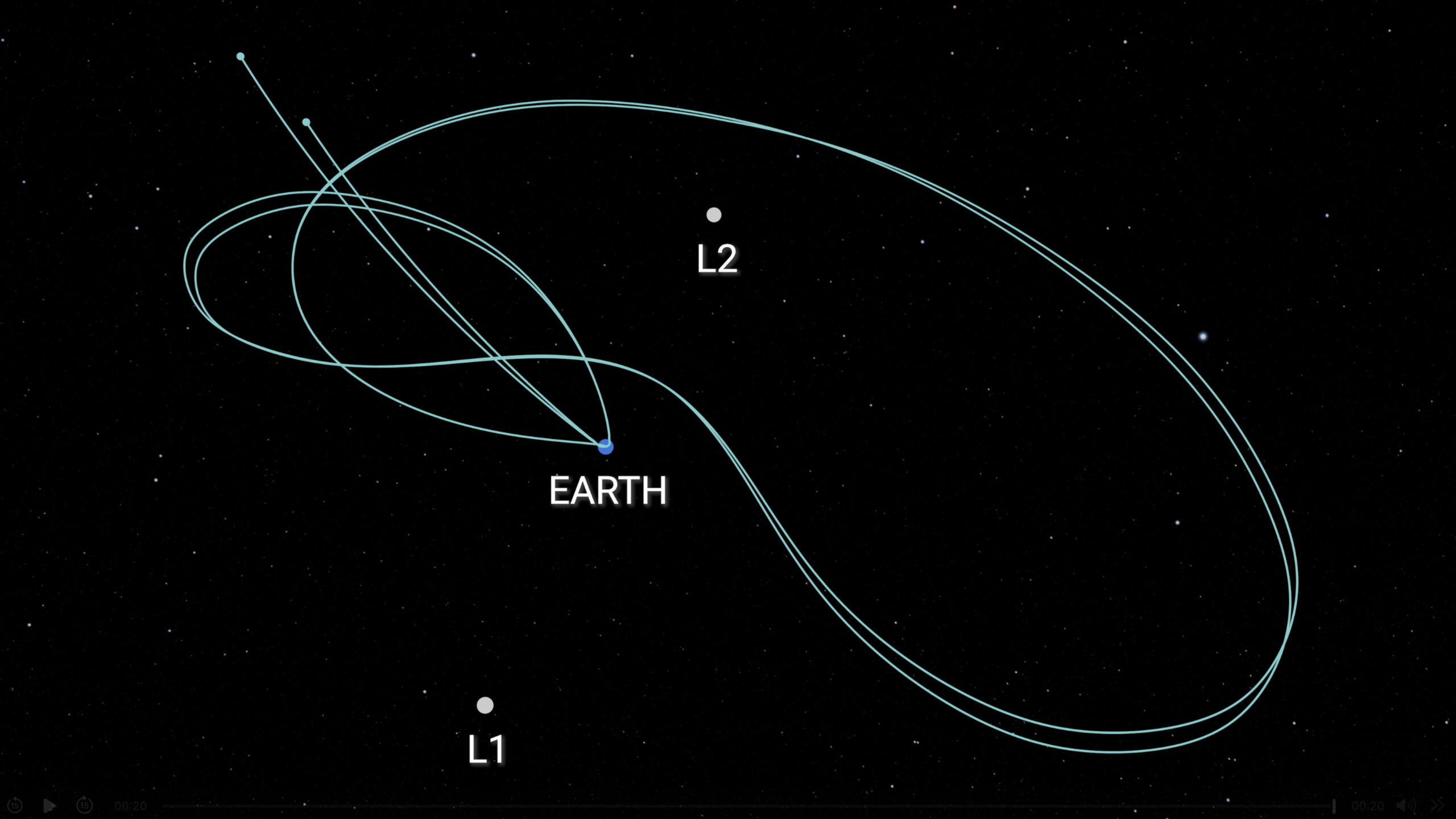
The route also created an unexpected scientific opportunity. As the twins traveled through the distant part of Earth’s magnetotail, they crossed a region that no spacecraft had directly measured before. The solar wind compresses Earth’s magnetic field on the sunward side and stretches it into a long tail on the night side. ESCAPADE’s instruments were built for plasma and magnetic-field measurements, so the detour became a chance to collect useful observations before the main Mars campaign even began.
What Earth contributes to the maneuver
A gravity assist is often described as a slingshot, but the spacecraft does not simply fall toward a planet and leave with free speed. From Earth’s point of view, an unpowered flyby can look nearly symmetrical: the spacecraft speeds up as it approaches, slows as it departs, and keeps roughly the same speed relative to Earth. The important change appears when the motion is measured relative to the Sun.
Earth is racing around the Sun at about 30 kilometers per second. During a flyby, the planet’s gravity turns the spacecraft’s velocity in a new direction. If the geometry is arranged correctly, the departing spacecraft receives some orbital energy from Earth’s motion and leaves the encounter moving faster around the Sun. Earth loses an immeasurably tiny amount of its own orbital energy in the exchange. The effect is real, but far too small to alter the planet in any practical sense.
The direction matters as much as the speed. A spacecraft bound for another planet must arrive at the right place, at the right time, and moving in a direction that the destination can capture. Earth’s gravity will curve each ESCAPADE spacecraft onto a Mars-bound path while its engine provides the additional change in velocity needed for trans-Mars injection. That is why mission teams calculate a narrow corridor rather than merely aiming for a close pass.
Why the engine burn happens near Earth
ESCAPADE’s maneuver is more than an ordinary gravity assist because each spacecraft will fire its engine close to Earth. NASA describes it as a powered flyby, also called an Oberth maneuver. The timing takes advantage of the Oberth effect: a fixed amount of propellant can produce a larger change in orbital energy when the engine burns while the spacecraft is already moving quickly.
A useful way to picture this is to separate speed from energy. The engine changes the spacecraft’s speed by a certain amount, but the resulting gain in kinetic energy depends on how fast the spacecraft was moving before the burn. Adding a little speed to a fast-moving object increases its energy more than adding the same amount of speed to a slow-moving one. Near Earth, gravity has already accelerated ESCAPADE, so the engine burn does more useful work than an identical burn performed far away at a lower speed.
According to NASA’s November 2 mission update, each nine-minute burn should raise the spacecraft’s speed by more than 1,000 miles per hour, from roughly 6.3 to 6.7 miles per second. The numbers alone can be misleading because the maneuver’s real purpose is not simply to make a speedometer rise. The burn and the gravitational turn must work together to place each spacecraft on an orbit around the Sun that intersects Mars at the planned arrival time.
This also explains why the sequence is demanding. A small navigation error before closest approach can change where the spacecraft passes Earth, which changes the direction and effectiveness of the flyby. A burn that starts late or points slightly off target can compound that difference. Tracking stations will measure the spacecraft’s radio signal before and after the encounter, and mission controllers can use later trajectory-correction maneuvers to trim the route. Those corrections are designed to refine a successful departure, not replace the main injection burn.
Two flybys, two chances to measure success
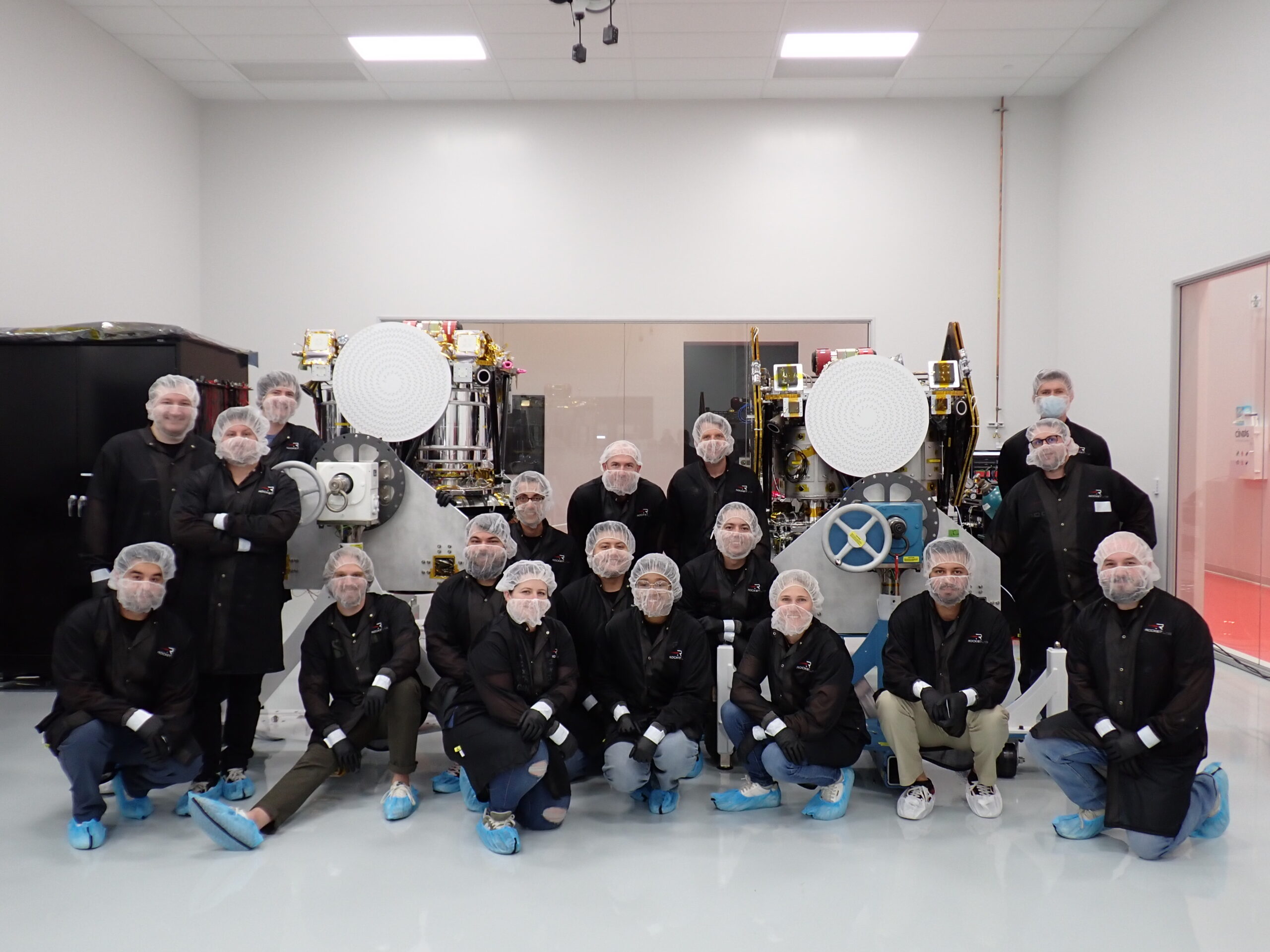
The first ESCAPADE spacecraft is scheduled to make its closest approach and complete its burn at about 5 a.m. Eastern time on November 7. The second will follow at about 6 a.m. Eastern time on November 9. Each refrigerator-size spacecraft will pass roughly 600 to 1,100 miles above Earth, with the engine burns occurring over southern Australia. The pair travels separately so controllers can track, command, and evaluate each vehicle on its own path.
Observers in parts of the western United States and Australia may be able to see the spacecraft through telescopes as faint points moving against the stars. They will be below the horizon from the United States at closest approach, so local visibility comes earlier in the night. NASA’s Scientific Visualization Studio has published location-specific star charts, while the Jet Propulsion Laboratory’s Horizons system can calculate coordinates for a particular observing site. These are not bright naked-eye objects, and clouds, moonlight, telescope size, and accurate pointing will all affect whether they can be detected.
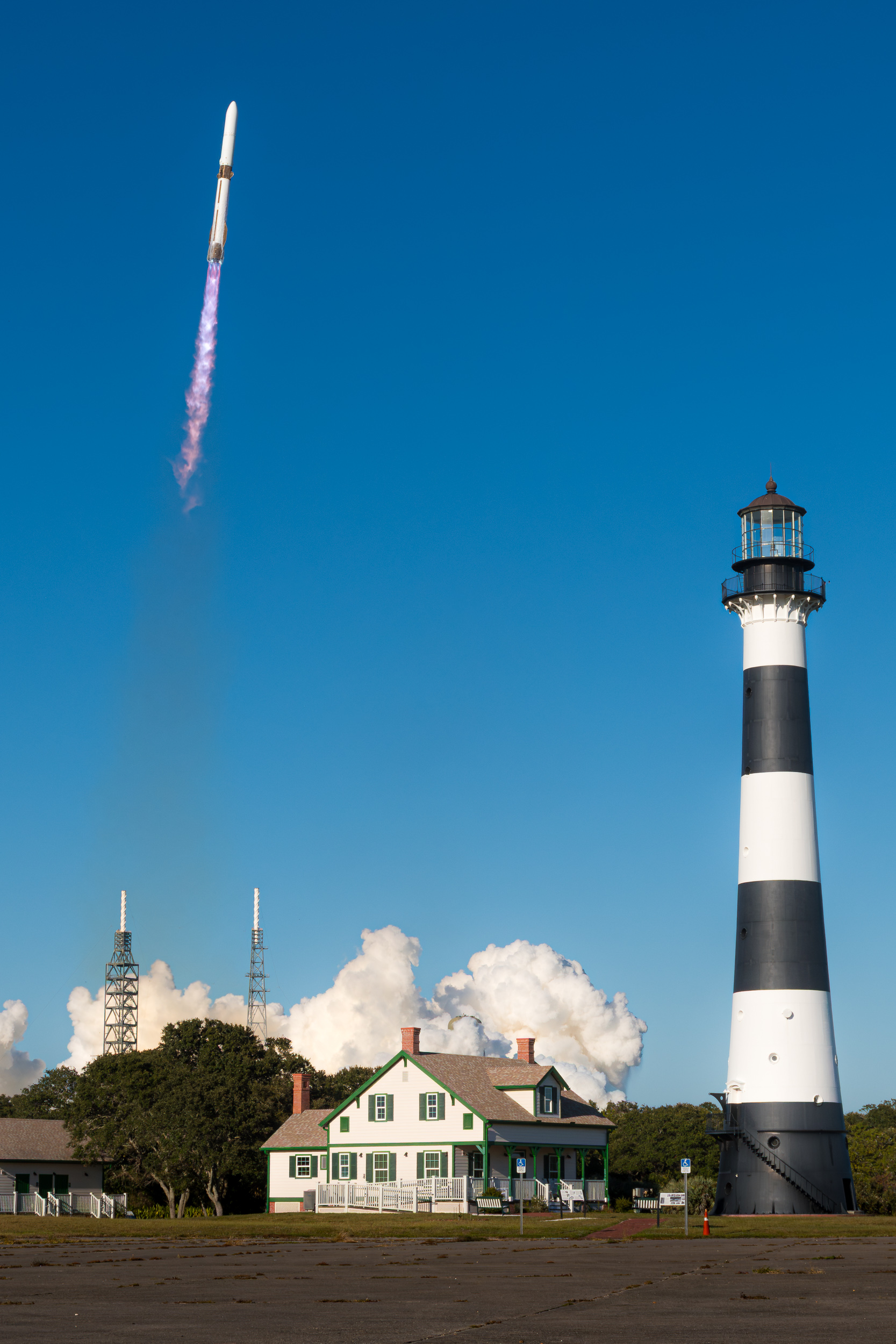
The encounter will not be declared perfect the instant a burn ends. Navigators need several days of Doppler and ranging measurements to reconstruct the new orbit and determine how closely it matches the intended path. The spacecraft will then spend about ten months cruising to Mars, with planned corrections along the way. Current schedules place their arrivals on September 7 and September 9, 2027.
Why send twins to Mars?
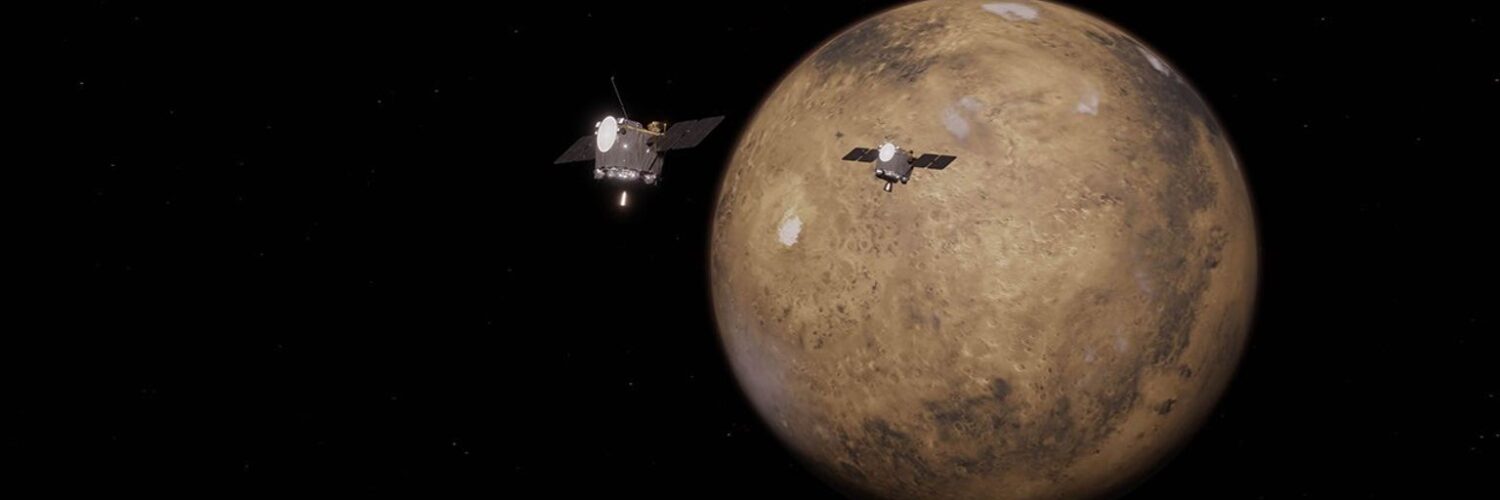
The unusual route is only the opening act. At Mars, ESCAPADE will become the first coordinated multi-spacecraft mission to orbit another planet. Mars lacks a strong global magnetic field like Earth’s. Instead, it has patches of magnetized crust and an induced magnetic field created as the solar wind interacts with its upper atmosphere. That hybrid environment changes rapidly, making it difficult for a single spacecraft to tell whether a measurement varies because conditions changed over time or because the spacecraft moved into a different region.
Two orbiters can separate those possibilities. During one campaign, the spacecraft will follow similar paths like a string of pearls, crossing the same regions minutes apart. If both measure the same structure in the same place, scientists can see how it evolved over that short interval. In a later campaign, one spacecraft will sample the incoming solar wind while the other observes Mars’ response closer to the planet. That arrangement can connect cause and effect across the system.
The measurements will help researchers study how energy and charged particles move through the Martian magnetosphere and how the solar wind carries atmospheric particles into space. That loss is part of the larger story of how ancient Mars changed from a wetter world with a thicker atmosphere into the cold, thin-aired planet seen today. The findings may also improve forecasts of the radiation and communication environment that future robotic and human missions will face.
ESCAPADE’s looping journey is therefore not wasted distance. The yearlong detour allowed a launch outside the usual Mars window, opened a new region of Earth’s magnetotail to observation, and set up a powered flyby that concentrates the work of gravity and propulsion into a few crucial minutes. If the November maneuvers succeed, the twins will leave Earth on nearly identical missions but with the independence needed to turn two points of view into a clearer picture of Mars.