
 Akshay Dinesh
Stand on a beach and the ocean can look like a moving surface of waves, tides, and foam. Beneath that surface is a far larger kind of motion: rivers of seawater that carry heat, salt, oxygen, nutrients, and even floating life across enormous distances. These currents help explain why some coasts feel milder than others, why marine ecosystems gather in certain places, and why changes in the ocean can affect weather and climate far from the water itself.
The ocean does not move heat evenly. Sunlight warms tropical water more strongly than polar water, and the planet’s rotation, winds, continents, temperature differences, and saltiness all help organize that heat into moving pathways. NOAA describes ocean currents as major heat-transfer systems, and the Gulf Stream is one of the clearest examples: it carries warm water from the tropical Atlantic along the eastern coast of North America and then toward Europe. NASA and ocean scientists also study deeper circulation, sometimes called thermohaline circulation, because the movement depends partly on heat and salt.
Currents Are the Ocean’s Heat Highways
The Sun heats Earth unevenly. Tropical regions receive more direct sunlight, while higher latitudes receive sunlight at a lower angle and lose more heat during long winters. If the ocean simply stayed still, the tropics would hold far more heat and polar regions would be even colder. Instead, water moves, and moving water carries energy with it.
A warm current is not just warmer water drifting by chance. It is a transport system. Water has a high heat capacity, which means it can absorb and store a lot of heat before its temperature changes dramatically. That makes the ocean one of Earth’s largest heat reservoirs. When currents carry warm water away from the tropics, they move stored energy into new regions. When that water releases heat into the air, it can influence nearby weather patterns and coastal climates.
The Gulf Stream shows this clearly. It begins as warm Atlantic water moving out of the tropics, strengthens along the edge of the North American continent, and then continues into the North Atlantic. This does not make climate simple; winds, landforms, latitude, and seasonal patterns all matter too. Still, a powerful warm current can shift the amount of heat available to the atmosphere above it. That is one reason the North Atlantic is so closely watched by climate scientists.
Wind Starts Many Surface Currents
Some currents are driven mainly by wind. Global wind belts push across the ocean surface, dragging water along through friction. Because Earth rotates, moving water does not travel exactly in the direction the wind blows. In the Northern Hemisphere, surface water tends to be deflected to the right; in the Southern Hemisphere, it tends to be deflected to the left. This effect, called the Coriolis effect, helps organize surface currents into large rotating systems called gyres.
Ocean gyres are found in the major ocean basins. The North Atlantic gyre, for example, includes the Gulf Stream on its western side and other currents that complete the broad circular pattern. These systems move heat, floating material, and marine organisms across ocean basins. They also help shape where nutrients are scarce or abundant, because surface circulation affects mixing and upwelling.
Wind-driven currents are especially visible near coasts. When winds push surface water away from shore, colder water from below can rise to replace it. This process, called upwelling, brings nutrients into sunlit surface waters, often supporting rich fisheries. The coasts of Peru, California, northwest Africa, and other regions are known for productive waters partly because upwelling delivers the raw ingredients that plankton need to grow.
Density Moves Water Below the Surface
Surface currents are only part of the story. Deep ocean circulation depends heavily on density, which is controlled by temperature and salinity. Cold water is generally denser than warm water. Saltier water is generally denser than fresher water. When seawater becomes cold and salty enough, it can sink, pulling water downward and helping drive a much slower global circulation pattern.
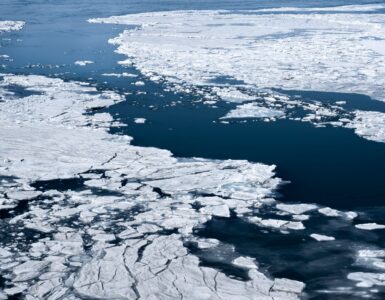
This is where the word thermohaline becomes useful. Thermo refers to heat, and haline refers to salt. In places such as the North Atlantic, warm water moving north can lose heat to the atmosphere. As sea ice forms, salt is left behind in surrounding seawater, making parts of the water saltier and denser. Dense water can sink into the deep ocean, while other water eventually moves to replace it.
This deep movement is much slower than a wind-whipped surface current. A parcel of deep water may take centuries to complete parts of the journey through the global ocean. But slow does not mean weak. Deep circulation helps distribute heat, carbon, oxygen, and nutrients through the ocean’s interior. It also connects distant regions that may look separate on a map but are linked through water movement over long timescales.
The Atlantic Overturning Circulation Gets Special Attention
One of the most watched circulation systems is the Atlantic Meridional Overturning Circulation, usually shortened to AMOC. NOAA describes it as a system of currents that moves warm water northward and cold water southward within the Atlantic. It includes surface flow, sinking in high-latitude regions, and deep return flow. The Gulf Stream is related to this broader system, although the two terms do not mean exactly the same thing.
AMOC matters because it helps move heat through the Atlantic basin. It influences the North Atlantic climate system, affects sea level along parts of the North American coast, and helps shape rainfall and temperature patterns beyond the ocean itself. Scientists do not study it because one current controls everything, but because it is one of the planet’s major heat-moving systems.
Recent scientific attention has focused on whether AMOC may weaken as the planet warms. Warmer air and melting ice can add heat and freshwater to the North Atlantic, and fresher water is less dense than saltier water. If high-latitude water becomes less able to sink, the overturning part of the circulation could slow. Research groups do not all agree on the exact timing or size of future changes, and direct observations cover only a limited slice of time. That uncertainty is part of why sustained ocean monitoring matters.
The most careful way to think about AMOC is neither panic nor dismissal. It is a major circulation system with real climate influence, and scientists have reasons to watch it closely. At the same time, the ocean is complicated, and different models can produce different projections. Good science here depends on measurements from satellites, floats, ships, moorings, and long-running ocean programs that can track change over decades.
Currents Shape Weather, Ecosystems, and Everyday Life
Ocean currents matter even when people never name them. A warm current can add moisture and heat to air passing over it, helping shape storm tracks and coastal humidity. A cold current can cool nearby air and contribute to fog, dry coastal deserts, or rich upwelling zones. Currents also affect where fish feed, where plankton blooms form, and how larvae or floating seaweed move from one habitat to another.
Currents can also move unwanted material. Plastic debris, oil, harmful algal bloom cells, and other pollutants can travel with water movement. That does not mean currents are the cause of pollution, but they influence where pollution spreads and where cleanup becomes harder. Understanding currents helps scientists forecast drifting debris, search-and-rescue areas, and the possible movement of contaminants after spills.
For students, ocean currents are a useful reminder that Earth systems are connected. A change in wind can affect surface water. A change in ice melt can affect salinity. A change in salinity can affect density. A change in density can influence deep circulation. None of these links works alone, but together they show why ocean science sits at the center of climate, weather, biology, geography, and human planning.
How Scientists Track a Moving Ocean
No single instrument can capture the whole ocean. Satellites measure sea surface height, temperature, ocean color, winds, and other clues from above. Drifting floats rise and sink through the water column, recording temperature and salinity. Research ships collect direct samples. Moorings stay in place and measure changes as water passes by. Together, these tools help scientists see patterns that would be invisible from the shoreline.
Sea surface height is especially useful because water does not pile up evenly. Differences in height can reveal pressure gradients and help scientists infer how water is moving. Temperature maps show warm and cold currents. Salinity measurements help identify water masses with different origins. When these observations are combined with models, researchers can estimate how heat moves through the ocean and how circulation may be changing.
The deeper lesson is that ocean currents are not just lines on a classroom map. They are moving parts of Earth’s heat engine. They connect the tropics with the poles, the surface with the deep sea, and local weather with global climate. Learning how they work makes the planet feel less like a set of separate topics and more like one physical system, constantly moving energy from one place to another.




Add comment