Akshay Dinesh
A rocket may look like one enormous machine on the launch pad, but most orbital launch vehicles are really several rockets stacked together. During flight, they deliberately break apart. The empty lower section falls away or returns toward Earth, while a smaller upper stage continues accelerating the payload.
That sequence is called staging, and its purpose is simple: a rocket should not spend the rest of its journey pushing tanks and engines that have finished their work. Releasing that dead weight lets the remaining engines produce a much larger change in speed. The idea sounds almost wasteful, but it is one of the main reasons practical orbital flight is possible.
Reaching orbit is mostly a speed problem
A rocket does have to climb above the thickest part of the atmosphere, but altitude is only part of the job. To stay in low Earth orbit, a spacecraft needs to travel sideways at roughly 7.8 kilometers per second, or about 28,000 kilometers per hour. At that speed, gravity still pulls it downward, yet Earth’s curved surface falls away beneath it at the same time. The spacecraft keeps falling around the planet instead of returning to the ground.
A launch vehicle must provide even more than that orbital speed. Some of its effort is lost while it fights gravity during the climb, and some is lost to atmospheric drag and steering. Engineers describe the total change in velocity a vehicle can deliver as delta-v. A typical mission to low Earth orbit needs roughly 9 to 10 kilometers per second of launch-vehicle delta-v once those losses are included.
No chemical rocket can reach that target simply by carrying a little more fuel. Fuel itself has mass, so every added kilogram must also be accelerated. Extra propellant may require a larger tank, and the larger tank adds structure that must be lifted too. The design quickly becomes a contest between useful propellant and the hardware needed to contain, pump, and burn it.
The rocket equation makes empty mass expensive
The relationship is captured by the Tsiolkovsky rocket equation: Δv = ve ln(m0/mf). Here, Δv is the possible change in velocity, ve is the effective exhaust velocity, m0 is the mass before a burn, and mf is the mass after the propellant has been used. The natural logarithm matters because it means performance does not rise in direct proportion to the amount of fuel added.
NASA’s Glenn Research Center explains the same constraint through mass ratio: the full rocket includes propellant, structure, and payload, while the empty rocket still carries its structure and payload. A larger ratio between full and empty mass produces more delta-v, but tanks cannot be weightless and engines cannot vanish after shutdown. In a single-stage vehicle, every empty tank, pipe, pump, engine, and support remains attached all the way to orbit.
Imagine a simplified rocket that begins at 100 tonnes and has an effective exhaust velocity of 3 kilometers per second. If it burns fuel until 20 tonnes remain, its ideal delta-v is about 4.8 kilometers per second because 3 × ln(100/20) is approximately 4.8. That is impressive, but still far short of what an Earth launch needs. Making the initial rocket dramatically heavier does not solve the problem neatly because the structure and engines in the final mass refuse to disappear.
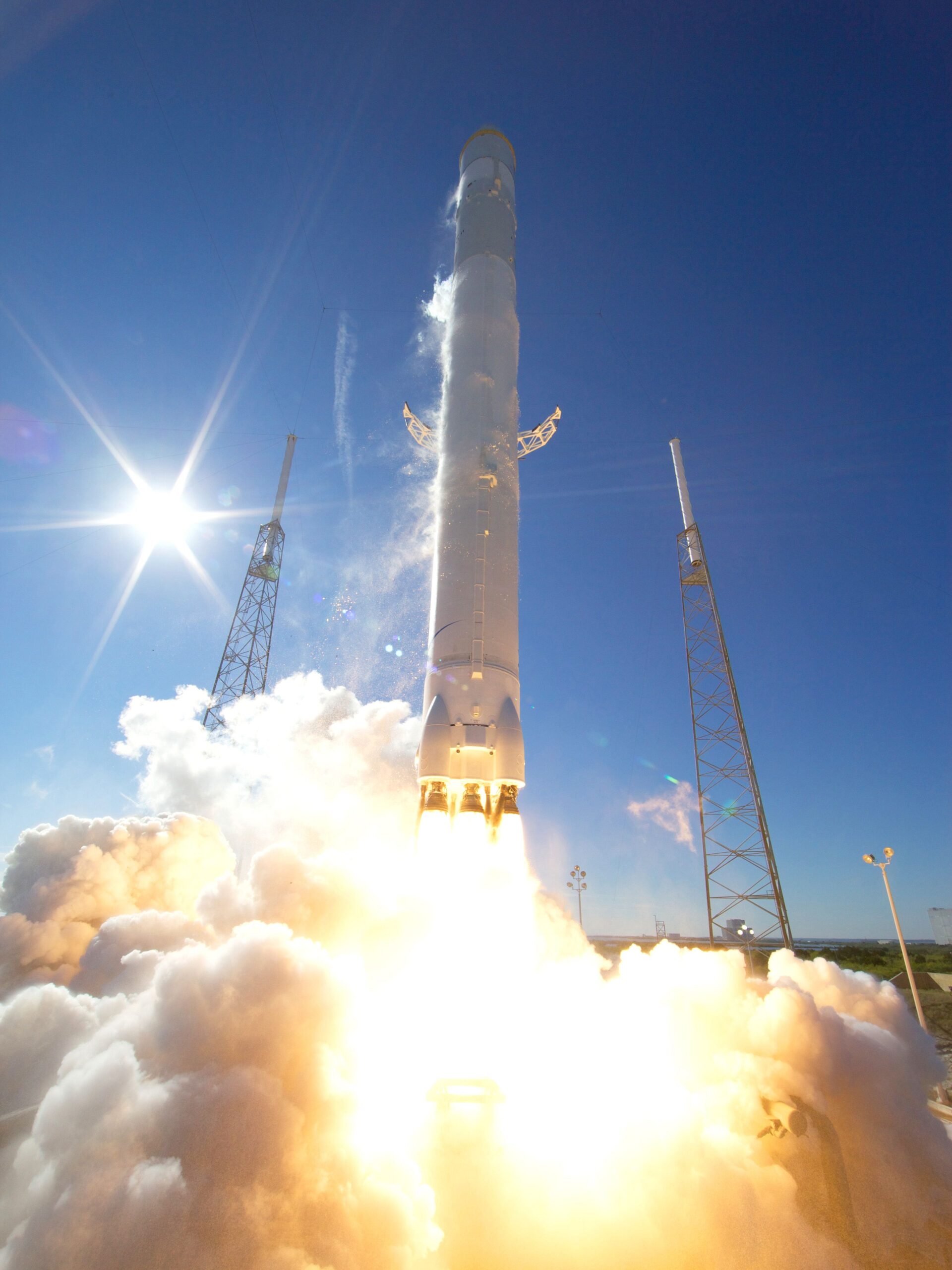
Staging throws away hardware at the moment it becomes a burden
A multistage rocket divides the propellant and machinery among two or more self-contained sections. The first stage is usually the largest because it must lift every upper stage and the payload from the pad. Once its propellant is nearly exhausted, clamps or separation mechanisms release it. The upper stage then ignites or continues its burn with far less mass to accelerate.
The discarded stage takes its empty tanks, engines, plumbing, and supporting structure with it. That changes the mass ratio available to the next stage. Instead of dragging the spent first stage to orbital speed, the upper stage spends its propellant accelerating only itself, the payload, and any stages still above it. Each stage contributes part of the mission’s total delta-v, and those contributions add together.
A rough two-stage example shows the advantage. Suppose the first stage accelerates a stacked vehicle, then drops 50 tonnes of empty hardware. The second stage no longer has to push those 50 tonnes during its own burn. Its starting mass may be much smaller, but the fraction of that mass devoted to useful propellant can be high. Applying the rocket equation separately to both burns can yield far more total delta-v than treating the same vehicle as one inseparable rocket.
This is also why an empty stage is not simply an empty fuel container. It includes expensive engines and complex equipment, but usefulness during the first minutes of flight does not guarantee usefulness later. When the stage can no longer provide thrust, keeping it attached imposes a performance penalty on everything above it.
What happens during a stage separation
Staging is quick, but it is not casual. The vehicle’s computers confirm that the lower-stage engines have shut down or reached the planned cutoff point. Separation devices then release the connection between stages. Small motors, springs, or carefully controlled motion create distance so the sections do not collide. Only when the geometry and timing are safe does the upper-stage engine begin or continue its work.
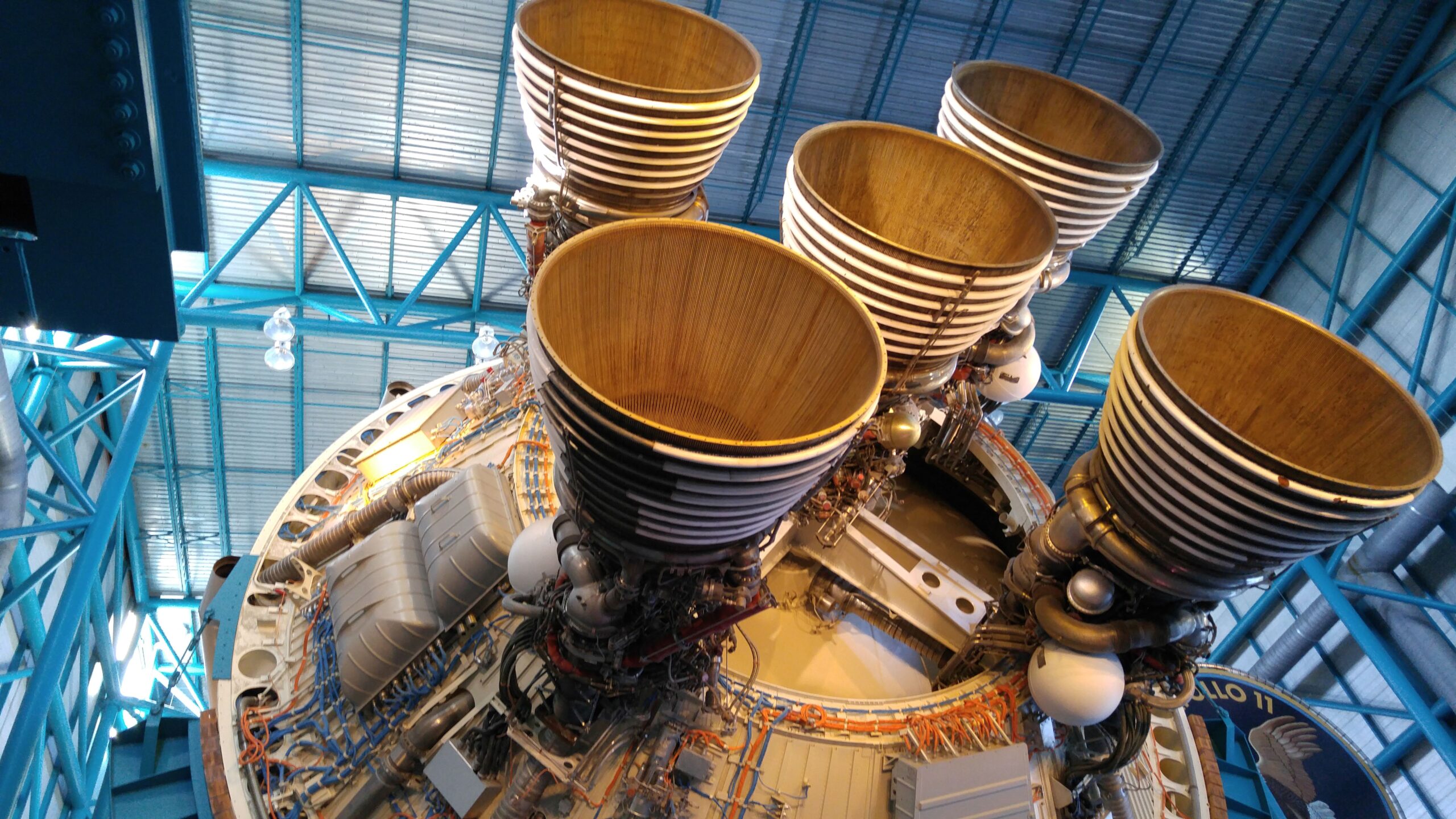
The first stage usually handles the thick lower atmosphere and the strongest gravitational load. Its engines are designed for high thrust, and its nozzles must work near sea-level pressure. An upper stage operates in thinner air or vacuum, where a larger nozzle can expand exhaust more efficiently. Its job is less about lifting from the pad and more about building horizontal speed with precision.
The flight path bends gradually rather than going straight up. NASA describes this pitch-over as part of the powered ascent: after clearing the dense atmosphere, the rocket increasingly accelerates sideways. By the time an upper stage approaches orbital insertion, most of the speed it is adding is parallel to Earth’s surface. Reaching space without enough sideways velocity would produce only a high arc followed by a fall.
Different missions arrange the sequence differently. Some vehicles use strap-on boosters beside a central core; others stack stages vertically. A mission to a high orbit or another world may use an additional upper stage to perform a later burn. The shared principle is that each section stays only as long as its propellant, engines, or guidance role justifies its mass.
Why rockets do not use an unlimited number of stages
If dropping mass helps, it may seem that a rocket should be divided into dozens of stages. In practice, every separation adds hardware, control logic, testing, and another moment when a failure could end the mission. Each stage needs tanks, engines, attachment structures, electrical connections, and often its own guidance or pressurization equipment. Very small stages can lose more mass to those duplicated systems than they save.
Engine choice creates another tradeoff. A first stage benefits from high thrust and must work in the atmosphere, while an upper stage can favor efficiency in vacuum. NASA uses specific impulse to compare how effectively rocket engines use propellant. Higher specific impulse helps, but even efficient chemical engines remain bound by the logarithmic rocket equation. Staging and engine efficiency solve different parts of the same mass problem.
Reusability changes where the discarded hardware goes, not the underlying physics. A reusable first stage still separates so the upper stage does not carry it to orbit. The booster then reserves propellant for reentry and landing, accepts the mass of landing hardware, and returns for another flight. Engineers trade some maximum payload performance for the possibility of recovering an expensive stage. A fully reusable single-stage-to-orbit vehicle would avoid separation, but it would need an extraordinarily light structure and demanding mass fraction while surviving launch, orbit, reentry, and landing as one machine.
Most launch systems therefore settle on two or three major powered stages or a core with detachable boosters. That range captures much of the mass advantage without multiplying complexity beyond reason. The exact architecture depends on payload, destination, engines, recovery plans, launch site, and cost.
Staging turns one impossible burden into several manageable jobs
The sight of a rocket shedding pieces can make spaceflight look improvised, as though parts are being lost along the way. The opposite is true. Each separation is planned around the point when a section’s remaining value becomes smaller than the cost of carrying its mass.
Rockets use multiple stages because orbit demands enormous speed and the rocket equation punishes dead weight. The first stage provides the brute force to leave the pad; upper stages continue with a lighter vehicle and engines suited to thinner air or vacuum. By dividing the journey, discarding spent structure, and adding each stage’s delta-v, engineers turn a nearly impossible single-machine problem into a sequence of achievable ones.