
 Akshay Dinesh
A road sign at night can look almost as if it has its own power source. A stop sign flares red. A curve warning sign jumps out of the dark. Lane markers and roadside posts seem to wake up the moment headlights touch them. The sign is not glowing like a bulb, and it is not simply acting like an ordinary mirror. Its brightness comes from a carefully engineered optical trick called retroreflection.
Retroreflection means that light is returned back toward the direction it came from. For a driver, that direction is roughly the same line between the car’s headlights, the sign, and the driver’s eyes. The sign takes some of the light the car sends out and sends a useful portion of it back toward the car, which is why the sign can appear vivid even when the surrounding roadside stays dark.
Ordinary Reflection Sends Light Somewhere Else
To see why retroreflection is special, start with a familiar mirror. When light hits a flat mirror, it follows the law of reflection: the incoming angle and outgoing angle match. If a flashlight beam strikes the mirror from the side, the reflected beam leaves on the other side. Unless the mirror is aimed just right, the light does not return to the person holding the flashlight.
Most everyday surfaces behave even less neatly. Asphalt, tree bark, fabric, and painted walls scatter light in many directions. That diffuse reflection is why you can see them from different viewpoints, but it also means only a small share of the headlight beam returns to the driver. At night, that small share may not be enough to make an object stand out quickly.
A traffic sign has a different job. It needs to send important information back to a moving driver at a useful distance, often in rain, glare, fog, or rural darkness. A surface that merely reflects light like a mirror would be unreliable because it would have to be aimed perfectly. A surface that scatters light like ordinary paint would waste too much of the beam. Retroreflective sheeting solves the problem by turning the sign face into a field of tiny optical structures.
Retroreflection Points Light Back Toward Its Source
The National Institute of Standards and Technology describes retroreflection as reflection that returns rays preferentially in directions close to the opposite of the incoming rays. That wording sounds technical, but the idea is simple: instead of throwing light off at a matching angle, a retroreflective surface sends much of it back toward the source.
Two common designs make this possible. One uses tiny glass beads. Light enters each bead, bends as it passes through the glass, reflects from the back side, and bends again as it exits. The bead acts a bit like a miniature lens-and-mirror system, guiding the beam back near its original path. Another design uses microscopic prisms shaped like tiny cube corners. Light bounces inside the prism faces and leaves traveling almost back where it came from.
Both designs explain why a sign can look bright to the driver whose headlights are hitting it, while someone standing far off to the side may not see the same strong glow. The sign is not sending light equally everywhere. It is returning light mainly toward the illumination source, which is exactly where the vehicle is.

The Sign Face Is Built Like Optical Machinery
A retroreflective road sign is usually made from layers. A rigid backing gives the sign its shape. A colored sign face carries the letters, symbols, and background colors. Over or within that face is reflective sheeting filled with beads or microprisms. To the eye in daylight, it may look like a smooth colored surface. Under magnification, the surface is doing much more work.
Color matters because drivers must recognize signs quickly. A stop sign needs to look red. A warning sign needs to look yellow. A guide sign often needs to read green, blue, or brown. Retroreflective sheeting has to preserve those colors while still returning enough light to make the sign readable. That balance is harder than it sounds, because a sign must be visible without becoming so glaring that it is uncomfortable or unreadable.
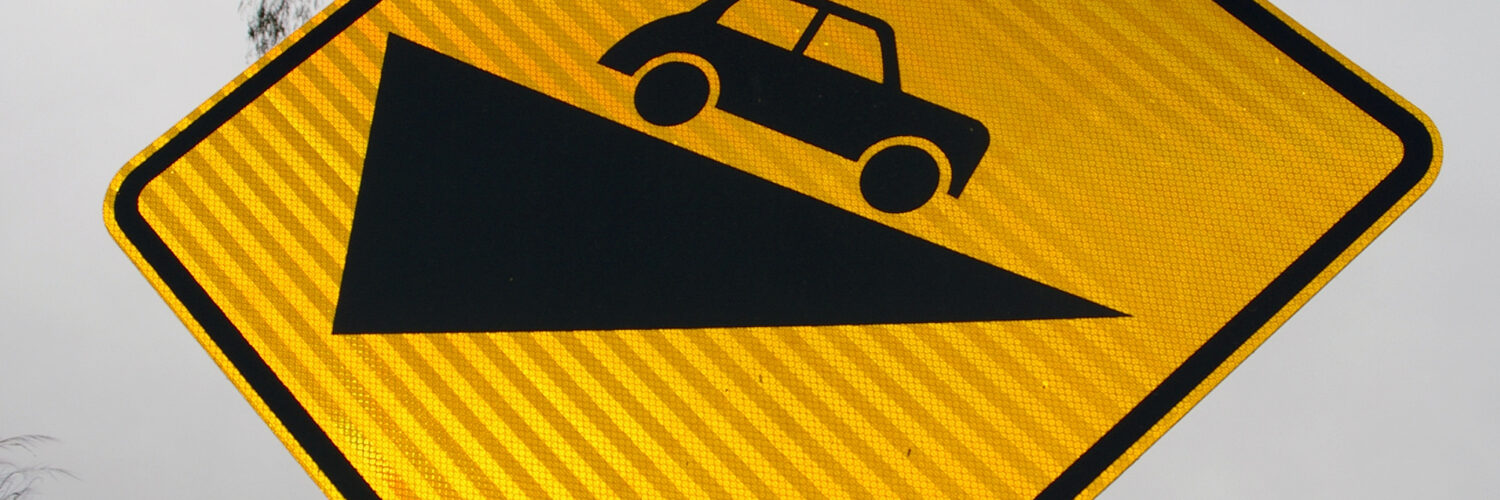
Lettering matters too. Black symbols on yellow warning signs often work because the yellow background returns light while the dark symbol does not. The contrast makes the shape readable. On a stop sign, both the red background and white letters have visibility requirements because the driver must recognize the sign shape, color, and word quickly. Retroreflection is not only about brightness; it is about usable contrast.
Why Headlights Make the Effect So Strong
Headlights are positioned close to the driver’s line of sight, especially compared with the distance to a sign down the road. That geometry is what makes retroreflection useful. The light leaves the car, hits the sign, and returns along a path close enough that much of it reaches the driver’s eyes. If the light source were far away from the driver, the returned beam would be less useful.
This is also why the effect changes with distance and angle. A sign far ahead may glow well because the headlight beam, sign, and driver are aligned in a narrow viewing geometry. As the car gets very close, the angles can change quickly. Large trucks, low cars, motorcycles, curves, hills, and wet windshields all change the exact geometry. Good sign design has to work across many of those real-world conditions, not only in a perfect diagram.
Rain and age make the problem harder. Water, dirt, sun exposure, abrasion, and fading can reduce how much light a sign returns. A sign may still look acceptable in daylight while performing poorly at night. That is one reason road agencies inspect and replace signs according to visibility standards rather than waiting until a sign looks completely worn out.
Road Agencies Measure Visibility, Not Just Appearance
The Federal Highway Administration connects sign retroreflectivity to nighttime safety and requires agencies to maintain traffic signs at or above minimum levels in the Manual on Uniform Traffic Control Devices. Those standards do not mean every sign must use the same material. Instead, agencies use approved assessment or management methods so signs remain readable at night.
The measurement is about how efficiently a sign returns light toward the observer under defined conditions. Engineers use instruments and field methods to judge whether signs are still bright enough for drivers. They also consider sign type, background color, lettering, location, speed, and expected driver needs. A small neighborhood sign and a high-speed highway warning sign do not place the same demand on a driver.
Nighttime visibility becomes especially important because driving at night reduces contrast and reaction time. A driver may have only a few seconds to read a curve warning, lane instruction, exit sign, or stop sign. Retroreflectivity cannot remove every hazard, but it gives important information a better chance of reaching the driver early enough to matter.
A Small Optical Trick With a Big Everyday Role
Road signs glow in headlights because they are designed to cooperate with the car’s own light. Ordinary paint would scatter too much light. A plain mirror would reflect light in the wrong direction unless it were perfectly aimed. Retroreflective materials use beads or prisms to send a strong share of the beam back toward the vehicle, making signs readable in darkness.
Once you notice the effect, it shows up everywhere: lane markers, bicycle reflectors, safety vests, traffic cones, license plates, and roadside posts. Each uses the same basic idea. Light goes out, meets a surface built to guide it, and returns toward the source. On a dark road, that quiet bit of optics can turn a patch of darkness into a clear instruction at just the right moment.






Add comment