 Akshay Dinesh
A phone screen that suddenly turns black through sunglasses can feel like a broken display, but the screen is usually fine. The strange effect comes from the same physics that makes polarized sunglasses useful on a bright road, snowy sidewalk, or lake. They do not simply make the whole world dimmer. They are built to block light that is vibrating in a particular direction, and some screens send out light that already has a preferred direction.
That makes polarized sunglasses a small, everyday demonstration of how light behaves as a wave. Brightness matters, color matters, and direction matters too. When the direction of light from a screen lines up poorly with the direction allowed through the lenses, much of the screen light is blocked before it reaches your eyes. Rotate the phone, tilt your head, or turn the glasses, and the display may brighten again.
Light Can Have a Direction
Light travels as an electromagnetic wave. In ordinary sunlight, the waves vibrate in many directions at once. That kind of light is called unpolarized because there is no single preferred vibration direction. A polarizing filter changes that by letting through mostly one orientation of light while absorbing or blocking much of the rest.
A simple way to picture the idea is to imagine a fence with long narrow openings. A wave moving in the same direction as the openings can pass through more easily. A wave moving across the openings is blocked. Real light is not a rope moving through a fence, but the analogy helps explain why turning a polarizing filter changes what gets through.
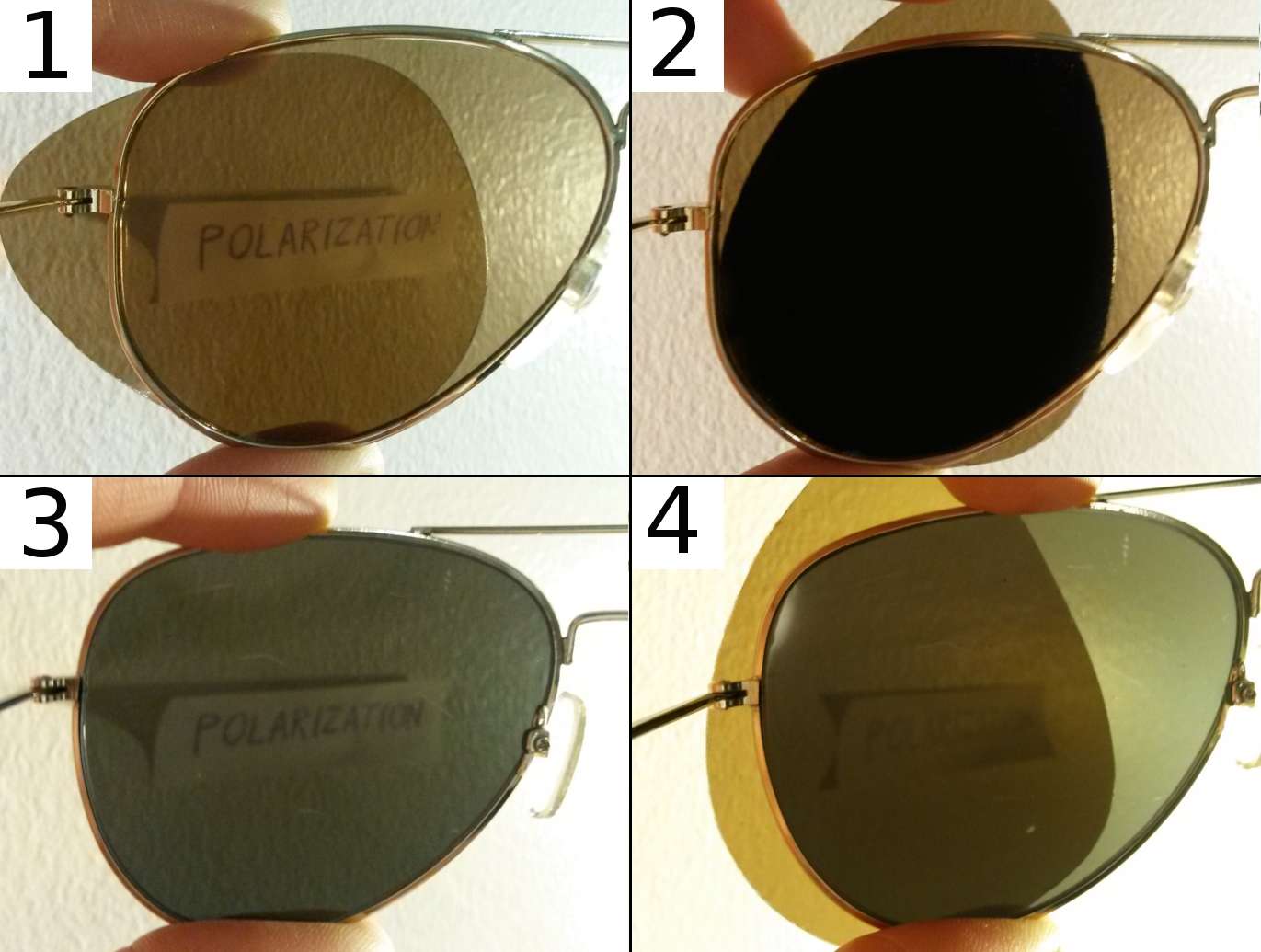
Two polarizing filters make the effect even clearer. If their allowed directions are lined up, light that passes through the first filter can also pass through the second. If one filter is turned 90 degrees, the light that survived the first filter is now aimed the wrong way for the second. The view can become very dark because the filters are crossed.
Why Reflected Glare Is So Annoying
Polarized sunglasses are especially good at reducing glare from flat, nonmetallic surfaces such as water, wet pavement, glass, snow, and car hoods. When sunlight reflects from those surfaces, part of the reflected light becomes organized in a direction mostly parallel to the surface. That direction-heavy reflected light is often what feels harsh or blinding.
The lenses in polarized sunglasses are usually arranged to reduce much of that horizontally polarized glare. The result is not just a darker view. Reflections can soften, contrast can improve, and objects behind the glare may become easier to see. A driver may see the road surface more comfortably, and someone near water may see past some of the shine on the surface.
That benefit comes with a tradeoff. The sunglasses are not deciding whether light is useful or annoying. They are filtering by direction. If helpful light happens to be polarized in a direction the lenses block, that helpful light is reduced too. Screens are one of the most common places where this tradeoff shows up.
Why LCD Screens Are Different From Paper
A printed page reflects light from many directions and does not usually send a neatly polarized beam toward your eyes. Many LCD screens are different. An LCD does not make its picture simply by shining colored light straight through open holes. It uses a backlight, liquid crystals, color filters, and polarizing layers to control how much light each pixel lets through.
The polarizers are not an extra detail. They are central to how many liquid-crystal displays work. A backlight shines through a polarizing layer. Liquid-crystal molecules respond to electrical signals and change how the light is turned or blocked. Another polarizing layer helps turn those controlled changes into dark and bright pixels. By changing the light that reaches red, green, and blue subpixels, the screen builds the image you see.
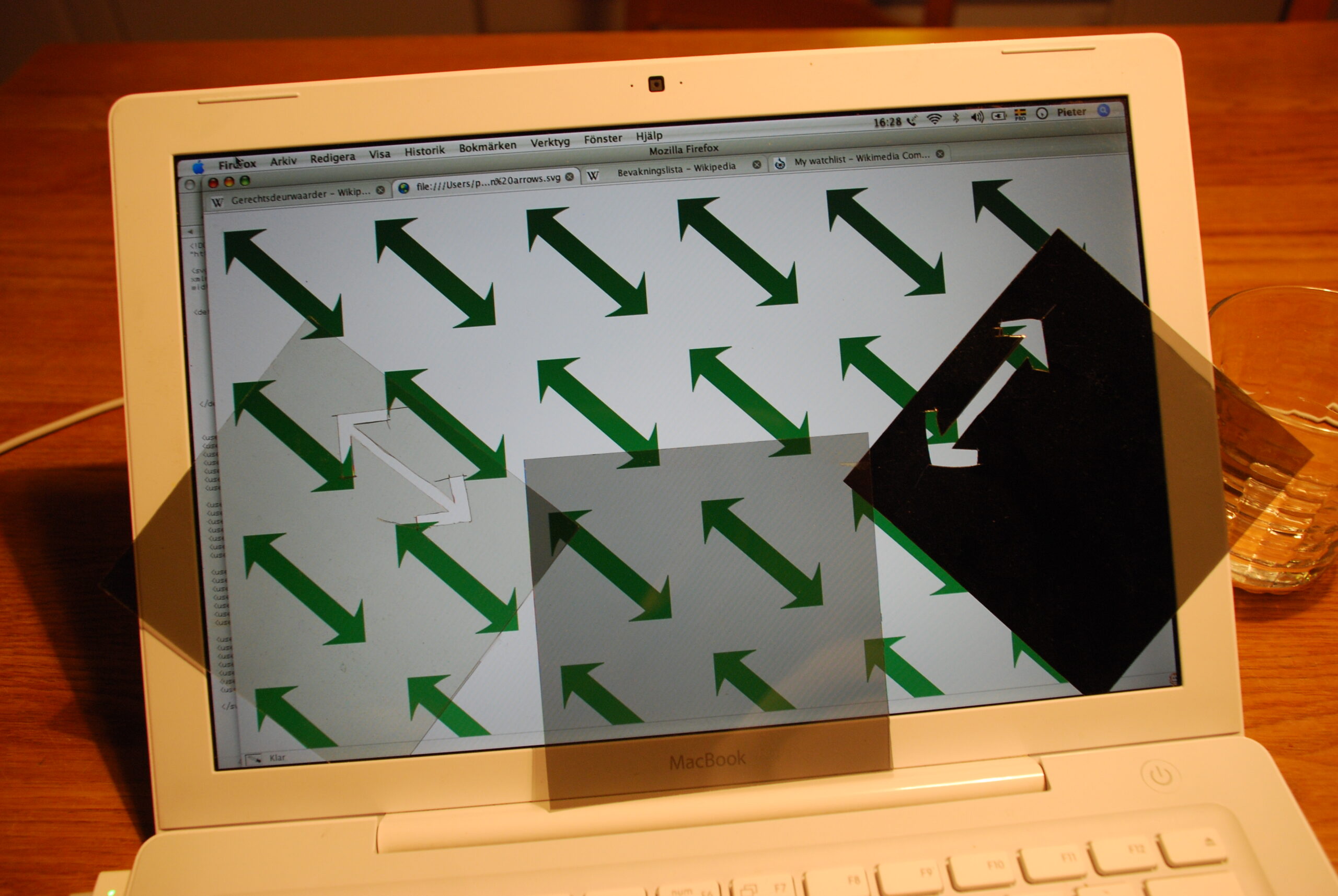
Because of that design, the light leaving many LCD screens is already polarized. When polarized sunglasses meet that screen light, the glasses act like a second polarizer. If the screen’s light direction mostly matches the direction the sunglasses allow, the display looks normal enough. If the directions are close to crossed, the screen can look dim, patchy, rainbow-tinted, or almost black.
Why Rotation Changes Everything
The most useful clue is rotation. If a phone or car display looks too dark through polarized sunglasses, turn the device slightly. The screen may brighten as its polarization direction moves closer to the direction allowed by the lenses. Turn it farther, and the display may darken again. The same thing can happen if you tilt your head because the sunglasses rotate with you.
This is why some screens are readable in portrait orientation but frustrating in landscape, or the other way around. It is also why one pair of polarized sunglasses may behave differently from another pair. Manufacturers can choose different orientations for screen polarizers, and sunglasses makers can vary lens designs. A dashboard display, gas-pump screen, phone, tablet, camera viewfinder, and laptop may not all line up the same way.
Physics describes the dimming with a relationship called Malus’s law: the transmitted brightness depends on the angle between the light’s polarization direction and the filter’s allowed direction. The key idea is simple even without the formula. Small angle changes may only dim the screen a little, while a near-90-degree mismatch can make the screen fade dramatically.
Not Every Screen Behaves the Same Way
The effect is common, but it is not identical on every display. Many older calculators, watches, car displays, laptops, and monitors use LCD technology, so they often show strong polarization effects. Some phone screens are OLED rather than LCD, and OLED pixels emit their own light instead of relying on a liquid-crystal shutter and backlight. Even then, phones may include other optical layers that can interact with polarized sunglasses, so the result still depends on the device.
Screen protectors and privacy filters can add another layer of complexity. A privacy filter is designed to limit viewing angles, which already changes how light leaves the screen. A polarized lens can make that limitation feel stronger. Anti-glare coatings, curved glass, and plastic stress patterns may also create odd colors or dark patches when viewed through polarized lenses.
None of this means polarized sunglasses are bad. It means they are specialized. They are excellent when glare is the problem, especially outdoors near reflective surfaces. They are less convenient when the thing you need to read is itself controlled by polarization. Pilots, photographers, boaters, drivers, and people who rely on instrument displays often pay attention to this tradeoff when choosing eyewear.
A Quick Way to Test the Effect
You can test the idea with a pair of polarized sunglasses and a phone or laptop screen. Hold the glasses in front of the screen and slowly rotate them. If the lenses are polarized and the screen light is polarized, the display should brighten and darken as the angle changes. The darkest position shows where the lens filter and screen light are most nearly crossed.
You can also test two pairs of sunglasses. Look through both lenses at once, then rotate one pair. If both are polarized, the view should become much darker at one angle and brighter again as the filters line up. If the brightness changes only slightly, one of the lenses may be tinted but not strongly polarized.
The everyday takeaway is simple: polarized sunglasses reduce glare by filtering light direction, and screens often depend on light direction too. When those two designs meet at the wrong angle, the screen has not failed. The light is just being blocked before it reaches your eyes. A small rotation is often enough to bring the picture back.