
 Akshay Dinesh
A lightning rod can look almost too simple for the job it is asked to do: a metal point on a roof, a few cables, and a connection to the ground. That plain appearance is part of why lightning rods are often misunderstood. They do not make storms safer, cancel a strike, or create an invisible shield around a building. They work because lightning is electrical current, and current is far less destructive when it is given a continuous, well-connected path that does not pass through wood, brick, wiring, plumbing, or people.
The National Weather Service describes a lightning rod as only one part of a larger protection system. The rod intercepts a strike, but the real protection comes from the complete route: metal strike points, heavy conductors, bonding between metal parts, grounding electrodes, and surge protection for lines that enter the structure. When those pieces are designed and connected properly, a building has a much better chance of surviving a direct strike without fire, explosive damage, or dangerous side flashes.
Why lightning looks for a path
Lightning begins when charge separation inside a thunderstorm grows strong enough to break through the insulating air. NOAA’s National Severe Storms Laboratory explains that the most common cloud-to-ground flash starts with a faint, branching channel of charge called a stepped leader. It moves downward in quick segments, usually too fast and dim for the eye to see. As it nears the ground, objects below can send upward streamers of opposite charge from trees, poles, buildings, and other raised points.
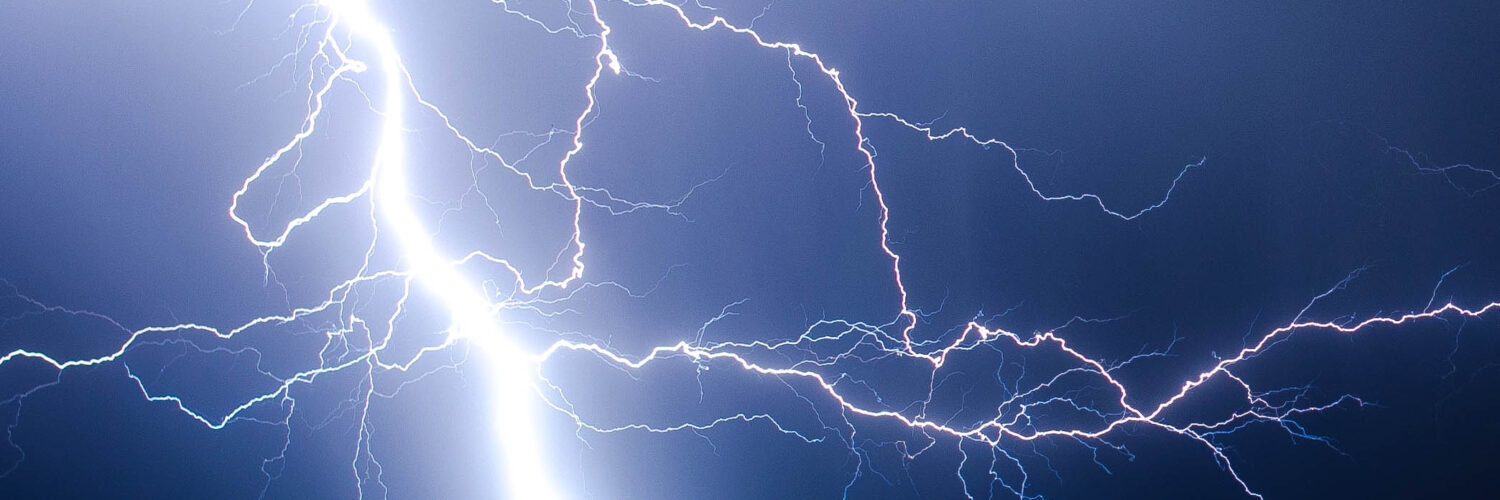
When one of those streamers connects with the descending leader, the bright return stroke races along the channel. That return stroke is the flash people see. The lightning channel may be only a few centimeters wide, but the current is intense enough to heat air suddenly, produce thunder, melt metal, split wood, shatter masonry, and start fires. The strike is brief, but it is not gentle.
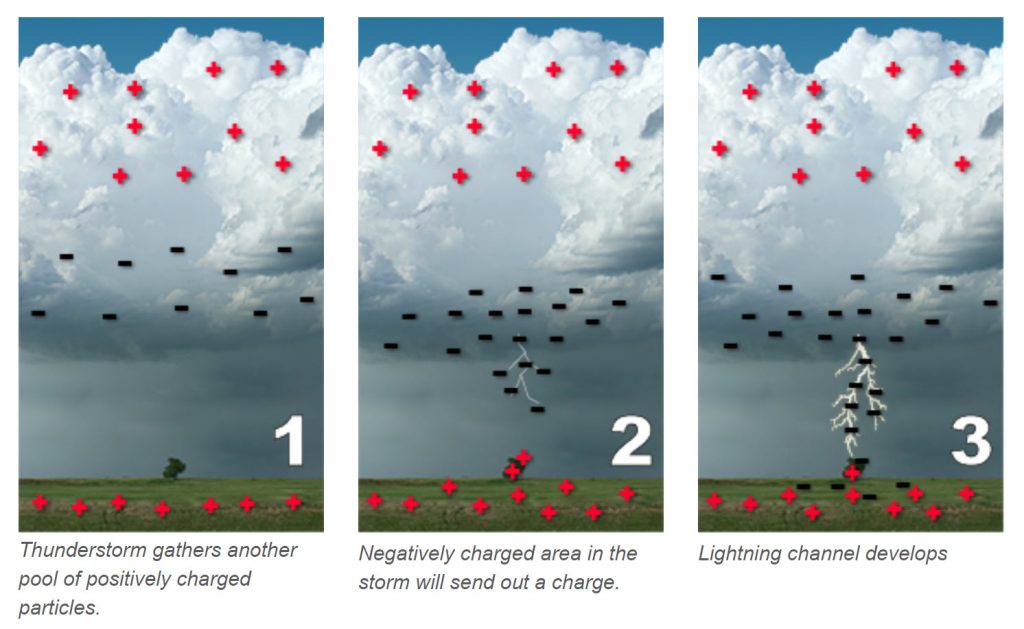
This is the first key to understanding lightning protection: the rod is not a magnet that pulls lightning from a storm cloud like a hook. A strike forms because of the electrical conditions around the storm and the ground. A lightning protection system changes what happens if the building becomes part of that path. Instead of letting the current tear through whatever material it finds, the system offers metal components meant to carry the current outside and down.
The rod is only the starting point
The visible rod on the roof is often called an air terminal or strike termination device. Its job is to be a likely connection point if lightning reaches the building. Because it is metal and placed at exposed high points, it can become the place where the upward streamer forms and the strike attaches. But the rod alone would be a poor protector if it were not connected to the rest of the system.
From the rod, thick copper or aluminum conductors carry current downward. These are not ordinary household wires. They are chosen and routed so they can handle a lightning impulse and stay connected during a violent electrical event. If current jumps away from the conductor because a nearby metal object is not bonded to the system, the result can be a side flash. That jump may cross through air, wall material, pipes, framing, or wiring, creating heat and damage in places the system was supposed to protect.
Bonding reduces that risk by connecting metal parts so they rise and fall in voltage together during the strike. Roof metal, gutters, metal vents, structural steel, nearby pipes, and other conductive parts may need to be tied into the system depending on the building. This is why lightning protection is more than attaching a pointed rod to the highest spot. A well-installed system is a network, not a decoration.
Grounding lets the current spread out
After the current moves down the conductors, it still has to go somewhere. Grounding electrodes give it a way to enter the earth and spread out. The word ground can make this sound as if the current simply disappears. It does not. The current disperses through soil and buried conductors, and the quality of that connection matters.
Dry rocky soil, shallow electrodes, broken conductors, or poor connections can make the route less effective. A lightning strike is not patient; if one path is difficult, the current can divide among many available paths. It may travel through plumbing, utility lines, damp masonry, or anything else conductive enough in the moment. That is why standards such as NFPA 780 treat grounding, bonding, and surge protection as parts of one coordinated system.
A useful comparison is rainwater drainage. A roof gutter does not stop rain from falling, and it does not remove the storm. It catches water at a vulnerable surface and carries it along a planned route. If the gutter is broken, blocked, or not connected to a downspout, water goes where it can. Lightning protection works with current rather than water, but the idea of a planned path is similar.
Surges can enter through wires and pipes
A direct strike is not the only problem. Lightning can also create dangerous surges in electrical, communication, and data lines. A strike near a building can induce voltage in wiring, and a strike to a utility line can send a surge toward connected equipment. The National Weather Service notes that a complete lightning protection system includes surge protection for incoming power, data, and communication lines, along with protection for vulnerable appliances.
This matters because many modern buildings contain sensitive electronics: routers, computers, security systems, smart thermostats, medical devices, and control boards inside appliances. A roof-mounted rod may help with a direct strike to the structure, but it does not automatically protect every device plugged into the wall. Surge protective devices work at a different part of the problem by limiting sudden voltage spikes on lines that enter the building.
Plumbing and gas piping also deserve attention. Metal pipes can conduct current or become part of a side-flash path if they are not properly bonded. In older buildings, additions and repairs may leave a mix of materials and connections that do not behave the way a simple diagram suggests. The safest systems are designed with the whole structure in mind, including the pathways people usually forget because they are hidden inside walls or underground.
What lightning rods can and cannot promise
A lightning protection system reduces certain risks; it does not make a building invincible. It cannot stop lightning from occurring, guarantee that every strike will attach exactly where expected, or make it safe to stand outside during a thunderstorm. NOAA safety guidance is blunt on that point: if thunder is close enough to hear, lightning is close enough to be dangerous. A protected building is a safer place to be, but the outdoor threat remains.
It is also easy to confuse building protection with personal protection. A metal-roofed shelter, picnic pavilion, dugout, or small open structure may have metal components and still be unsafe because it does not provide the same enclosed, wired, grounded protection as a substantial building. The safest shelter during lightning is a large enclosed structure with electrical wiring or plumbing, or a fully enclosed metal-topped vehicle. A lone pole, tree, fence, umbrella, or open shelter should not be treated as protection.
For buildings, installation quality matters. The National Weather Service points readers toward national safety standards and requirements from groups such as the National Fire Protection Association, Underwriters Laboratories, and the Lightning Protection Institute. That recommendation is practical, not bureaucratic. Lightning moves too quickly and carries too much energy for improvised systems, loose connections, or undersized materials to be trustworthy.
The real lesson is controlled damage
Lightning rods are sometimes described as attracting lightning, but that wording hides the more useful idea. A protection system does not invite storms; it prepares for a strike that may happen anyway. It accepts that a building can become part of an electrical path and then tries to make that path predictable, conductive, bonded, and grounded.
That is a powerful engineering idea. Many safety systems do not erase danger. Seat belts do not prevent crashes, levees do not prevent storms, and circuit breakers do not prevent every electrical fault. They reduce harm by controlling what happens when energy arrives in the wrong place. Lightning rods belong to that same family of protective design.
The small metal point on a roof is only the visible clue. Behind it is a lesson about electricity: current follows connected paths, jumps across gaps when voltage is high enough, and becomes less destructive when a system gives it somewhere safer to go. A lightning rod protects a building not by defeating lightning, but by respecting how lightning behaves.





Add comment