
 Akshay Dinesh
A rocket engine usually brings to mind burning fuel, expanding gas, and a violent burst of thrust. A Hall-effect thruster works in a quieter way. It uses electricity and magnetic fields to strip electrons from a gas, accelerate the resulting ions, and send them out of a spacecraft at tremendous speed. The push is far too gentle to lift anything from Earth, but in the vacuum of space it can continue for months or years.
That combination of weak thrust and long endurance makes Hall thrusters valuable for keeping satellites in position, avoiding debris, raising orbits, and crossing interplanetary distances. In November 2026, NASA opened the Advanced Mid-Power Electric Rocket, or AMPERE, Challenge to encourage new thrusters in the 3-to-7-kilowatt range. The competition is timely, but the physics behind it answers a broader question: how can an engine that barely pushes at any one moment reshape an entire space journey?
A rocket without combustion
Every rocket moves by throwing mass in the opposite direction, as described by Newton’s third law. A chemical rocket releases energy stored in fuel and oxidizer, producing hot gases that rush through a nozzle. A Hall thruster still carries propellant, but it does not burn that propellant. Instead, electricity turns a neutral gas into plasma and drives charged particles out of the engine.
Xenon is a common choice because it is chemically inert, dense, and comparatively easy to ionize. Krypton and argon can also be used. The electrical power usually comes from solar arrays, although a nuclear power source could supply it on missions where sunlight is weak. The engine’s job is to convert that electrical energy into the directed motion of ions.
The distinction matters. Chemical propulsion can deliver the enormous thrust needed for launch, landing, or a rapid change in velocity. Electric propulsion trades that immediate force for much greater propellant efficiency. Hall thrusters therefore begin working after another rocket has already placed the spacecraft in space.
Inside the annular channel
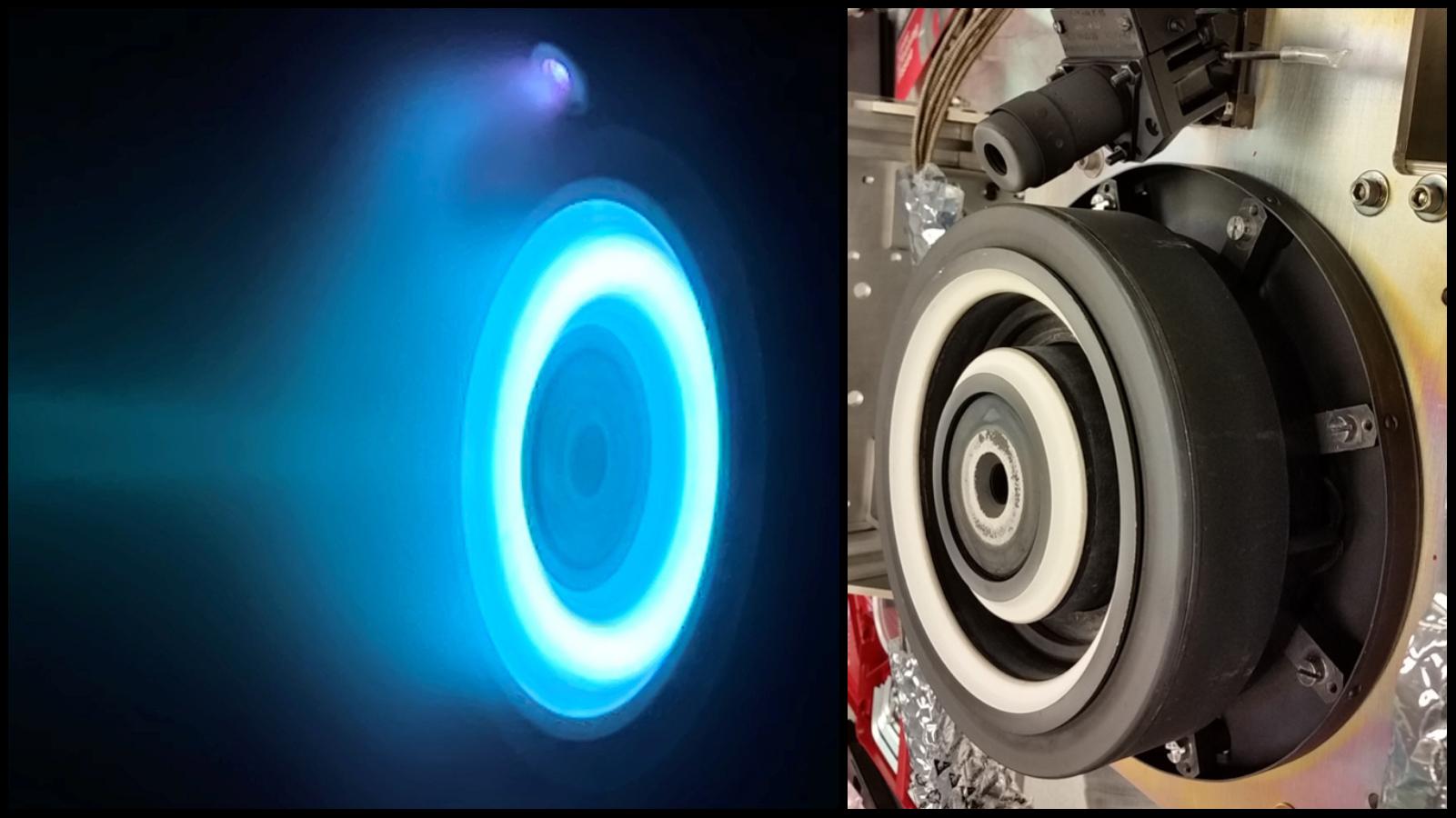
The working chamber of a Hall thruster is usually shaped like a ring. Neutral xenon flows into the back of this annular channel through an anode, while a hollow cathode near the exit supplies electrons. An electric field points roughly along the channel toward the exhaust, and a magnetic field crosses it near the opening.
Those crossed fields affect electrons and xenon ions differently. Electrons are light enough for the magnetic field to bend their paths strongly. Instead of flying directly to the anode, many circle around the channel in an azimuthal current. This circulating electron motion is the Hall current that gives the engine its name. As electrons collide with xenon atoms, they knock electrons away and leave positively charged xenon ions behind.
The much heavier ions are only weakly diverted by the magnetic field. The electric field accelerates them out of the channel, forming a fast ion beam and producing thrust. Some electrons from the cathode then join the outgoing beam so the exhaust is electrically neutral. Without that neutralization, the spacecraft would build up charge and could pull ions back toward itself.
The familiar blue glow is light emitted by excited xenon in the plasma. It makes the process visible, but the glow is not the source of the force. Momentum carried away by the ion beam is what pushes the spacecraft forward.
Why a tiny push can win
A Hall thruster’s force may be measured in millinewtons rather than the millions of newtons produced by a launch vehicle. NASA’s Psyche spacecraft provides a useful scale. Its solar electric propulsion system can deliver roughly 250 millinewtons, comparable to the weight of a small battery resting on a hand. That would be unimpressive for a few seconds. Applied for most of a multiyear cruise, it steadily changes the spacecraft’s velocity.
Propulsion engineers compare engines partly through specific impulse, a measure of how effectively an engine uses propellant. Hall thrusters expel ions much faster than chemical rockets expel combustion gases, so each kilogram of propellant can create more total change in velocity. The spacecraft does not suddenly leap ahead. Its speed accumulates gradually, like interest building on a balance.
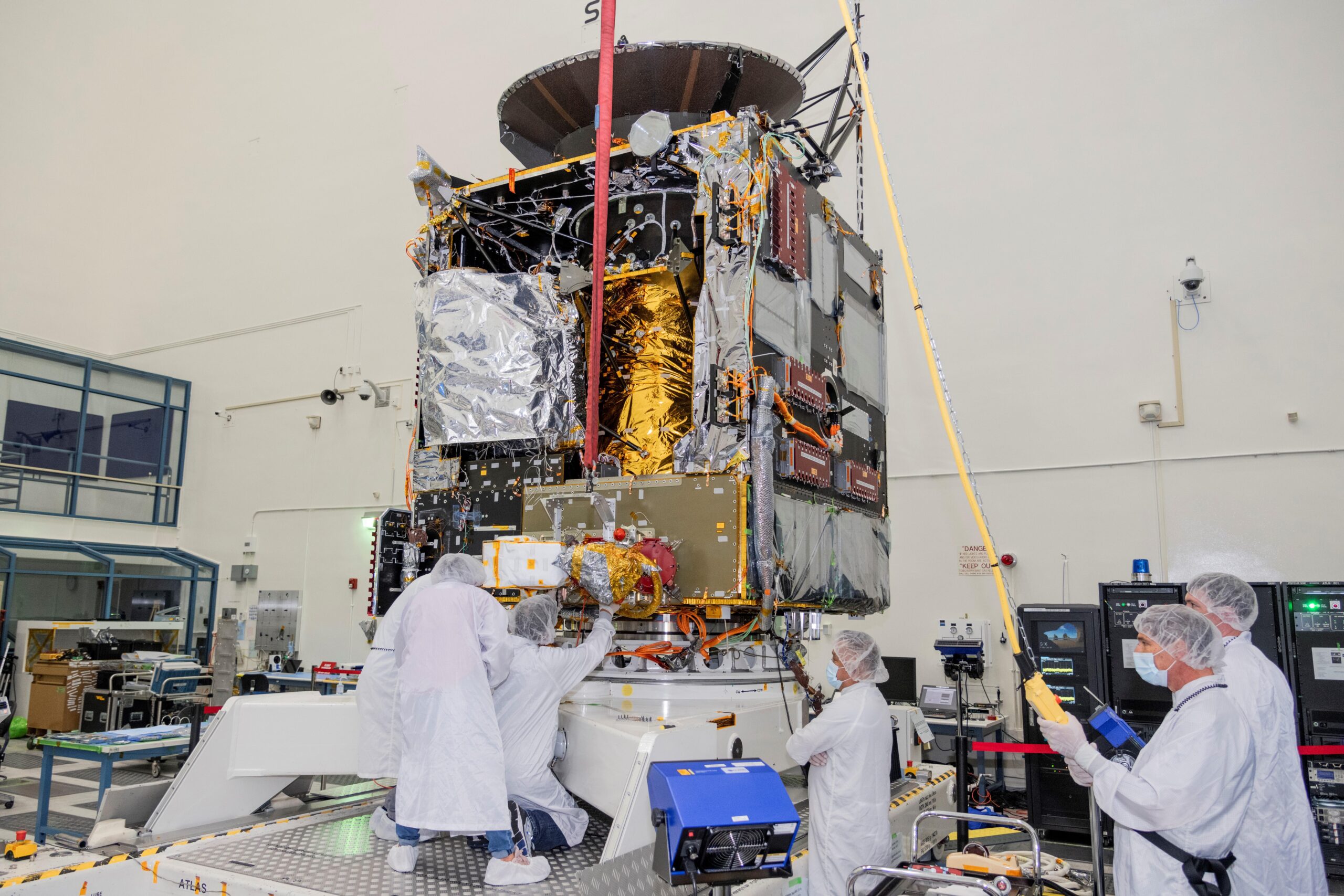
Psyche launched with nearly 1,090 kilograms of xenon in seven tanks. After a Mars gravity assist, the mission began running its propulsion system almost continuously in September 2026, pausing mainly for communications and engineering work. As the spacecraft travels farther from the Sun and its solar arrays receive less light, operators reduce the thruster’s power. The engine and the trajectory must be planned together.
Continuous thrust also affects pointing. The swirling ion flow can create a slight torque, so Psyche uses reaction wheels and carefully timed low-power maneuvers to manage the accumulated twist. Electric propulsion saves propellant, but it does not make navigation simple.
The engineering behind the blue glow
The basic sequence of ionization and acceleration sounds clean on paper. A flight engine must repeat it reliably for thousands of hours while exposed to hot plasma. Energetic particles can erode the ceramic discharge channel and nearby magnetic components. NASA Glenn has developed magnetic-shielding arrangements that steer the most damaging plasma away from channel walls, extending operating life without changing the underlying principle.
The cathode presents its own challenge. It must emit electrons reliably, while parts of a Hall-thruster system can reach very high temperatures. Engineers also watch how the exhaust plume interacts with solar arrays, antennas, sensors, and spacecraft surfaces. Ions leaving at wide angles may erode or contaminate hardware far from the engine’s centerline.
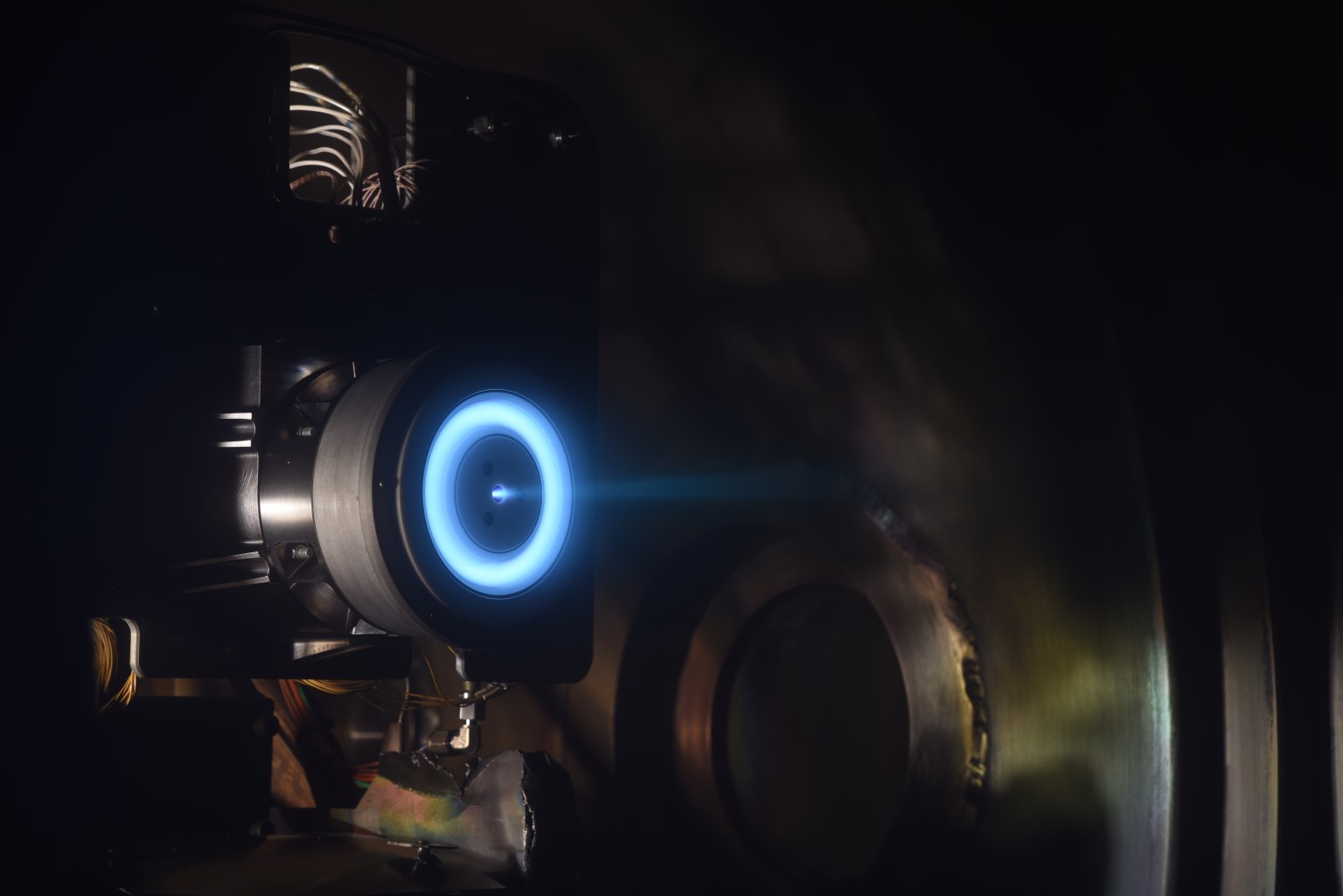
Ground testing has to reproduce space closely enough for those risks to be measured. Large chambers are pumped down to very low pressure, and diagnostic probes map the density and energy of the plasma plume. Thrust stands measure forces so small that ordinary vibration can matter. Tests may run for thousands of hours to reveal slow erosion, temperature changes, or electrical instability.
Even an excellent vacuum chamber is not identical to orbit. Residual gas, chamber walls, pumping speed, and measuring equipment can alter the plume. Engineers therefore combine test data with plasma models and flight observations. Psyche is especially useful because its long operation allows JPL to compare behavior in space with predictions made on the ground.
Why NASA is targeting the middle
Hall thrusters span a wide range of power. Sub-kilowatt systems can give small spacecraft more freedom to change orbit, while NASA’s 12-kilowatt-class Advanced Electric Propulsion System was developed for larger deep-space work. The new AMPERE Challenge focuses on 3 to 7 kilowatts, a middle range suited to many commercial satellites, government missions, and exploration spacecraft.
Power level is not merely a label for engine size. A higher-power thruster can usually process more propellant and produce more thrust, but it demands larger electrical hardware, more heat rejection, and enough solar-array output throughout the mission. Farther from the Sun, the same array produces less power. Designers must balance trip time, spacecraft mass, available electricity, engine lifetime, and cost.
NASA’s challenge offers a total of $500,000 and access to agency testing, with the aim of moving commercial prototypes toward demonstrated systems. The deeper goal is a dependable domestic supply of engines in a class that mission planners increasingly need. A successful design must do more than glow impressively in a chamber: it must start repeatedly, throttle predictably, survive long operation, and fit into a complete spacecraft.
Hall-effect thrusters do not replace the thunderous engines that leave a launchpad. They take over where patience matters more than brute force. By pushing a very small amount for a very long time, they turn electrical power into journeys that would demand far more propellant by other means. The blue plume is striking, but the real achievement is the accumulated motion that cannot be seen in a single moment.