

 Akshay Dinesh
Catch a snowflake on a dark sleeve and you may see a tiny star, a slender needle, or an untidy cluster that melts before you can make out its shape. The familiar six-armed star is real, but it is only one form snow can take. Its geometry begins with the way water molecules arrange themselves in ice; its delicate details record the changing conditions the crystal encountered in a cloud.
That combination explains a lovely puzzle. Many snow crystals share a six-sided framework, yet their branches can look strikingly different. Temperature and the available water vapor help determine how a crystal grows, while collisions and melting can change it on the way down.
From a tiny ice particle to a snow crystal
Snow begins in clouds cold enough for ice to form. A microscopic droplet can freeze around a suitable particle, providing a starting point for a crystal. Clouds can contain liquid water below the ordinary freezing point; such droplets are called supercooled. Once ice is present, water vapor can join its surface directly, building the solid without first becoming a liquid drop.
The growing ice develops flat surfaces, or facets, and often takes the form of a small hexagonal prism. Imagine a six-sided pencil cut very short: it has two broad end faces and six side faces. Depending on how quickly those different faces grow, the prism may become a plate, a column, or something more elaborate.
A snow crystal is one individual crystal of ice. A snowflake can be a single crystal, but the term also includes several crystals stuck together. The large, fluffy flakes falling near freezing are often aggregates, not giant copies of a single crystal. That distinction helps explain why many flakes look nothing like the designs cut out of folded paper.
Why six sides appear
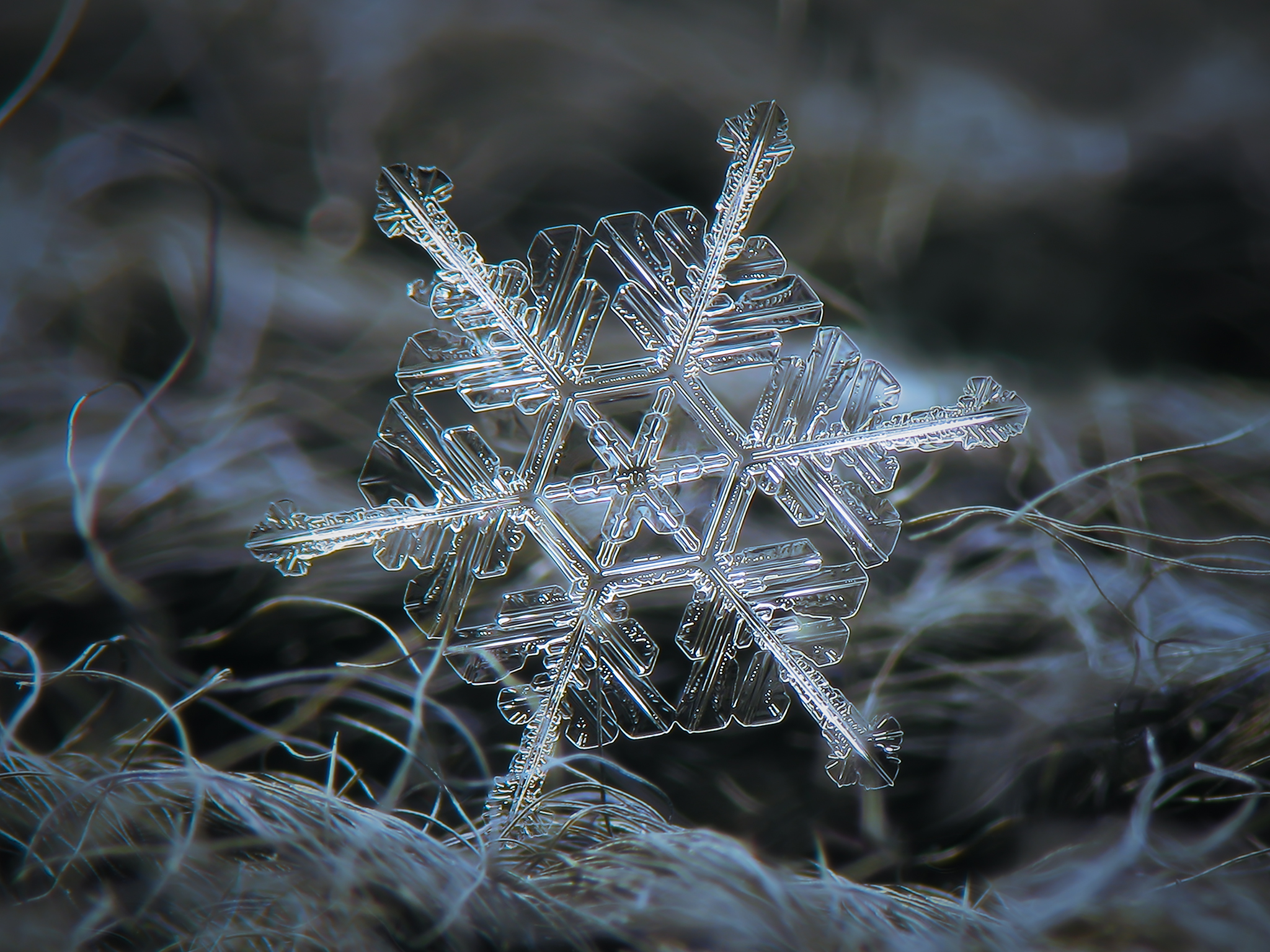
In ordinary atmospheric ice, water molecules fit into an orderly crystal lattice with hexagonal symmetry. The connections between neighboring molecules constrain the arrangement; the molecule is not itself a little hexagon. As many molecules join the growing surface, that microscopic order can show up in the crystal’s larger, six-sided shape.
Facets are the bridge between those scales. Kenneth Libbrecht, a Caltech physicist who studies snow crystals, explains that the way molecules attach locally produces the flat faces of a hexagonal prism. When a growing plate develops branches at its six corners, those branches inherit the sixfold arrangement. The crystal does not need a central controller to tell each arm where to grow.
Sixfold symmetry does not mean every piece of falling snow has six visible points. A column viewed from the side looks more like a rod; a broken crystal may have missing arms; several crystals can stick together at different angles. Even an intact star may be uneven. What is shared is the underlying crystal structure, not a promise of a picture-perfect silhouette.
Why temperature changes the shape
A crystal’s form depends on its surroundings, especially temperature and the amount of water vapor available for growth. Under some conditions the broad faces grow in a way that produces thin plates; under others, growth favors long columns or needles. More available vapor can encourage branching, while a relatively limited supply tends to produce simpler shapes. These are tendencies, not a reliable thermometer for a single flake: the crystal may have traveled through several different layers of air.
For a concrete example, Libbrecht’s laboratory work describes large, thin, branching plate-like crystals growing around −15°C (5°F) in humid conditions. At other temperatures, columns can be favored. The pattern is not simply “colder means more branches.” In experiments, the preferred shape can switch as temperature changes because the rates at which molecules join different crystal surfaces also change.
A crystal may begin in one kind of cloud environment and then enter another. Its later growth builds on what is already there: a column can acquire plate-like ends, for example. The finished shape is therefore a partial history of a journey, not a snapshot of the temperature at the ground.
Are any two snowflakes alike?
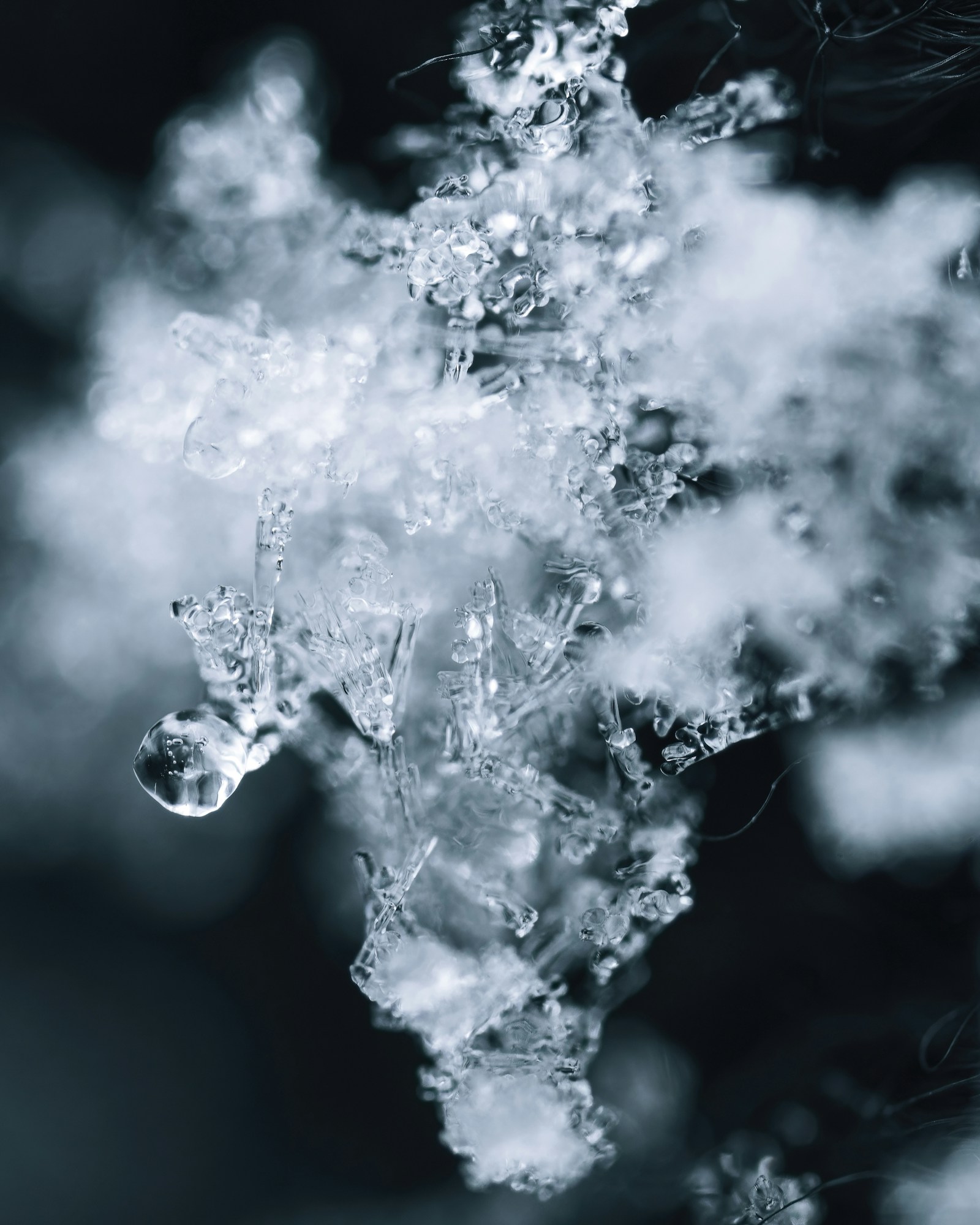
The saying that no two snowflakes are alike is a useful picture of how much variation is possible, but it is not a proven inventory of every crystal that has ever fallen. Small, simple crystals can look alike under a microscope, especially when they grow in similar conditions. Deciding whether two are “the same” also depends on the level of detail: a resemblance in outline is not the same as an identical arrangement of every molecule.
Complex stars offer many more opportunities for differences. As a crystal moves through a cloud, it experiences changes in temperature and moisture; small variations influence where side branches develop. Another crystal follows its own path and encounters a different sequence. Even two branches on the same crystal grow independently, so their resemblance is approximate.
Why do the arms often resemble one another at all? They are close together and travel through nearly the same air at nearly the same time. When conditions change, all the arms respond, though not perfectly in step. Libbrecht notes that highly symmetrical specimens are unusual: the most beautiful photographs tend to be selected precisely because they stand out.
What happens before the snow reaches you
Growth from vapor is only part of the story. A falling crystal may collide with supercooled droplets that freeze onto it, a process called riming. Light riming adds small frozen bumps; extensive riming can obscure the original shape and produce a soft pellet called graupel. Crystals can also collide and stick together, particularly when conditions favor aggregation, creating the larger flakes people notice during a snowfall.
To look for individual crystals, try catching fresh snow on a dark, chilled piece of fabric or card and examining it promptly with a magnifying glass. The cold surface buys a little time before melting. Some flakes will be broken or clumped, and that is part of the observation: a storm delivers a mixture of shapes and histories, not a box of identical stars.
The six-sided pattern is a reminder that molecular order can become visible to the eye. The irregularities are just as informative. Together they show how a simple arrangement of water molecules responds to the complicated, changing air through which snow falls.
Sources: Kenneth Libbrecht, Snow Crystal FAQs, Caltech; Caltech, “Snowflake Science”; NOAA NESDIS, “How Do Snowflakes Form?”; American Meteorological Society, snow crystal shapes.




Add comment