 Akshay Dinesh
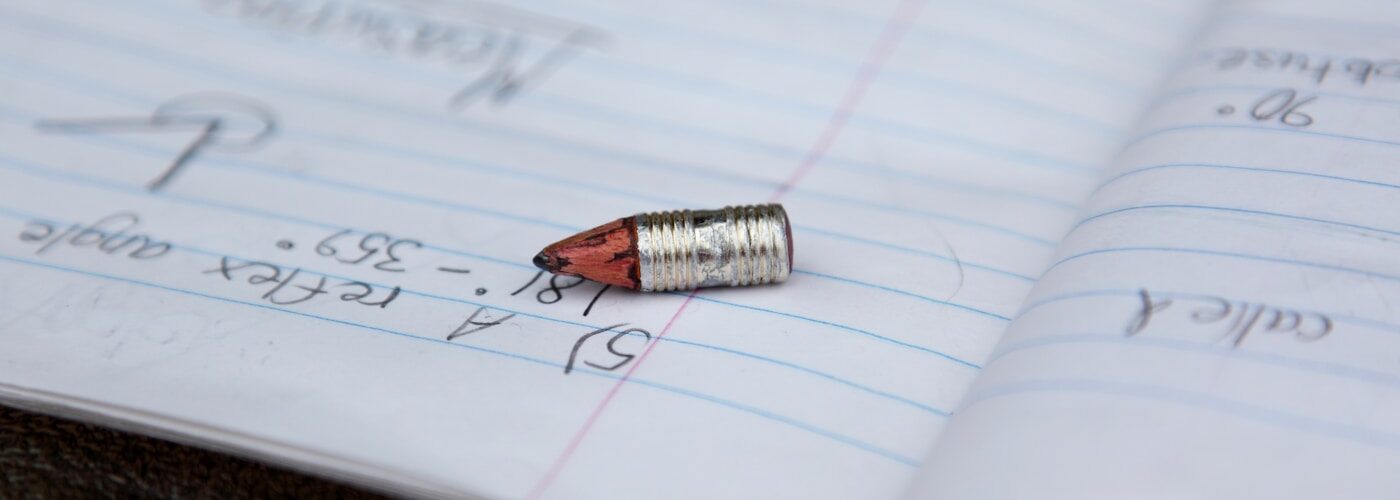
A pencil mark looks simple because it appears so easily: press a sharpened point to paper, move your hand, and a line appears. Yet that line is not ink soaking into a page. It is a thin trail of graphite, clay, and tiny broken particles clinging to the rough surface of paper. That difference is why a pencil can feel permanent enough for schoolwork but temporary enough to revise.
The reversibility of pencil writing depends on several materials working together. Graphite must be soft enough to rub off the pencil core, paper must have enough texture to catch the particles, and an eraser must be sticky or grippy enough to pull many of those particles away again. The whole process is a quiet materials-science lesson hiding inside a school supply box.
The Pencil Core Is Not Lead
The dark center of a modern pencil is often called lead, but it is not made of metallic lead. The material is mostly graphite mixed with clay and, depending on the pencil, small amounts of wax or other binders. The American Chemical Society has described pencil cores as a graphite-clay mixture, which is a useful correction because the chemistry matters: graphite is a form of carbon, not a toxic heavy metal.
Graphite has a layered structure. Within each layer, carbon atoms hold together strongly, but the layers can slide past one another more easily. That slippery quality is why graphite has been used in lubricants as well as pencils. When a pencil moves across paper, tiny flakes from those layers shear off and settle onto the page.
The clay in the core changes how the pencil behaves. More clay generally makes a harder pencil that leaves a lighter mark. More graphite makes a softer pencil that leaves a darker mark and wears down faster. That is why a 4B pencil feels rich and smudgy while a 2H pencil feels pale and firm. The familiar No. 2 pencil sits near the middle because it is dark enough to read but firm enough for everyday writing and test forms.

Paper Gives the Graphite Somewhere to Hold
A page may look smooth from a normal reading distance, but under magnification it is a landscape of cellulose fibers, tiny gaps, and uneven ridges. Pencil writing depends on that texture. As the point drags across the sheet, friction breaks loose microscopic bits of graphite and clay. The particles lodge among the raised fibers and rough spots, creating the visible line.
This is why pencils behave differently on different surfaces. On ordinary notebook paper, the mark appears quickly because the paper has enough tooth to grab graphite. On glossy paper, the point may slide more and leave a weaker mark because the surface gives particles fewer places to settle. On very rough paper, a pencil can look darker and grainier because the surface catches more material and wears down the point faster.
Pressure matters too. A light pencil stroke leaves fewer particles near the top of the paper texture, so it usually erases more cleanly. A heavy stroke pushes graphite deeper into the fibers and may also press a groove into the sheet. Even if an eraser removes much of the graphite, the dent can remain, which is why erased writing sometimes leaves a faint ghost of the original line.
Erasers Remove Marks by Grabbing, Not Undoing
An eraser does not make graphite disappear. It removes graphite from one surface and carries it away on another. Traditional rubber erasers, modern synthetic rubber erasers, and vinyl erasers all work by rubbing against the page with enough friction to loosen graphite particles from the paper. As the eraser moves, its material grips the graphite more strongly than the paper does, so many particles transfer into the eraser crumbs.
Those crumbs are not just mess. They are part of the cleaning system. As the eraser wears, fresh surface is exposed, and the dirty outer layer rolls away carrying graphite with it. A good eraser sheds just enough material to keep grabbing the mark without grinding the paper apart.
The balance is delicate. If the eraser is too hard or the paper too fragile, rubbing can tear fibers, polish the surface, or leave a shiny damaged patch. If the eraser is too soft or already loaded with graphite, it may smear the mark instead of lifting it. That is why kneaded erasers, block erasers, pencil-top erasers, and vinyl drafting erasers feel so different in use. They are solving the same problem with different material tradeoffs.
Ink Is Harder to Erase Because It Behaves Differently
Pencil marks are easier to remove because much of the graphite stays near the paper surface. Ink usually behaves differently. Many inks are liquids designed to flow into the spaces between paper fibers and then dry, bind, or set in place. Once pigment or dye has soaked into the paper, rubbing the top surface cannot simply lift the mark away.
This is also why a pen line often looks smoother than a pencil line. Liquid ink spreads through tiny channels in the paper and can fill a stroke more evenly. Pencil lines are made of solid particles caught on surface texture, so they can look grainier under magnification. Each tool makes a different bargain: ink gives strong, flowing marks; pencil gives marks that can be changed.
Some erasable pens work, but they do not erase in the same way a pencil does. Many rely on special inks that become clear with heat from friction, rather than ink being physically removed from the paper. The writing may look gone, but the chemistry and physics are not the same as graphite being lifted by an eraser.

Why Some Pencil Marks Refuse to Vanish
Anyone who has tried to erase a dark sketch or a heavily written math problem knows that pencil is not perfectly reversible. Several things can make a mark stubborn. A soft pencil leaves more graphite behind. Heavy pressure pushes particles deeper. Rough paper traps material in valleys between fibers. A dirty eraser can redeposit graphite as fast as it removes it.
Humidity and paper quality can matter as well. Damp or low-quality paper may weaken during rubbing, making the surface more likely to pill or tear. Very smooth paper may resist the original mark but then smear because loose particles slide across the surface. The best erasing usually happens when the graphite is not pressed too deeply and the eraser surface is clean enough to keep collecting particles.
Artists use these limits deliberately. A kneaded eraser can lift graphite gently to create highlights without removing every trace. A hard eraser can sharpen an edge but may damage soft paper if used aggressively. In drawing, as in note-taking, erasing is not a magical reversal. It is controlled removal.
A Small Tool With a Lot of Science Inside
The pencil survives because it fits a common human need: thinking on paper without making every mark final. A student can try a calculation, cross out a word, shade a diagram, or revise a sketch without starting over. That flexibility comes from graphite’s layered carbon structure, paper’s fibrous texture, friction at the pencil point, and the eraser’s ability to pull particles away.
Seen closely, a pencil is not a primitive version of a pen. It is a different technology with its own strengths. Ink is excellent when a mark should last. Pencil is excellent when a mark should help the mind move before the answer is settled. Every erased line leaves a small reminder that learning often depends on materials that make revision possible.