
 Akshay Dinesh
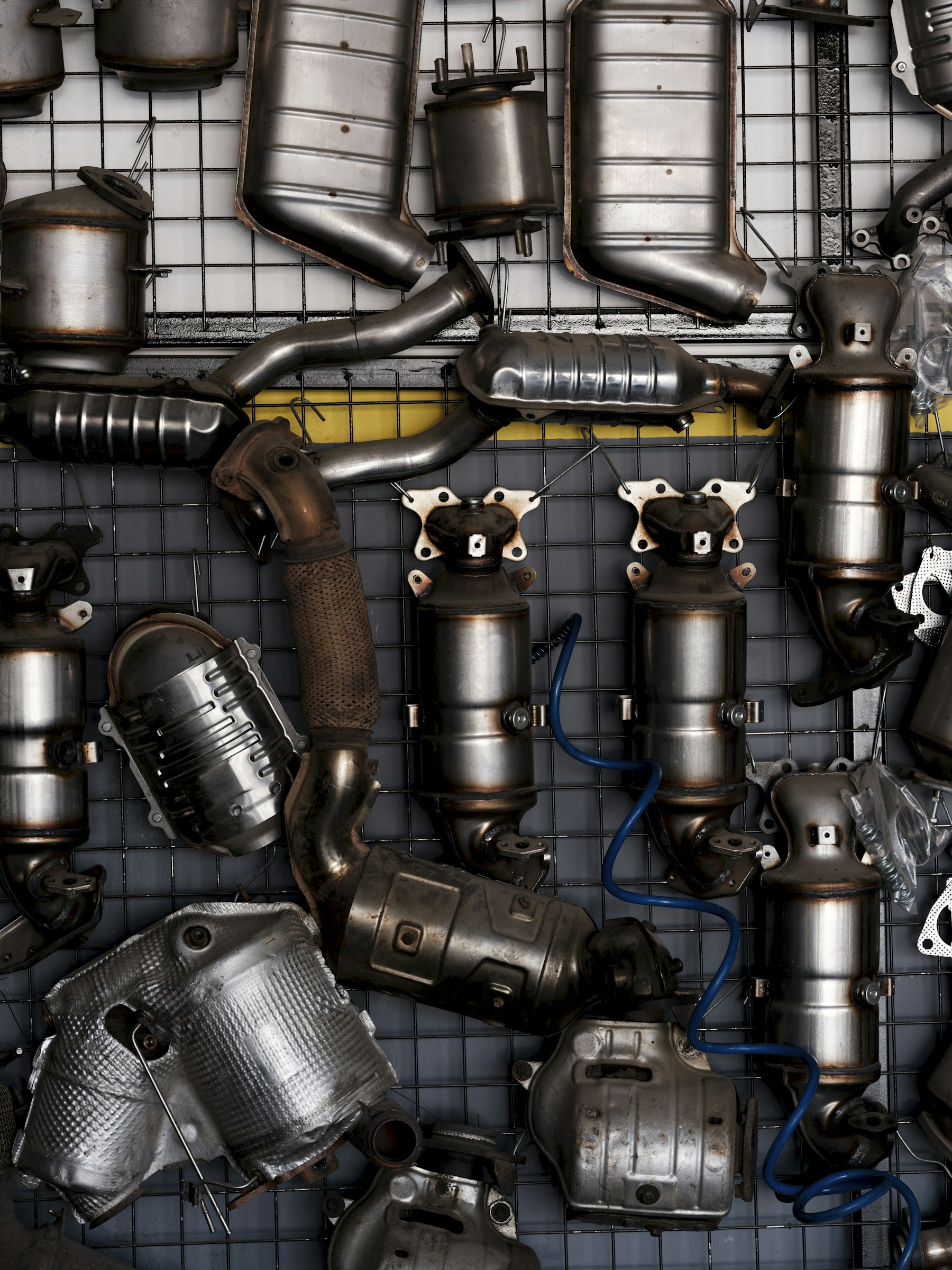
A car engine does not simply burn fuel and send harmless air out the back. Inside the cylinders, gasoline or diesel reacts with oxygen in a fast, hot burst that produces useful motion, but the reaction is never perfectly clean. Along with carbon dioxide and water vapor, exhaust can carry carbon monoxide, unburned hydrocarbons, and nitrogen oxides, all of which matter for air quality and health. The catalytic converter sits in the exhaust system to deal with those gases before they leave the tailpipe.
The clever part is that the converter does not work like a filter that traps pollution until it fills up. It is closer to a tiny chemical factory packed into a metal case under the car. Hot exhaust flows through thousands of small channels coated with catalyst materials, and those surfaces help unstable molecules rearrange into less harmful ones. The device is ordinary enough to be hidden beneath millions of vehicles, but the chemistry inside it is one of the clearest everyday examples of catalysis, reaction rates, and oxidation-reduction chemistry at work.
Why exhaust needs chemistry, not just a pipe
Combustion in an engine starts with a simple goal: mix fuel with air, ignite it, and use the expanding hot gases to push pistons. If every fuel molecule met exactly the right amount of oxygen at exactly the right time, the main products would be carbon dioxide and water. Real engines are messier. Some fuel molecules do not fully burn, some carbon atoms stop at carbon monoxide instead of reaching carbon dioxide, and the intense heat inside the cylinders can make nitrogen and oxygen from the air combine into nitrogen oxides.
Those three groups of pollutants behave differently. Carbon monoxide, or CO, is dangerous because it binds strongly to hemoglobin in blood and interferes with oxygen transport. Unburned hydrocarbons can help form ground-level ozone and smog when they react in sunlight with nitrogen oxides. Nitrogen oxides, often written as NOx, contribute to smog, acid rain chemistry, and respiratory irritation. The U.S. Environmental Protection Agency’s transportation history notes that early Clean Air Act standards targeted hydrocarbons, carbon monoxide, and nitrogen oxides from new cars, pushing automakers toward cleaner engine design and emission-control technology.
A plain exhaust pipe can move gases away from the engine, and a muffler can reduce sound, but neither changes the molecules enough. To clean exhaust, the system needs chemical reactions that happen fast while the gas is still hot and moving. That is the catalytic converter’s job: give the right molecules a place to react before they escape into the air.
What a catalyst actually does
A catalyst speeds up a chemical reaction without being used up as a reactant. The Department of Energy describes catalysts as substances that help reactions happen more easily by lowering the energy barrier needed to start rearranging bonds. That matters because exhaust gases spend only a short time inside the converter. The reactions need help if they are going to happen quickly enough during normal driving.
The catalyst does not magically erase atoms. It gives molecules a better pathway. When gases touch the active surface, bonds can weaken, atoms can move, and new combinations can form. After the reaction, the catalyst surface is still available to help another set of molecules. In a working converter, this cycle repeats constantly as exhaust flows through.
Most modern gasoline vehicles use a three-way catalytic converter because it handles three major jobs at once. It helps oxidize carbon monoxide into carbon dioxide. It helps oxidize unburned hydrocarbons into carbon dioxide and water. It also helps reduce nitrogen oxides into nitrogen and oxygen. The word reduce here has its chemistry meaning: nitrogen oxides lose oxygen or gain electrons in the process, rather than simply becoming smaller in amount.
This is why catalytic converters are often tied to redox chemistry. Oxidation and reduction happen side by side. Some gases give up electrons, some gain them, and the converter’s surfaces help steer the exchange toward products that are more stable and less harmful in the amounts released from a vehicle.
Why precious metals and honeycomb channels matter
The active materials in many catalytic converters include tiny amounts of platinum, palladium, and rhodium. These metals are valuable not because they are shiny, but because their surfaces are unusually good at helping certain exhaust reactions happen. Platinum and palladium are especially useful for oxidation reactions involving carbon monoxide and hydrocarbons. Rhodium is especially important for reducing nitrogen oxides.
The metals are not usually present as a solid block. They are spread in very small particles across a ceramic or metallic support, often arranged in a honeycomb structure. That honeycomb design solves a practical problem. Exhaust must pass through with limited resistance, but the gas also needs to touch as much active surface as possible. Thousands of narrow channels create a huge contact area without forcing the engine to push against a clogged passage.
Surface area is the quiet hero of the whole device. A reaction can only be catalyzed when molecules reach the catalyst surface. If the same amount of active metal were hidden inside a lump, much of it would do little useful work. Spread thinly across many channels, the same kind of material can meet far more exhaust molecules per second. That is why the inside design matters as much as the metal names.
The honeycomb also helps explain why a catalytic converter can be both small and powerful. It does not need to store all the pollution. It needs to expose moving gases to reactive surfaces at high temperature, over and over, thousands of times per drive.
The converter needs the right temperature and mixture
Catalytic converters work best when they are hot enough for the reactions to proceed quickly. A cold engine at startup is a challenge because the converter has not yet reached its effective operating range. Until it warms up, more pollutants can pass through unchanged. This is one reason modern vehicles place converters closer to the engine and use engine controls that help the system warm efficiently.
The air-fuel mixture matters too. A three-way catalyst has to balance oxidation and reduction reactions, which means the exhaust cannot be too oxygen-rich or too oxygen-poor for long. Modern gasoline vehicles use oxygen sensors and computer-controlled fuel injection to keep the mixture close to the point where the converter can handle all three pollutant groups. If there is too much oxygen, reducing nitrogen oxides becomes harder. If there is too little oxygen, oxidizing carbon monoxide and hydrocarbons becomes harder.
That balancing act is one reason the EPA timeline highlights the arrival of sophisticated three-way catalysts with onboard computers and oxygen sensors in the early 1980s. The converter itself is a chemistry device, but it depends on a larger control system. The engine, sensors, fuel mixture, and exhaust temperature all affect how well the chemical reactions can run.

What the converter changes, and what it cannot change
A catalytic converter can greatly reduce several harmful pollutants from a gasoline engine, but it does not make exhaust perfectly clean. Turning carbon monoxide into carbon dioxide removes one acute poison, yet carbon dioxide is still a greenhouse gas. Oxidizing hydrocarbons helps reduce smog-forming compounds, but the result still depends on how much fuel the vehicle burns. Reducing nitrogen oxides helps air quality, but the converter only works well when the engine and emissions system are functioning properly.
The converter also cannot fix every kind of pollution from transportation. Tire wear, brake dust, road dust, evaporating fuel vapors, and carbon dioxide from fuel combustion are separate problems. Diesel engines often need additional systems, such as diesel oxidation catalysts, particulate filters, or selective catalytic reduction, because diesel exhaust chemistry and operating conditions differ from those of gasoline engines.
Still, the catalytic converter is a powerful example of targeted chemistry. It takes gases that are already moving through a hot exhaust stream and gives them a better path to react. It uses expensive materials sparingly by spreading them across enormous surface area. It depends on sensors and engine controls, but the heart of the device is a simple chemical idea: the right surface can make a difficult reaction happen faster.
That is why a catalytic converter is more than a car part. It is a compact lesson in how chemistry can change real-world systems. Molecules enter as the leftovers of combustion, touch carefully chosen surfaces, and leave in forms that usually do less harm. The process is not perfect, and it does not replace the need for cleaner energy choices, but it shows how a small change in reaction pathway can make a large difference when it happens millions of times on the road.