 Akshay Dinesh
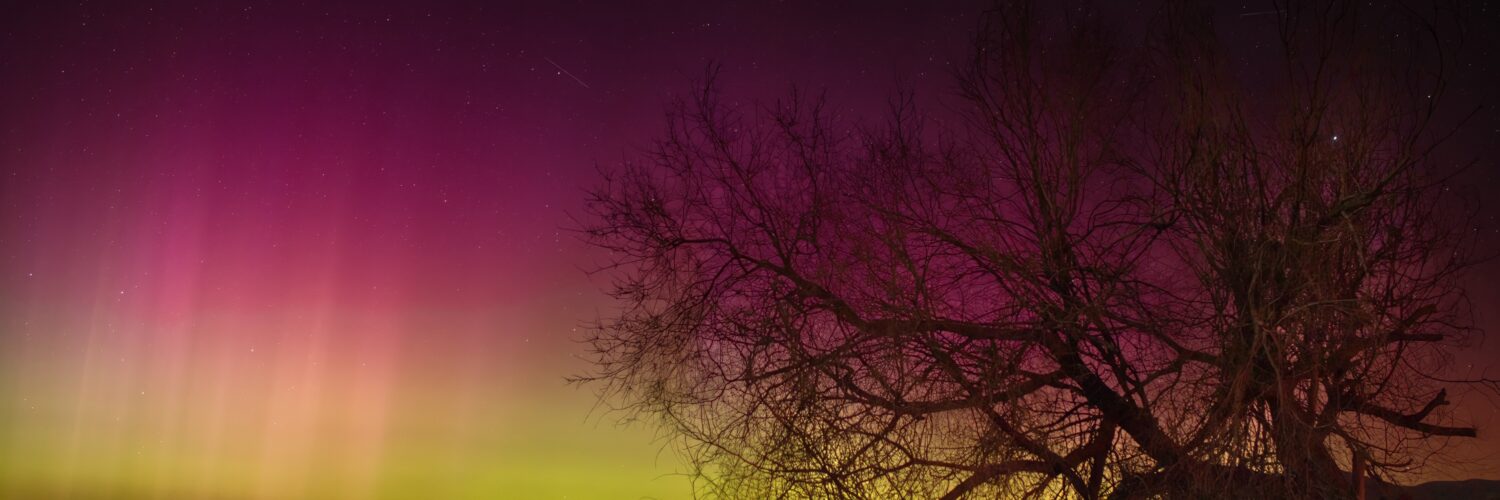
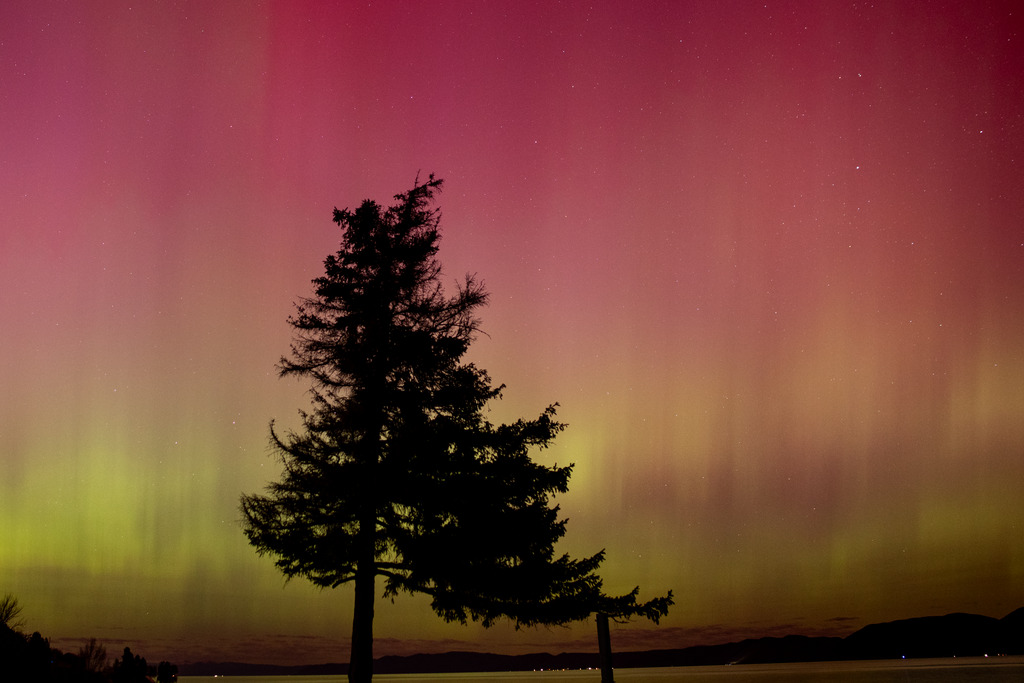
On most nights, auroras belong to high-latitude skies. People in Alaska, northern Canada, Scandinavia, Iceland, and parts of Antarctica have the best chance of seeing them because Earth’s magnetic field naturally guides charged particles toward the polar regions. Then, every so often, the glowing curtains appear much farther south. A sky that usually shows only stars and city glow suddenly turns green, red, or purple, and people far from the Arctic start asking the same question: why did the northern lights come here?
The answer begins with the Sun. Auroras are not simply pretty weather in the upper atmosphere. They are visible signs of space weather, a chain of events that can start with magnetic activity on the Sun and end with energy pouring into Earth’s magnetic environment. During stronger solar storms, that energy can expand the auroral zone and make the lights visible from places that rarely see them.
The Sun Is Not Quiet
From Earth, the Sun can look steady: a bright disk that rises, sets, and seems mostly unchanged from day to day. Up close, it is a restless ball of plasma threaded with magnetic fields. Dark sunspots mark areas where intense magnetic activity reaches the solar surface. Around those active regions, magnetic fields can twist, snap, and reorganize, releasing energy in powerful bursts.
A solar flare is a sudden flash of electromagnetic radiation from the Sun. Flares can affect radio communication almost immediately because light and other radiation from the flare travel at the speed of light. A coronal mass ejection, often shortened to CME, is different. It is a huge cloud of magnetized plasma launched into space. NOAA’s Space Weather Prediction Center explains that the largest geomagnetic storms are often associated with CMEs, which can carry enormous amounts of solar material and embedded magnetic field toward Earth.
Not every solar eruption matters to us. A CME can miss Earth entirely, just as a storm at sea can move away from a coastline. The important question is whether the eruption is aimed in Earth’s direction and whether its magnetic field is arranged in a way that can connect efficiently with Earth’s magnetic field. When the answer is yes, the result can be a geomagnetic storm.
Earth’s Magnetic Field Guides the Energy
Earth is surrounded by a magnetic field that stretches far into space. This region, called the magnetosphere, helps deflect much of the solar wind, the stream of charged particles that constantly flows outward from the Sun. Without that protective magnetic environment, Earth’s upper atmosphere would be exposed to far more direct particle bombardment.
A geomagnetic storm happens when energy from the solar wind is transferred into the magnetosphere especially efficiently. NOAA describes these storms as major disturbances in Earth’s magnetosphere caused by changing solar wind conditions. One key ingredient is a southward-directed magnetic field carried by the solar wind. When that field is opposite Earth’s dayside magnetic field, the two can connect through magnetic reconnection, opening a path for energy to enter the magnetosphere.
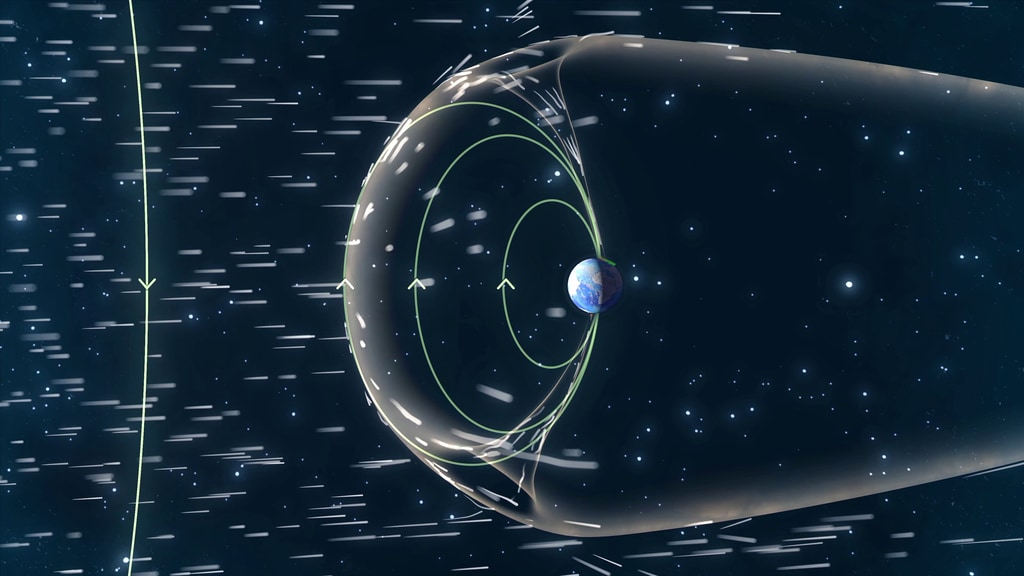
During a storm, electrical currents strengthen in the magnetosphere and ionosphere. The ionosphere is a high layer of the atmosphere where sunlight and energetic particles can strip electrons from atoms and molecules. These changing currents and particles do not stay neatly above the poles. As the magnetosphere becomes disturbed, the auroral oval – the ring-shaped region where auroras are most likely – can expand toward lower latitudes.
Why Auroras Glow in Different Colors
Auroras form when energetic particles travel along magnetic field lines and collide with atoms and molecules high in the atmosphere. Those collisions give atmospheric gases extra energy. When the gases release that energy, they emit light. The color depends on which gas is involved and how high the collision happens.
Oxygen is responsible for the most familiar green aurora, often seen at altitudes around 60 to 150 miles above Earth. Oxygen can also produce red auroras higher up, where the air is thinner and excited oxygen atoms can hold energy longer before releasing it. Nitrogen can add purplish, blue, or pink tones, especially in more active displays. The colors people see from the ground also depend on darkness, clouds, light pollution, camera exposure, and how sensitive human eyes are in low light.
That is why a person may see a faint grayish glow while a camera captures vivid reds and greens. Cameras collect light over several seconds, while human night vision is less sensitive to color. During strong geomagnetic storms, though, the aurora can become bright enough for color to be visible with the naked eye, especially away from city lights.
Why Strong Storms Push the Lights South
Under quiet conditions, auroras usually stay near the poles because Earth’s magnetic field guides charged particles toward high latitudes. The auroral oval sits like a glowing ring around each magnetic pole. When geomagnetic activity increases, that oval grows wider and shifts toward lower latitudes. To someone on the ground, it can look as if the aurora has moved south, even though the real change is happening across a large region of near-Earth space.
Space weather forecasters often use the Kp index to describe global geomagnetic activity. The scale runs from 0 to 9. Low values usually mean auroras remain far north or south. Higher values mean the auroral oval can expand. NOAA’s public viewing guidance notes that when geomagnetic activity is stronger, auroras can become brighter and appear farther from the poles.
The May 2024 geomagnetic storm showed how dramatic that expansion can be. NASA described it as the biggest geomagnetic storm in more than 20 years, and auroras were reported far beyond their usual range. The event became memorable not only because of the bright skies but because it helped many people connect an everyday view – a night sky suddenly filled with color – to activity that began about 93 million miles away.
Solar Maximum Raises the Odds
The Sun follows an activity cycle that averages about 11 years from one quiet period to the next. Near solar maximum, sunspots become more common, and the Sun tends to produce more flares and CMEs. NASA and NOAA announced in 2024 that Solar Cycle 25 had reached its maximum phase, and NOAA anticipated more solar and geomagnetic storms during that period, along with more chances to see auroras.
Solar maximum does not mean every night will bring northern lights. It also does not mean every solar storm will be dangerous or visible. It simply raises the odds of active space weather. Even after the peak begins to decline, significant storms can still happen, because the Sun does not shut off all at once. Large active regions, coronal holes, and CME-producing eruptions can still send disturbed solar wind toward Earth.
Forecasting these events requires watching the Sun and measuring the solar wind before it reaches Earth. NOAA’s Space Weather Prediction Center issues watches, warnings, and alerts for geomagnetic storms, solar radiation storms, and radio blackouts. Its scales help translate technical measurements into practical severity levels, much as weather scales help people understand hurricanes or tornadoes. In June 2026, NOAA also announced operational data from SOLAR-1, a space-weather observing mission designed to support earlier monitoring of solar wind and CMEs.
A Beautiful Sky With Practical Effects
For most people, an aurora is a rare and beautiful sky event. For engineers, satellite operators, power-grid managers, radio users, and astronauts, the same storm can be a practical concern. NOAA notes that geomagnetic storms can affect spacecraft operations, radio communication, GPS and other satellite navigation, and electric power systems. Strong storms can heat the upper atmosphere, increasing drag on low-Earth-orbit satellites. They can also disturb the ionosphere, where radio signals and navigation signals travel.
That does not mean auroras should be treated with fear. The lights themselves are happening high above the ground, and watching them from Earth is not dangerous. The lesson is that Earth is part of a larger space environment. The Sun’s magnetic behavior can reach across the solar system, and our technology is connected to that environment in ways people did not have to think about centuries ago.
The next time aurora forecasts spread across the news or social media, the key idea is simple: a stronger solar storm can expand the auroral oval. Charged particles follow magnetic pathways into the upper atmosphere, atmospheric gases release light, and the visible edge of the display can move far enough for millions of extra people to see it. The glow in the sky is local, but the story behind it begins on the Sun.