 Akshay Dinesh
A moon can orbit a planet safely for millions or billions of years, but only if it keeps enough distance. Move it too close and the planet’s gravity stops behaving like one gentle pull. The near side of the moon is tugged harder than the far side, stretching the moon across its own width. If that stretching becomes stronger than the moon’s ability to hold itself together, the moon can break apart. The boundary where that danger begins is called the Roche limit.
The Roche limit helps explain why some planets have rings, why small moons can be unstable near large planets, and why a broken comet once arrived at Jupiter as a long train of fragments instead of one solid body. It is not a magic line painted in space. The exact distance depends on density, strength, shape, orbit, and what the object is made of. Still, the idea gives astronomers a powerful way to think about a simple question: when does gravity hold an orbiting object together, and when does gravity pull it apart?
Why gravity can stretch an object in orbit
Gravity gets stronger with closeness. For a small object far from a planet, the difference between the pull on its near side and far side is tiny. Bring that object much closer, and the difference grows. NASA’s spaceflight basics describe this as a gravity gradient: the part of an orbiting object closer to the planet feels a slightly stronger attraction than the part farther away.
That difference is the root of tidal force. On Earth, tidal force is best known through ocean tides, where the Moon’s gravity and Earth’s rotation help create bulges in the oceans. Around a massive planet, the same kind of uneven pull can act on an entire moon, asteroid, comet, or cloud of debris. The near side is pulled inward more strongly, the far side lags behind, and the object is stretched along the line toward the planet.
Most solid worlds can resist a little stretching. Rock, ice, and internal structure provide strength, and the object’s own gravity pulls its pieces toward its center. The Roche limit is reached when the outside planet’s tidal force becomes strong enough to overcome the object’s self-gravity, at least for a body held together mostly by gravity rather than by strong rock or metal. A loose pile of icy fragments would be much easier to disturb than a compact metal-rich asteroid of the same size.
What the Roche limit means
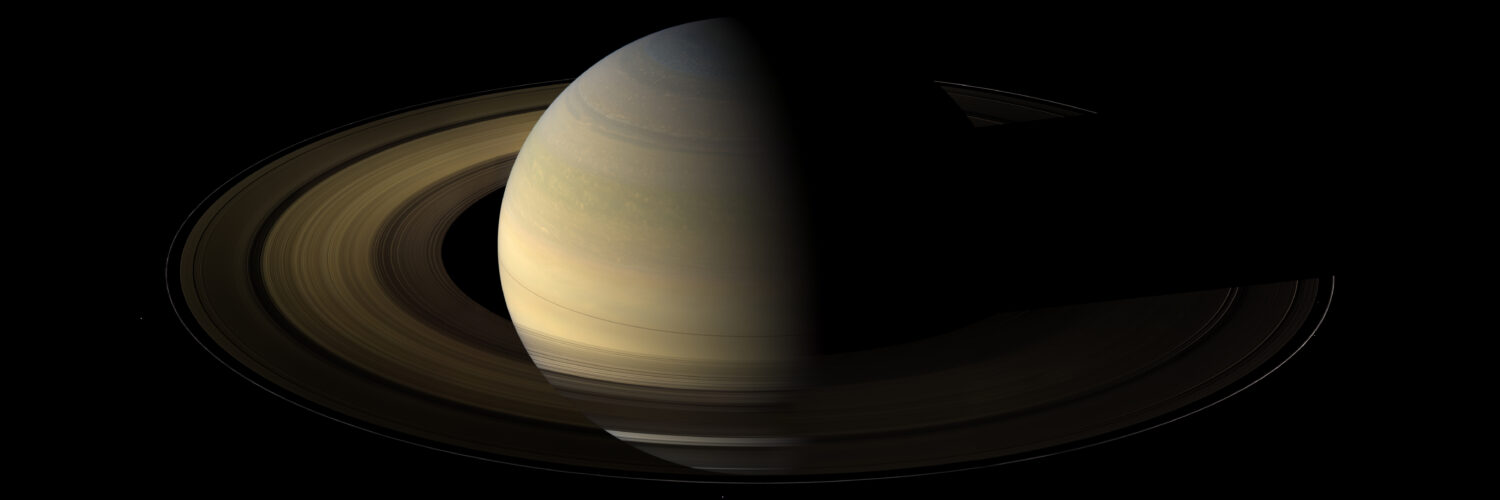
The Roche limit is named for Edouard Roche, the nineteenth-century French astronomer who calculated how close a satellite could come to a larger body before tidal forces overwhelmed its own gravity. In plain language, it is the minimum distance at which a large, loosely held moon can orbit without being torn apart by the planet it circles. NASA’s Cassini mission materials use Saturn’s rings to explain the idea: material too close to Saturn may remain as ring particles instead of gathering into one larger moon.
There is more than one Roche-limit calculation because real objects are not perfect textbook spheres. A rigid object can survive closer to a planet than a fluid or loosely packed object because its internal strength helps it resist deformation. A rubble-pile asteroid, a porous icy moonlet, or a comet with weak internal bonds behaves differently from a strong rocky moon. Density also matters. A dense object can hold itself together more strongly than a less dense object orbiting at the same distance.
That is why the Roche limit should be read as a physical threshold, not an automatic explosion point. Crossing it does not mean every object instantly disappears. Small rocks, spacecraft, and solid fragments can orbit inside a planet’s Roche limit because they are held together by material strength. The idea is most useful for objects whose own gravity is the main force keeping their pieces together.
Why rings often live where moons struggle to form
Saturn is the natural classroom for the Roche limit because its rings are bright, broad, and full of small particles. The main rings are not a smooth solid sheet. They are made of countless pieces, many rich in water ice, orbiting Saturn independently. From far away they blend into glowing bands; close up they are a swarm of material moving around the planet.
Inside or near a planet’s Roche zone, ring particles have trouble combining into a large moon. Their mutual gravity tries to gather them, but the planet’s tidal pull keeps stretching and stirring the material. Particles can collide, clump briefly, spread out again, or form small moonlets that are later disturbed. The result is not stillness. It is a busy orbital environment where the same forces that prevent one large moon from forming can still allow temporary clusters, gaps, waves, and small shepherding moons.
This helps explain why rings and moons can sit close together without behaving the same way. A ring can be stable as a collection of separate particles even where a large gravity-bound moon would struggle. A moon outside the Roche limit may gather material and grow; material inside the limit may remain scattered. The line between the two is not perfectly neat, but the Roche limit gives the broad reason that rings are often found close to their planets.
Phobos shows the idea is not only about Saturn
Mars has no bright ring system today, but its inner moon Phobos is a striking future example. Phobos orbits much closer to Mars than Earth’s Moon orbits Earth, and it is slowly spiraling inward. JPL has described research suggesting that Phobos may eventually reach the Roche limit, break apart, and form a ring around Mars. The estimated timescale is not next week or next century. It is roughly tens of millions of years, with one common estimate around 70 million years.
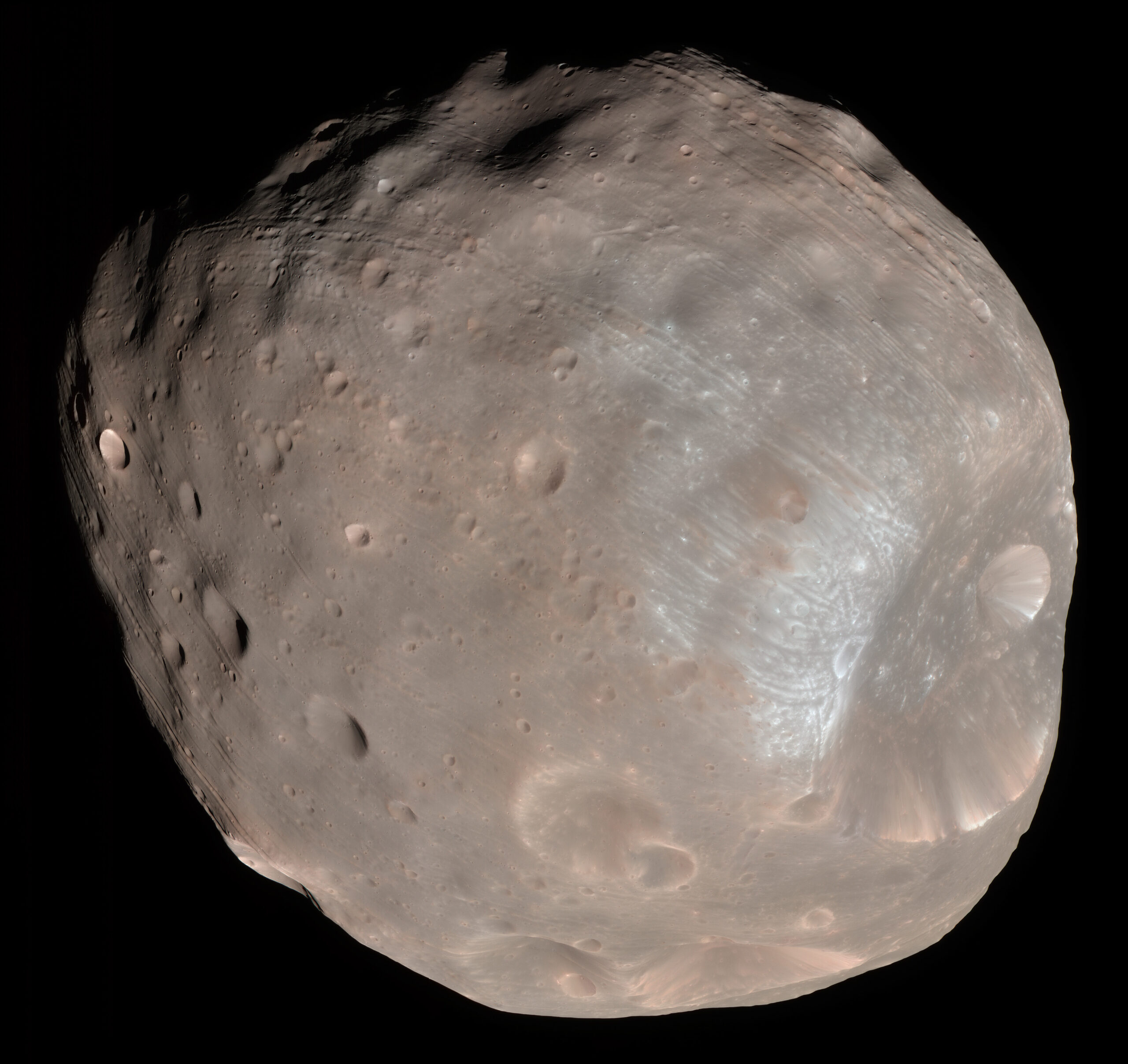
That future is a reminder that planetary systems are not frozen diagrams. Moons can migrate inward or outward over long spans of time because of tidal interactions with their planets. Some move away, as Earth’s Moon slowly does. Others, like Phobos, move inward. A moon that is safe today may not always stay safe if its orbit keeps changing.
Phobos also shows why composition matters. It is small, irregular, and not a dense round world like Earth’s Moon. If a weakly held moon moves close enough to its planet, fractures and tidal stress can gradually reshape it before any final breakup. A Roche-limit story is often less like a sudden snap and more like a long contest between internal strength, self-gravity, collisions, and the planet’s repeated pull.
Comets can break apart for similar reasons
The Roche limit is often discussed with moons and rings, but tidal disruption can also affect comets that pass close to giant planets. Comet Shoemaker-Levy 9 is the famous example. Before it struck Jupiter in July 1994, the comet had already been broken into many fragments, likely after a close approach to Jupiter in 1992. Hubble images showed the fragments stretched out like beads, a dramatic sign that the comet had not survived as one object.
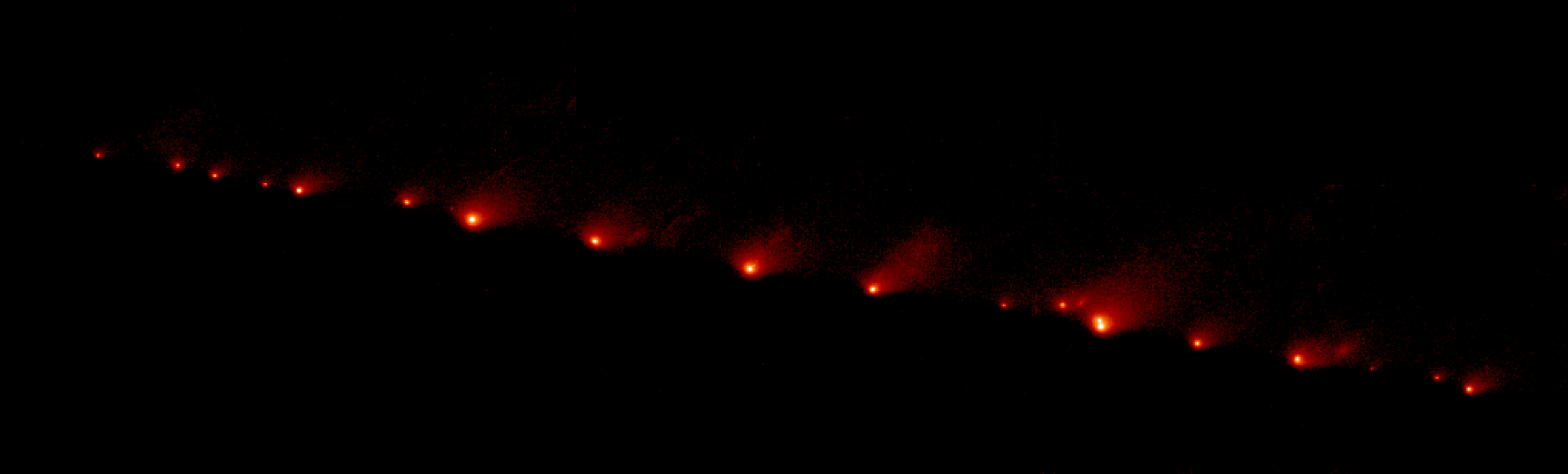
A comet is not built like a steel ball. It is a mixture of ice, dust, rock, and trapped gases, often with a fragile internal structure. When such an object swings too close to a massive planet, tidal forces can pull harder on one side than the other. If that differential pull exceeds the comet’s ability to hold together, the comet can split into pieces.
Shoemaker-Levy 9 also shows that tidal force is not the only stress in space. Comets can fracture from heating, rotation, gas pressure, collisions, or old weaknesses inside the nucleus. The Roche limit does not replace those explanations. It gives one important mechanism, especially when a fragile object passes very close to a much larger world.
Why the Roche limit matters
The Roche limit turns rings, moons, and broken comets into parts of the same bigger story. Gravity is not only the force that gathers matter into worlds. Under the right conditions, it is also the force that prevents matter from gathering, stretches objects apart, and keeps ring particles from becoming a single moon.
That idea matters because it changes how planetary systems look over time. A moon can be born from debris, migrate, break apart, and feed a ring. A ring can spread, clump, and interact with small moonlets. A comet can survive many trips around the Sun, then shatter during one close pass by a giant planet. The Roche limit gives astronomers a way to connect those events with one underlying rule: across a nearby object, gravity is uneven.
The best way to picture it is not as a wall but as a zone of increasing stress. Far enough away, self-gravity can hold a moon together and let loose material gather. Too close, a planet’s tidal pull may win. Between those outcomes lies much of the beauty of planetary rings: matter that is close enough to be organized by a planet, but too strongly stirred to settle into one ordinary moon.