 Akshay Dinesh
A lunar eclipse can make the full Moon look as if it has slipped into a quiet copper glow. The change is striking because the Moon is not making its own light, and Earth is supposed to be blocking the sunlight that normally reaches it. Yet during many lunar eclipses, especially deep partial and total eclipses, the Moon does not simply vanish into darkness. It dims, loses its bright white glare, and may turn orange, rust-colored, or deep red.
The reason is not mysterious once the geometry is clear. During a lunar eclipse, Earth stands between the Sun and the Moon, casting a shadow into space. Some sunlight still skims through Earth’s atmosphere, where air scatters blue light away and bends redder light toward the Moon. The Moon becomes red because it is being lit by filtered sunlight from the rim of Earth, the same kind of light that colors sunrises and sunsets.
The alignment that creates a lunar eclipse
A lunar eclipse can happen only at full Moon, when the Moon is on the opposite side of Earth from the Sun. Most full Moons do not become eclipses because the Moon’s orbit is tilted about five degrees compared with Earth’s path around the Sun. Usually the full Moon passes a little above or below Earth’s shadow. An eclipse happens when the full Moon is close enough to one of the two points where the Moon’s tilted orbit crosses Earth’s orbital plane.
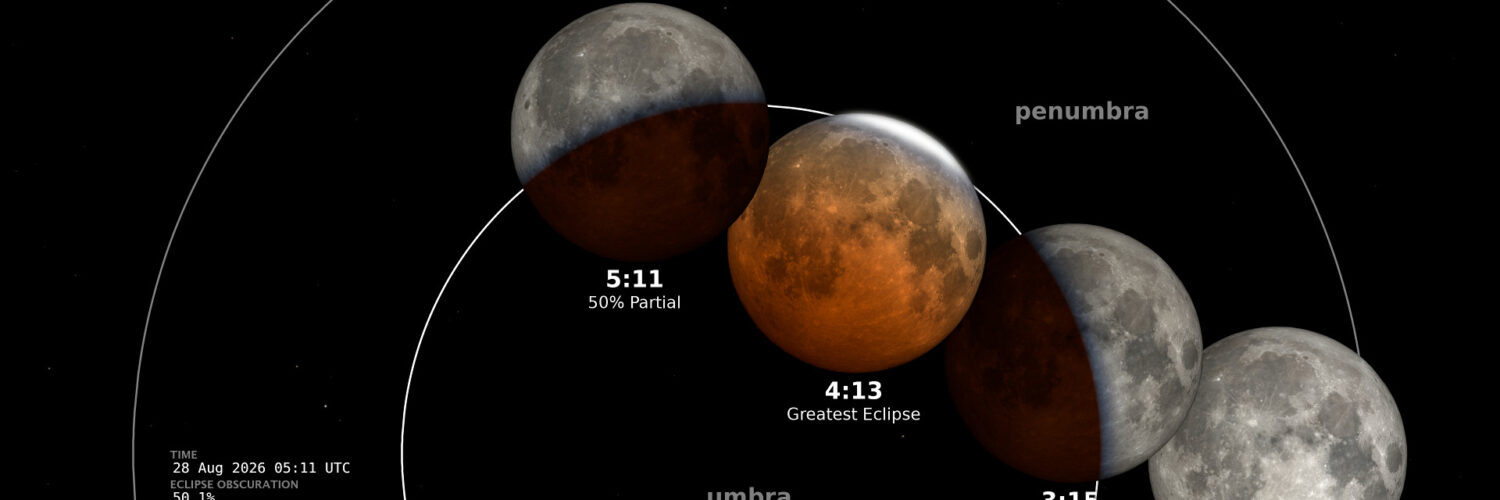
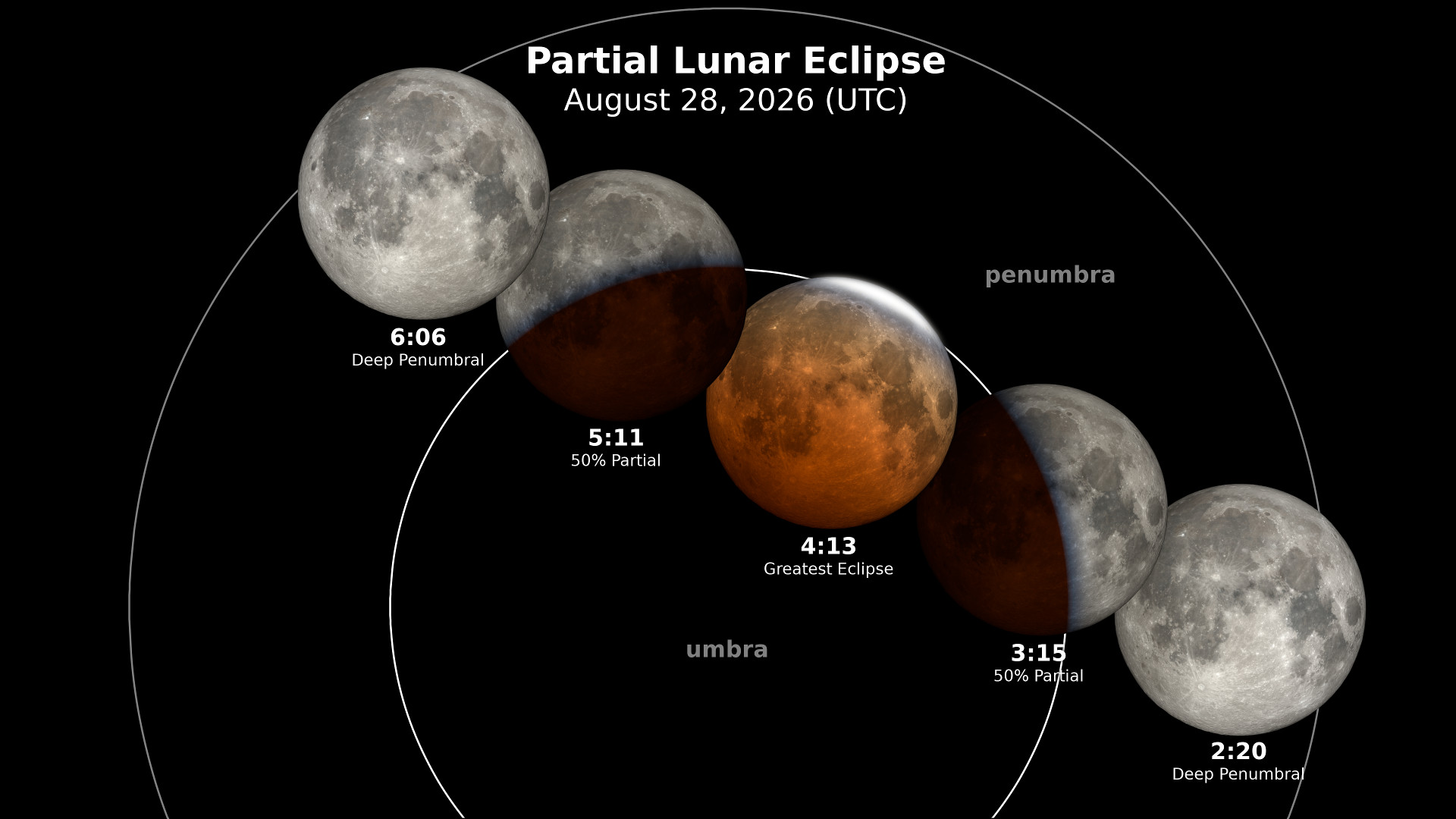
That alignment puts the Moon into Earth’s shadow. The shadow has two main parts. The penumbra is the lighter outer shadow, where Earth blocks only part of the Sun. The umbra is the darker central shadow, where Earth blocks the Sun completely from the Moon’s point of view. The difference between those two shadow regions explains why the beginning of a lunar eclipse can be hard to notice, while the deeper phases can look dramatic.
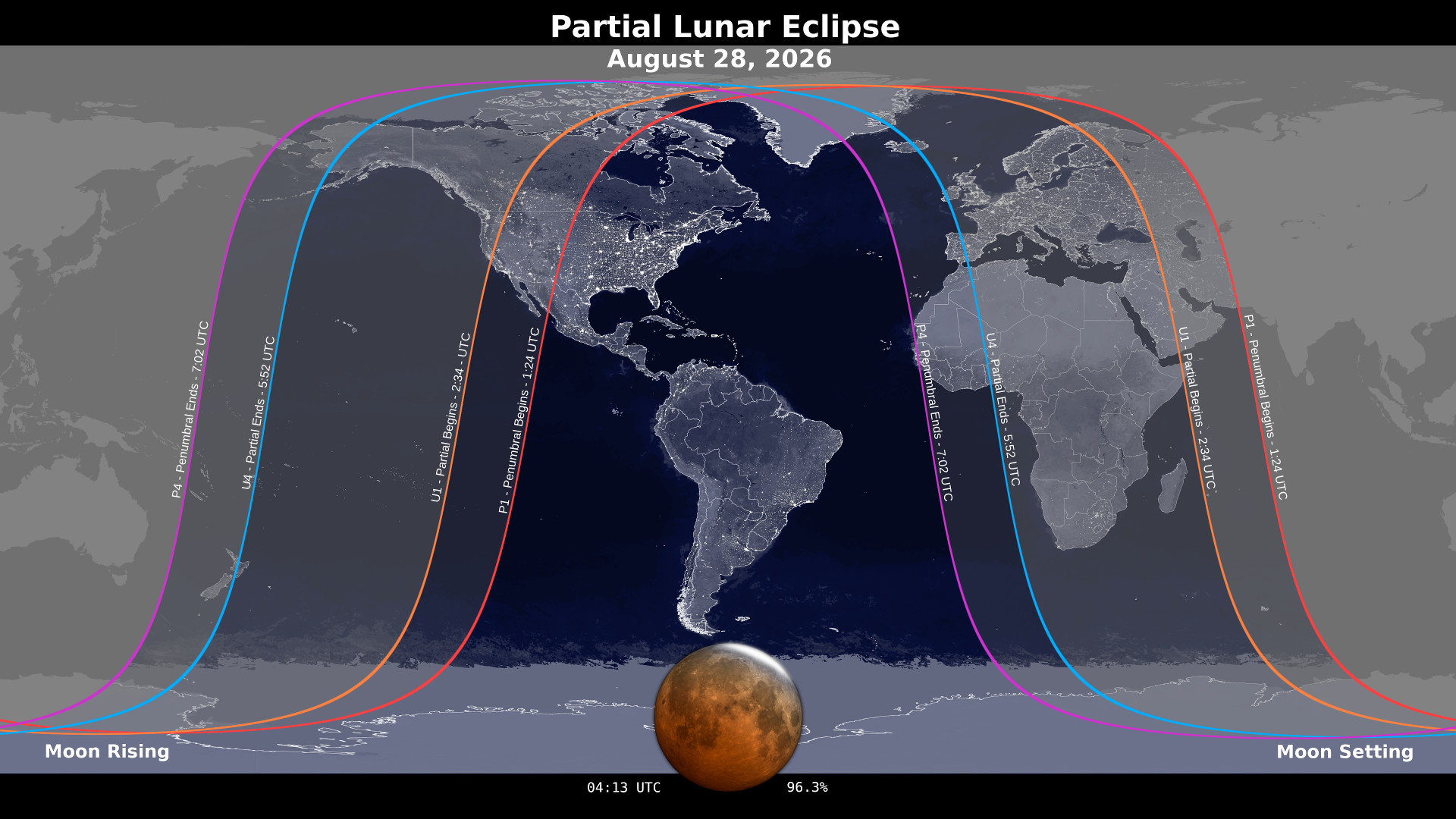
NASA’s Scientific Visualization Studio described the August 27-28, 2026 event as a deep partial lunar eclipse. At greatest eclipse, 96.3 percent of the Moon’s disk is within Earth’s umbra, close enough to totality for much of the Moon to look dark and coppery. Because the eclipse is partial, a sliver of the Moon remains outside the darkest part of the shadow, making the contrast especially easy to see.
Why Earth’s shadow is not completely black
If Earth had no atmosphere, a Moon inside the umbra would receive almost no direct sunlight. From the lunar surface, Earth would cover the Sun, and the Moon would become much darker than it does during real eclipses. Earth’s atmosphere changes that picture because it acts like a thin glowing ring around the planet. Sunlight that passes through that ring can be redirected into the shadow.
This is where the red color begins. Sunlight contains many visible colors, from shorter blue wavelengths to longer red wavelengths. When sunlight passes through air, molecules and tiny particles scatter the shorter wavelengths more strongly. That is why the daytime sky looks blue and why sunlight near the horizon looks warmer: the light has traveled through a longer path in the atmosphere, losing more of its blue and violet light along the way.
During a lunar eclipse, the sunlight that reaches the Moon has taken an especially long path through the edge of Earth’s atmosphere. Much of the blue light has been scattered away before the light can continue toward the Moon. The red and orange wavelengths survive the trip more easily, and the atmosphere bends some of that light inward through refraction. The result is a faint reddish illumination inside Earth’s shadow.
A useful way to picture it is to imagine standing on the Moon during a total lunar eclipse and looking back at Earth. The Sun would be hidden behind the planet, but the edge of Earth would be ringed by every sunrise and sunset happening around the world at that moment. That reddish ring is what lights the eclipsed Moon.
Why the color changes from one eclipse to another
No two lunar eclipses look exactly alike. Some are a bright copper orange. Some are brick red. Some are so dark that the Moon nearly disappears against the sky. The geometry matters, but the condition of Earth’s atmosphere matters too. Because the light reaching the Moon has passed through air around the entire planet, dust, clouds, smoke, volcanic aerosols, and water droplets can all affect how much light makes it through.
Scientists often describe total lunar eclipse brightness with the Danjon scale, a five-step visual scale introduced by French astronomer Andre-Louis Danjon. A very dark eclipse sits near the low end of the scale, while a bright orange or copper eclipse sits near the high end. The scale is not a laboratory measurement, but it gives observers a shared language for comparing eclipse appearances.
Large volcanic eruptions can make some eclipses unusually dark because volcanic aerosols in the stratosphere scatter and absorb more sunlight before it can be bent into Earth’s shadow. Ordinary weather can matter too, though in a more uneven way. If much of the sunrise-sunset ring around Earth is cloudy during an eclipse, less red light may reach the Moon. If the atmosphere is relatively clear, the eclipsed Moon may look brighter.
The Moon’s path through the umbra also affects the view. A total eclipse that carries the Moon through the center of Earth’s shadow usually looks darker than one that passes closer to the edge. A deep partial eclipse, such as the August 2026 event, can show both effects at once: a dark red region in the umbra beside a brighter uneclipsed portion of the lunar disk.
What the August 2026 eclipse shows especially well
The August 27-28, 2026 eclipse is useful because it is not quite total. NASA calculates that at greatest eclipse, more than 96 percent of the Moon is inside the umbra. That means most of the Moon is deep in Earth’s central shadow, while a small bright portion remains outside it. For observers in the Americas, western Europe, and western Africa, the event makes the structure of Earth’s shadow easier to notice.
The first stage, the penumbral phase, is subtle. The Moon may look only slightly dimmer because the penumbra blocks just part of the Sun’s light. When the Moon begins to enter the umbra, the change becomes obvious. A dark curve appears along one side of the lunar disk, showing the round shape of Earth’s shadow. As the Moon moves deeper, the shadowed region can take on the copper color created by filtered sunlight.
That curved bite is one of the oldest visible clues that Earth is round. Ancient observers did not need spacecraft to notice that Earth’s shadow on the Moon was always curved during lunar eclipses. Today the same view remains a simple, direct demonstration of Sun-Earth-Moon geometry. The sky turns into a diagram, but it is a diagram made of real shadows and real light.
How to watch the change carefully
Lunar eclipses are safe to view directly. Unlike a solar eclipse, where looking at the Sun requires proper eye protection, a lunar eclipse involves looking at the Moon. Binoculars or a small telescope can make the shadow edge and color easier to see, but they are optional. A clear view of the Moon and a little patience are enough.
The best observing trick is to give your eyes time to adapt. A full Moon is normally bright enough to wash out many stars, but as Earth’s shadow darkens the lunar surface, the surrounding sky may begin to look richer. If the eclipse is deep, the red color can become easier to detect once the bright portion of the Moon is small and your eyes adjust to the darker scene.
Photos can show color that is harder to see by eye, especially near maximum eclipse. A phone held steady against a railing may capture the broad change, while a camera on a tripod can record the dimmer red portion with longer exposures. The visual impression still matters more than the perfect photograph. Watching the shadow move across the Moon makes the mechanics of the eclipse easier to understand than any single image can.
It also helps to check local timing before going outside. Eclipse stages are often listed in UTC, but the local date can shift depending on time zone. For North American observers, the August 2026 eclipse occurs on the night of August 27 into the early hours of August 28. In other regions, the calendar date and visible stages may differ.
A red Moon is really Earth on display
The most interesting thing about a red eclipsed Moon is that it reveals Earth as much as it reveals the Moon. The Moon changes color because our planet has air. Its shadow is not just an empty dark cone in space; it is edged by an atmosphere that scatters, filters, and bends sunlight. The color on the Moon is a record of light passing through that global rim.
That is why lunar eclipses feel both familiar and strange. The full Moon is one of the most ordinary sights in the night sky, but during an eclipse it becomes a screen for Earth’s atmosphere. A reddish Moon is not glowing on its own, and it is not being changed by the Moon’s surface. It is reflecting sunlight that has taken a long, slanting path through the air around our planet.
Once that is understood, the copper color becomes more than a spectacle. It is a visible connection between sunrise, sunset, atmospheric scattering, orbital motion, and the Moon’s quiet path through Earth’s shadow. The next time the Moon turns red, the color is a reminder that even a familiar night-sky object can show the shape and behavior of the planet beneath our feet.