 Akshay Dinesh
Neptune has a strange kind of visibility problem. It is a giant planet, wider than Earth by about four times, yet from our backyard sky it hides in plain sight. Around opposition, when Earth passes between Neptune and the Sun, the planet is as close and bright as it gets for the year. That sounds like the perfect moment to look for it, and in one sense it is. But “best” does not mean easy when the target is nearly 30 times farther from the Sun than Earth and never bright enough for ordinary naked-eye viewing.
In 2026, NASA’s skywatching calendar lists Neptune at opposition on September 25, while detailed observing guides place the exact moment at about 2 UTC on September 26, or the evening of September 25 for much of the United States. The timing gives skywatchers a useful seasonal hook, especially because Neptune rises near sunset, stays up through the night, and reaches its highest point around midnight. Still, the planet’s appearance is modest: a faint, starlike dot that rewards patience more than spectacle. Understanding why helps explain not only Neptune, but also how distance, brightness, orbits, and telescopes shape what we can see in the night sky.
What Opposition Actually Changes
Opposition is a geometry event. It happens for outer planets when Earth moves between the Sun and that planet, placing the planet opposite the Sun from our point of view. The planet rises in the east around sunset, crosses the sky during the night, and sets in the west around sunrise. For observers, that matters because the planet is above the horizon for more of the dark hours, instead of being tucked close to the Sun’s glare.
Opposition also usually means the outer planet is near its closest approach to Earth for the year. Earth’s orbit is smaller and faster, so once each year it catches up to the line between the Sun and a distant planet. For Mars or Jupiter, that difference can be dramatic because they are much closer. For Neptune, the improvement is real but subtle. Earth moving a little closer helps, but it does not erase billions of miles of distance.
The best way to picture it is to imagine standing across a school gym from a tiny blue bead. Taking one step forward technically makes the bead closer. It may even make it a little easier to spot if the lighting is right. But the bead has not turned into a basketball. Neptune at opposition is better placed and slightly brighter, yet it remains a difficult target because its basic scale in our sky is so small.
Distance Makes a Giant Planet Look Tiny
Neptune’s average distance from the Sun is about 2.8 billion miles, or 4.5 billion kilometers. NASA describes that as about 30 astronomical units, with one astronomical unit equal to the average distance from Earth to the Sun. Around the 2026 opposition, EarthSky gives Neptune’s distance from Earth as about 28.9 astronomical units, or roughly 240 light-minutes. That means the light entering a telescope after bouncing off Neptune has spent about four hours crossing space before reaching us.
That distance changes the way size appears. Neptune’s equatorial diameter is about 30,775 miles, or 49,528 kilometers, which makes it a genuinely large world. If Earth were the size of a nickel, NASA’s comparison makes Neptune about the size of a baseball. But apparent size depends on both actual size and distance. A large object far away can look smaller than a small object nearby, which is why the Moon can cover the Sun during an eclipse even though the Sun is vastly larger.
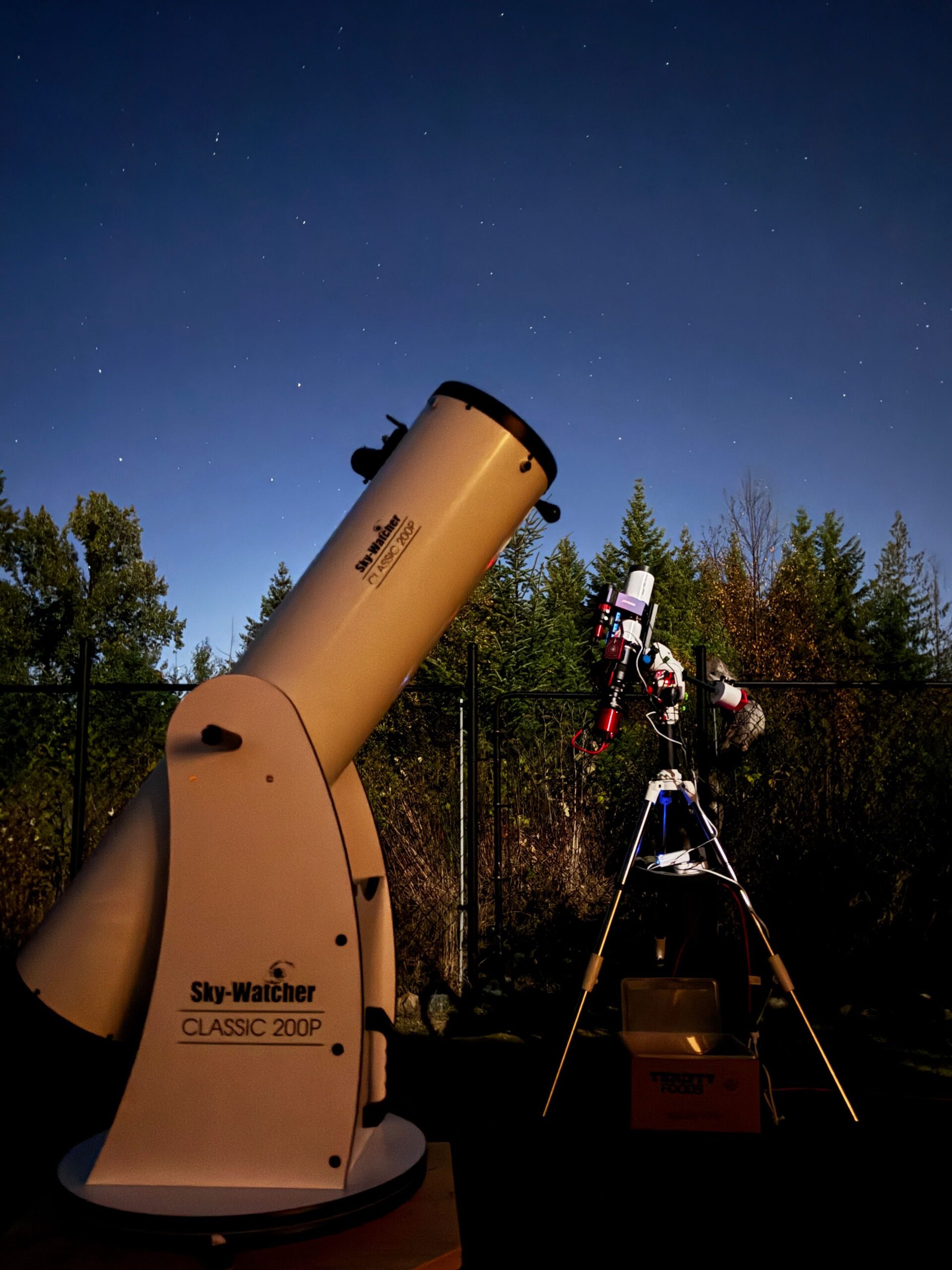
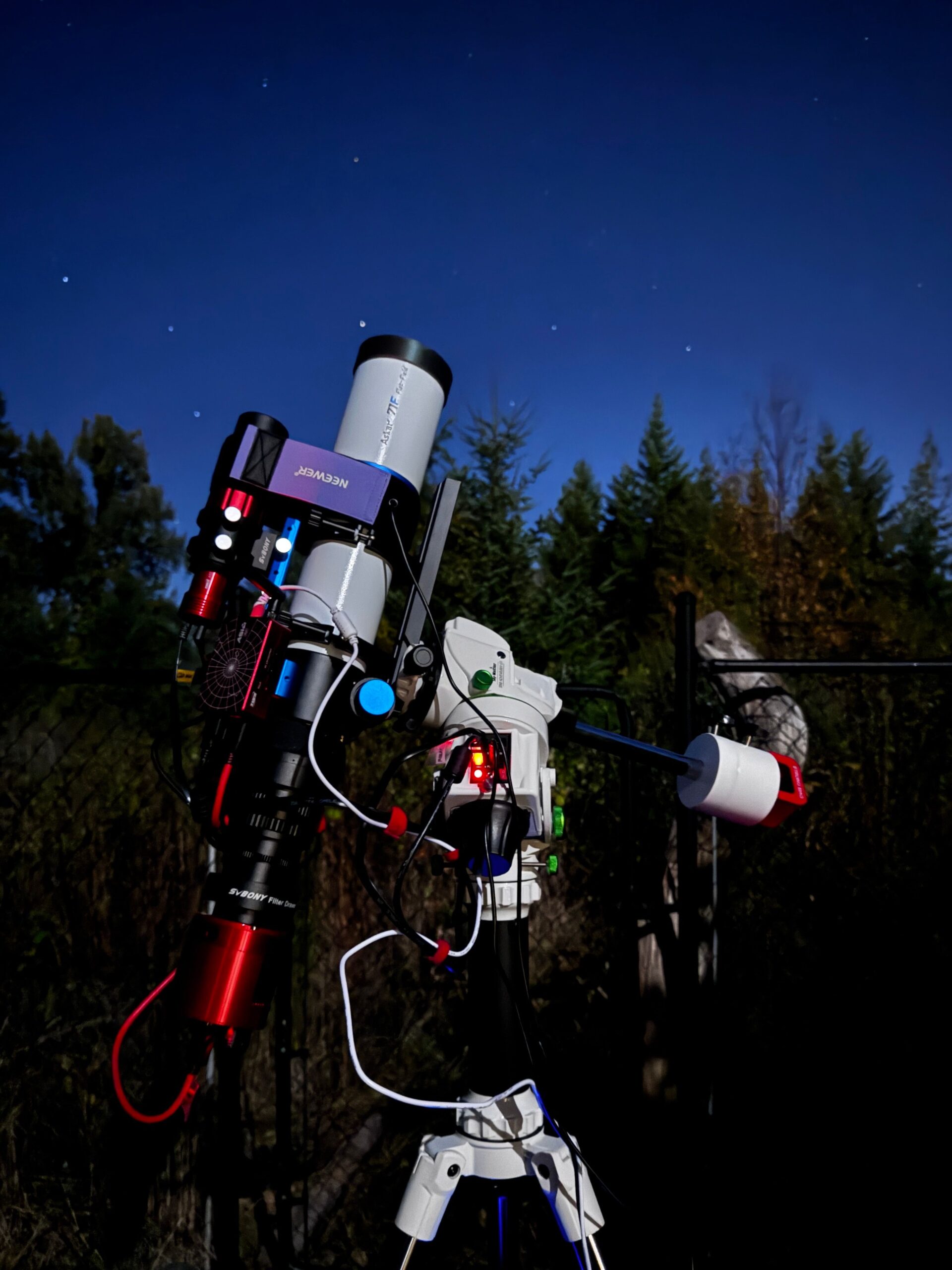
Through a backyard telescope, Neptune is not a showy disk like Jupiter or Saturn. Around opposition it appears only about 2.4 arcseconds across, according to EarthSky’s 2026 observing notes. An arcsecond is 1/3,600 of a degree, so this is a very small angle. Under enough magnification, steady air, and careful focus, Neptune can look like a tiny bluish disk rather than a point. In many beginner telescopes or binoculars, though, it looks almost exactly like a dim star.
Brightness Is More Than Being Big
A planet shines because it reflects sunlight. Neptune has two disadvantages at once: sunlight is weak by the time it reaches the planet, and the reflected light has to travel all the way back to Earth. NASA notes that sunlight on Neptune is roughly 900 times dimmer than sunlight on Earth. The planet may be huge, but it receives and returns only a small amount of light compared with the inner and middle planets.
Astronomers describe apparent brightness using magnitude, a scale that runs backward from what many people expect. Smaller or negative numbers mean brighter objects. Venus can shine around magnitude -4, Jupiter often appears brighter than magnitude -2, and the faintest stars most people can see with the naked eye under dark skies are around magnitude +6. Neptune at its 2026 opposition is listed around magnitude +7.8, which is too faint for unaided eyes even from a good dark site.
This is why opposition does not make Neptune suddenly obvious. The planet is closest and brightest for the year, but “brightest” still means below the naked-eye limit. Binoculars can collect more light than the human eye, and a telescope collects more still. Even then, the observer has to know exactly where to look because the view contains many background stars that may appear just as bright or brighter.
Why a Sky Chart Matters
Seeing Neptune is less like noticing the Moon and more like identifying a quiet face in a crowded room. It does not announce itself with rings, a bright color, or an obvious shape in low-power views. In 2026, Neptune is in front of Pisces and relatively near Saturn in the sky, but that does not mean Saturn points straight to it. A careful finder chart, planetarium app, or telescope mount with accurate alignment becomes part of the observation.
The practical method is usually a step-by-step star hop. An observer starts from a brighter landmark, then moves through a pattern of fainter stars until the field of view matches the chart. Neptune may reveal itself by its slightly bluish color, but color can be subtle at such low brightness. The stronger proof comes from position. If the faint dot sits exactly where the chart says Neptune should be, and if it shifts slowly against the background stars over several nights, the identification becomes much more reliable.
That slow motion is part of the fun. Neptune takes about 165 Earth years to orbit the Sun, so it barely creeps across the constellations from night to night. Earth’s own motion around the Sun makes Neptune appear to loop backward for part of the year, a pattern called retrograde motion. Around opposition, that apparent motion is especially noticeable to people who chart the planet across weeks. A single glance may be underwhelming; repeated observation turns it into evidence of orbital motion.
The Planet Behind the Dot
The small dot in the eyepiece represents one of the strangest worlds in the solar system. Neptune is an ice giant, not because it is a ball of ordinary ice, but because much of its mass is made of materials planetary scientists call ices, such as water, ammonia, and methane, under extreme pressure and temperature. Its visible atmosphere is mostly hydrogen and helium with a smaller amount of methane. Methane absorbs red light and helps give Neptune its blue appearance, although NASA notes that many Voyager 2 images were processed to emphasize contrast and cloud features.
Neptune is also a planet of violent weather. Voyager 2, the only spacecraft ever to fly by it, passed Neptune in 1989 and photographed the Great Dark Spot, a storm system in the planet’s atmosphere. The planet’s winds can be extraordinarily fast, even though it receives so little sunlight. That combination makes Neptune scientifically interesting: it challenges the simple idea that less solar energy should always mean quieter weather.
Its moon Triton adds another layer. Triton orbits Neptune backward compared with the planet’s rotation, a clue that it may have been captured rather than formed in place. Voyager 2 saw geyser-like activity on Triton, despite the moon’s extreme cold. None of these details are visible in a small telescope from Earth, but they give meaning to the observation. The faint point is not just a dot. It is a whole planetary system at the edge of ordinary classroom scale.
How to Think About the 2026 View
The 2026 opposition is a good time to try for Neptune because the geometry is working in the observer’s favor. Around September 25 and 26, the planet is opposite the Sun in the sky, visible for much of the night, and near its brightest point of the year. A dark location, steady air, a clear eastern horizon after sunset, and a telescope or strong binoculars all improve the chances. For many beginners, the most important tool will be a current sky chart matched to the exact date, time, and location.
Expect modesty. Neptune will not look like a space-probe portrait, and that is not a failure. The achievement is learning to connect a small point of light with a real object moving through the solar system. That connection is one of astronomy’s quiet pleasures: the eye sees something simple, while the mind understands the scale behind it.
Opposition makes Neptune easier to find, but it does not make it easy. The event sharpens the planet’s position in the night sky, gives observers more dark hours to work with, and brings the distant ice giant a little closer. The rest of the challenge remains part of the lesson. Neptune teaches that visibility is not only about whether something is present; it is about distance, light, motion, equipment, and knowing how to look.