 Akshay Dinesh
A small galaxy can make oxygen for billions of years and still end up with surprisingly little of it. The oxygen has not vanished or been destroyed. Much of it appears to have been blown out by energy from massive stars and supernova explosions, escaping the places where it formed and moving into the thin gas around or between galaxies.
That picture comes into sharper focus from the Galaxies Losing Oxygen via Winds project, or GLOW. In a study published in The Astrophysical Journal, Kristen Wingfield McQuinn and her colleagues assembled an oxygen budget for 37 nearby dwarf galaxies. Their result points to a mismatch: these galaxies retain only a small share of the oxygen their stars should have produced, and current models do not remove enough of it.
The missing oxygen offers more than a celestial mystery. Oxygen is one of astronomy’s best tracers of the heavier elements that stars manufacture. Following it reveals how galaxies recycle matter, why small galaxies remain chemically poor, and how the space between galaxies becomes enriched with the ingredients for later generations of stars and planets.
Stars make oxygen, then return it to space
Most oxygen begins inside massive stars. After a young star exhausts hydrogen in its core, fusion can turn helium nuclei into carbon. In sufficiently hot stellar interiors, carbon can capture another helium nucleus and become oxygen. Stars heavier than roughly eight Suns can continue building still heavier elements before their cores collapse.
A star does not keep all of those products. Powerful stellar winds strip material away during its life, and a core-collapse supernova can throw much of the star’s outer layers into surrounding space. Oxygen atoms then mix with hydrogen, dust, and other elements in the interstellar medium, the reservoir from which new stars may form.
This is why astronomers often use oxygen as an accounting tool. It is abundant, its production by stars is comparatively well understood, and its spectral fingerprints are measurable in glowing gas. When the observed amount falls far below the amount a galaxy’s stellar history says should exist, the shortfall carries information about where the galaxy’s matter has gone.
Why dwarf galaxies lose material so easily
Dwarf galaxies are not simply scaled-down versions of the Milky Way. Many contain millions rather than hundreds of billions of stars, and their gravity is correspondingly weaker. Gas that would rise, cool, and fall back inside a massive galaxy has a better chance of escaping a dwarf galaxy altogether.
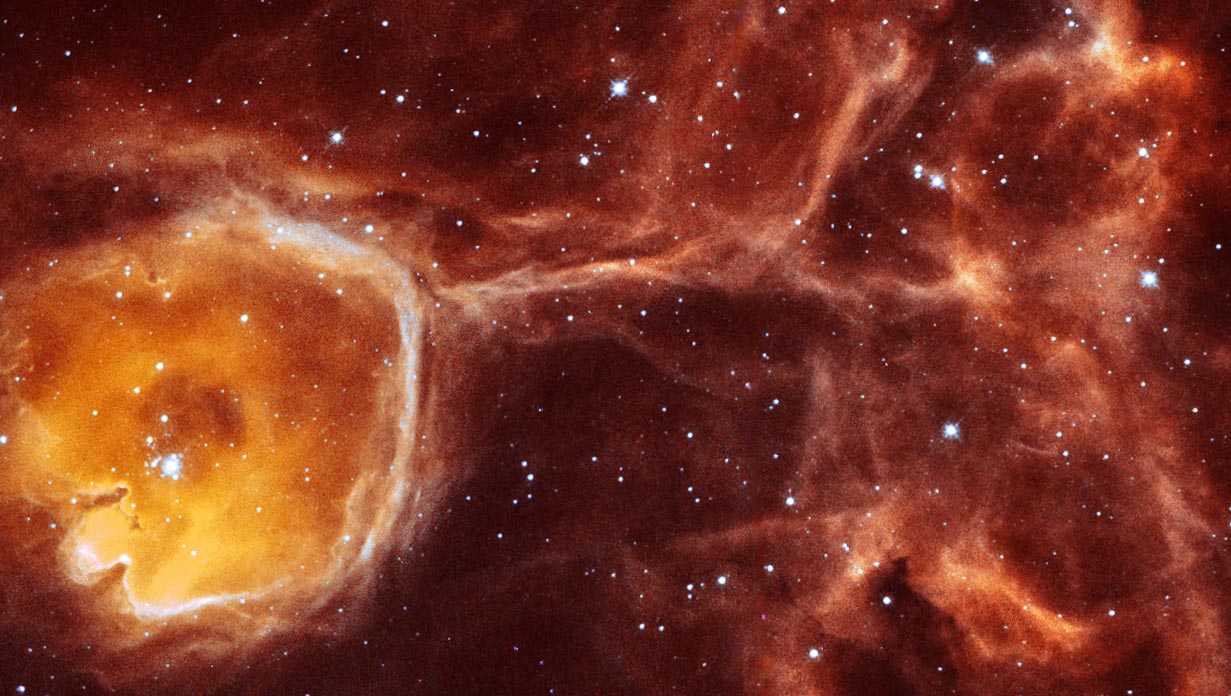
The process is collective. Winds from clusters of hot young stars carve bubbles in surrounding gas. When some of those stars explode, their shock waves can merge into larger cavities and break through the galaxy’s gas layer. The resulting galactic wind carries hot, chemically enriched material outward, sometimes far beyond the visible body of the galaxy.
A single supernova does not neatly sweep a galaxy clean. Gas density, the timing and location of star formation, dark matter, magnetic fields, and the surrounding environment all affect what escapes. Some material may slow in the circumgalactic medium, the diffuse halo beyond a galaxy’s main stellar body. Some may cool and return, while some may travel into intergalactic space.
That complexity makes dwarf galaxies demanding tests for computer simulations. Models must follow events that begin near individual stars but shape an entire galaxy over millions of years. If they underestimate how efficiently clustered explosions open escape routes, they will predict too much oxygen remaining inside the galaxy.
How GLOW built an oxygen budget
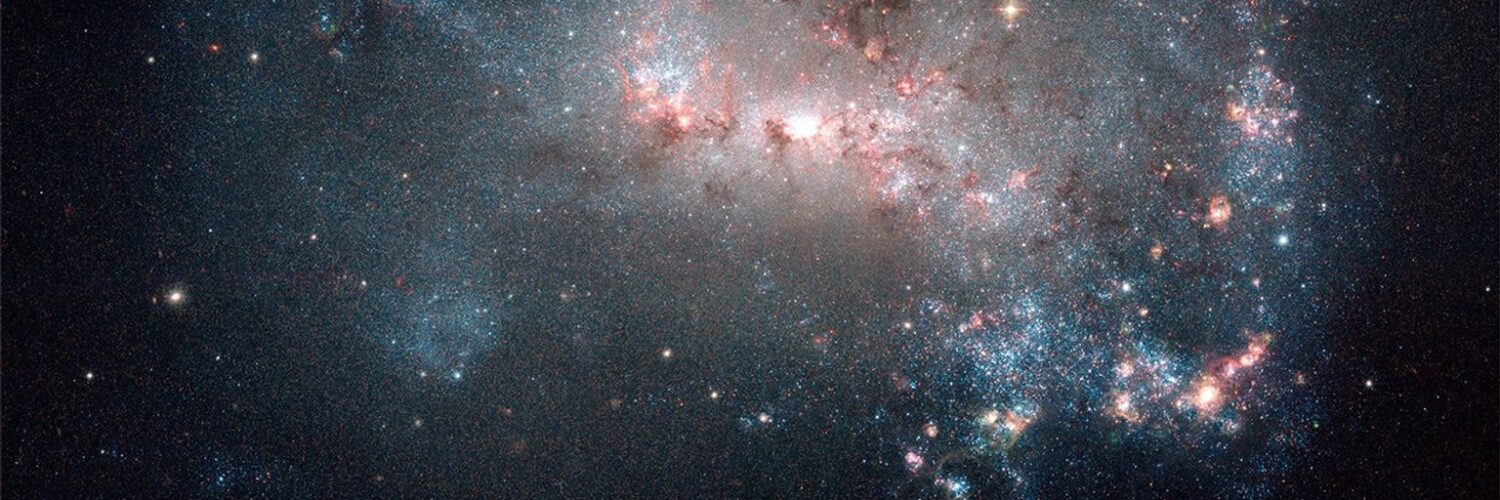
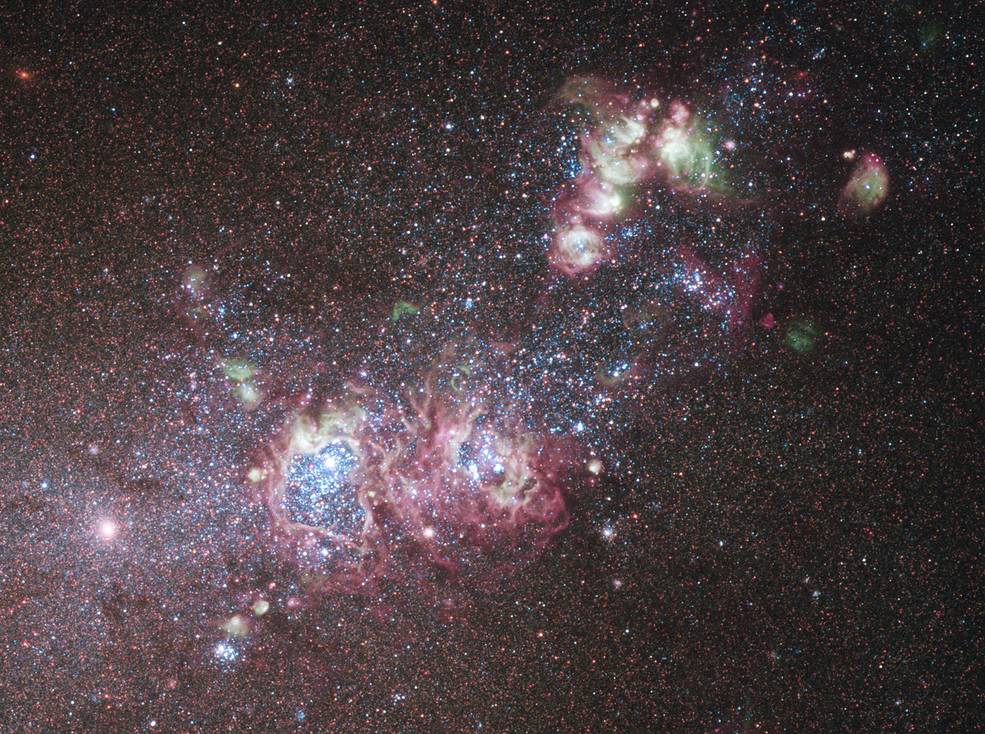
The GLOW team studied 37 gas-rich, low-metallicity dwarf galaxies within about 20 million light-years of Earth. The sample spans a critical range of stellar masses, from a few million to a few billion times the mass of the Sun, where theory predicts that stellar feedback should become increasingly effective at pushing material out.
Hubble’s sharp vision allowed researchers to resolve individual stars in galaxies close enough for this work. The colors and brightnesses of those stars preserve evidence of when the galaxy formed stars and how its stellar population changed. Reconstructing that history gives the team a way to estimate how much oxygen earlier generations of stars should have produced.
The accounting then extends beyond the stars. Researchers considered oxygen in the galaxies’ gas and dust as well as the amount locked into their stellar populations. NASA’s retired Spitzer Space Telescope supplied infrared data, while the Very Large Array and Australian Telescope Compact Array helped characterize gas. Combining those records produced a broader inventory than a measurement of glowing gas alone could provide.
The comparison exposed the deficit. Across galaxies with different masses and environments, the amount of oxygen retained was far below the expected production. The trend agrees with the basic idea that low-mass galaxies lose more material, but the loss is stronger than the models used for comparison predict.
The oxygen is missing from the ledger, not the universe
“Missing” can sound as though astronomers failed to look in the right place. Here it means that the oxygen is absent from the parts of each galaxy included in the inventory, even though stellar evolution says it must have been made. The leading explanation is ejection, but the present study does not locate every lost atom.
Some oxygen may remain in the circumgalactic medium, where gas is so thin and hot that it is difficult to detect. A 2014 study of star-forming galaxies closer to the Milky Way in mass found part of their missing oxygen in these extended gaseous halos. Around smaller galaxies, observations have detected enriched material too, but researchers still do not know whether the halo holds most of the deficit or whether much of it has escaped farther away.
The answer affects several big ideas in astronomy. Dwarf galaxies tend to contain fewer heavy elements than massive galaxies, a relationship known as the mass-metallicity relation. Efficient outflows help explain that pattern: small galaxies make metals but cannot keep them. Those outflows also seed intergalactic gas, spreading carbon, oxygen, and other elements that can later enter new galaxies.
Better measurements could also sharpen models of early cosmic history. Dwarf galaxies were far more common in the young universe, and systems like today’s nearby dwarfs provide accessible laboratories for studying them. If simulations hold on to too much oxygen, they may also misjudge how quickly early galaxies enriched their surroundings and how gas moved into and out of the first generations of small galaxies.
What astronomers need to find next
The immediate question is where the expelled oxygen now resides. Observing diffuse gas is difficult because it emits little light, so researchers often examine how it absorbs specific wavelengths from a bright background object. Future measurements across several forms of oxygen will be needed to trace gas at different temperatures and distances from a galaxy.
The team also plans to push toward even smaller systems. McQuinn has an approved program using the Nancy Grace Roman Space Telescope to find faint, low-mass galaxies over a wide field. Hubble and the James Webb Space Telescope can then study selected galaxies in greater detail, resolving their stars and reconstructing their histories.
The result is a useful correction to a familiar story. Stars forge oxygen, explosions scatter it, and new stars inherit part of the enriched material. In dwarf galaxies, that recycling loop is leaky. Their shallow gravity allows stellar feedback to export much of what their stars create, turning the space beyond the galaxy into part of the chemical history that must be counted.