Akshay Dinesh
A radio flash lasting only a few milliseconds has reached Earth from a galaxy seen when the universe was about 3 billion years old. Called FRB 20240304B, it is the most distant fast radio burst with a securely identified home galaxy. The record is striking, but the galaxy itself carries the more important clue: it is tiny, young, and rapidly forming stars. That setting strengthens the case that at least some fast radio bursts come from young, highly magnetized neutron stars called magnetars, while the signal’s long journey gives astronomers a rare way to trace otherwise hard-to-see matter between galaxies.
A millisecond signal with a 10-billion-year journey
Fast radio bursts, or FRBs, are brief pulses of radio energy that arrive from far beyond the Milky Way. Most appear once and vanish, so astronomers must recognize, record, and locate them before the sky returns to normal. Although a burst may last just a thousandth of a second, it can release enough radio energy to remain detectable after crossing billions of light-years. The first FRB was reported in 2007, and thousands have since been found, yet no single explanation accounts for every burst.
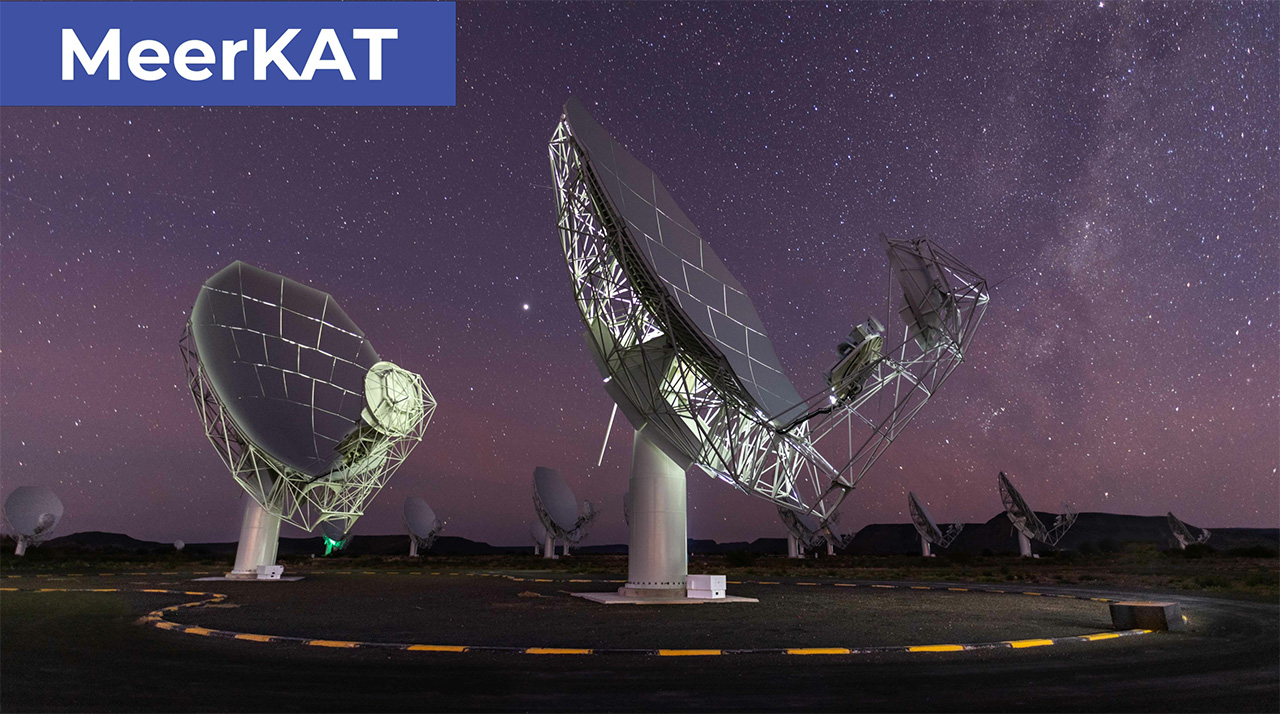
The MeerTRAP team detected FRB 20240304B on March 4, 2024, using South Africa’s MeerKAT radio telescope. MeerKAT is an interferometer: its 64 dishes observe together, and computers combine their signals so the array behaves like a much larger instrument. That combination provides both sensitivity and precise positions. In this case, the radio data indicated an extraordinary distance and narrowed the source to a tiny patch of sky, but even large optical telescopes could not reveal a galaxy there.
The burst’s distance was first suggested by dispersion. Space is not perfectly empty; it contains free electrons that interact with radio waves. Lower-frequency radio waves are delayed slightly more than higher-frequency waves, spreading an originally sharp pulse into a frequency-dependent sweep. The greater the column of electrons along the route, the larger the dispersion. A large value can signal a long intergalactic journey, although astronomers must separate contributions from the Milky Way, the host galaxy, and structures in between.
How astronomers found its nearly invisible home
Locating a burst is not the same as measuring the distance to its source. To confirm how far FRB 20240304B had traveled, researchers needed to identify its host galaxy and measure that galaxy’s redshift. The team turned to the James Webb Space Telescope because an extremely distant galaxy has much of its visible light stretched into infrared wavelengths. Webb’s NIRCam found a faint, clumpy object at the radio position where ground-based observations had seen nothing.
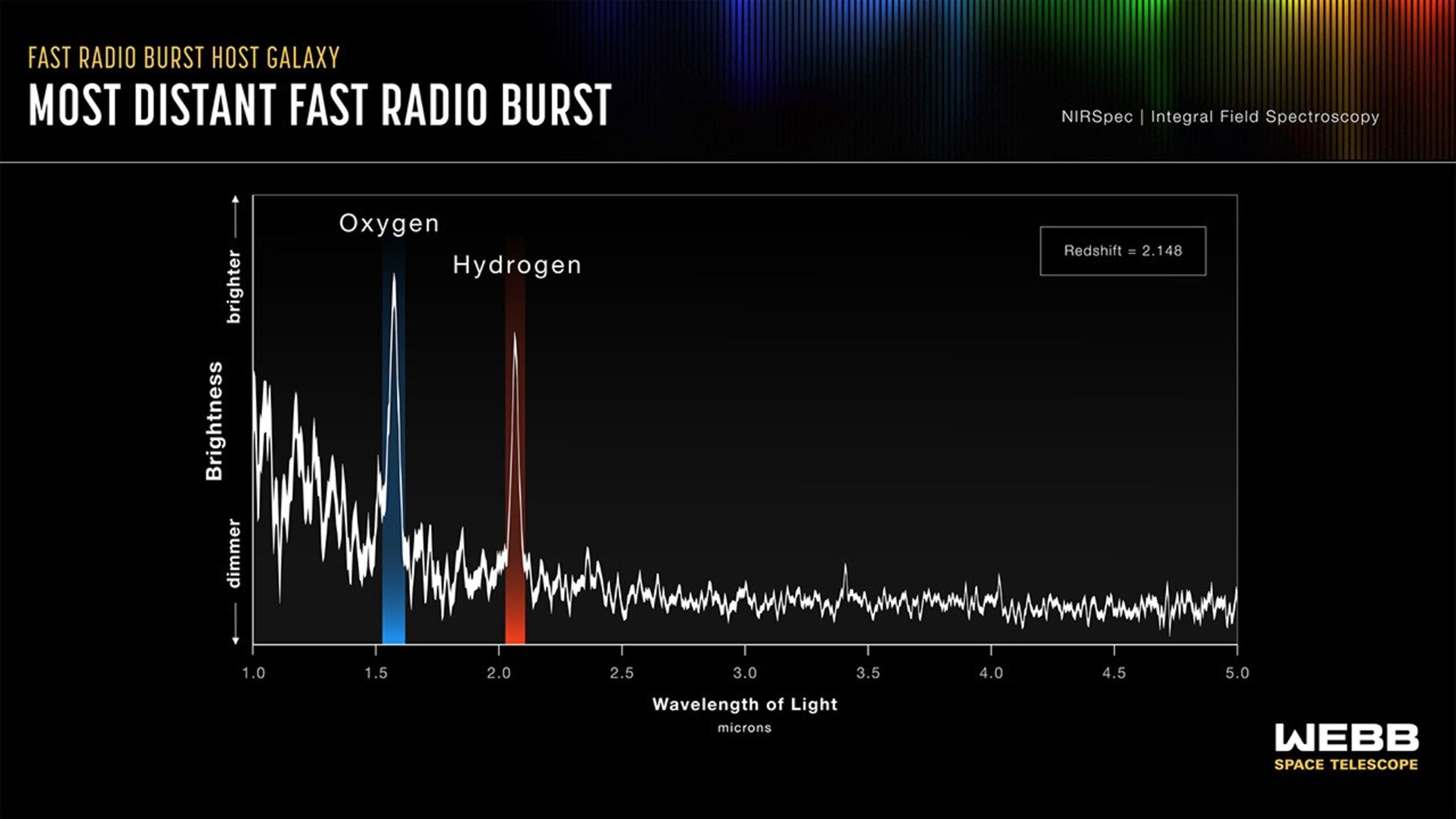
Webb’s NIRSpec instrument then separated the galaxy’s infrared light into a spectrum. Recognizable emission lines from hydrogen and oxygen appeared at wavelengths longer than they would in a nearby laboratory source. Their displacement gave a cosmological redshift of 2.148. Because the expansion of the universe stretches traveling light, that value places the galaxy at an epoch only about 3 billion years after the big bang, more than 10 billion years in the past.
The result, led by University of Sydney astronomer Manisha Caleb and published in Science on October 8, 2026, did more than confirm a distance record. The host was about 1,000 times less massive than the researchers had expected from previously known FRB galaxies. It was actively forming stars, and the observations suggested that most of its stars may have formed within roughly 30 million years. In cosmic terms, the system was caught very early in its development.
Why the young galaxy points toward magnetars
A neutron star is the compact core left behind when a massive star explodes. Some neutron stars possess magnetic fields so intense that they are called magnetars. Stress in a magnetar’s crust and sudden changes in its magnetic field can power violent flares. In 2020, telescopes detected an FRB-like radio pulse and an X-ray burst from the Milky Way magnetar SGR 1935+2154 at nearly the same time, providing direct evidence that magnetars can produce at least some of these radio flashes.
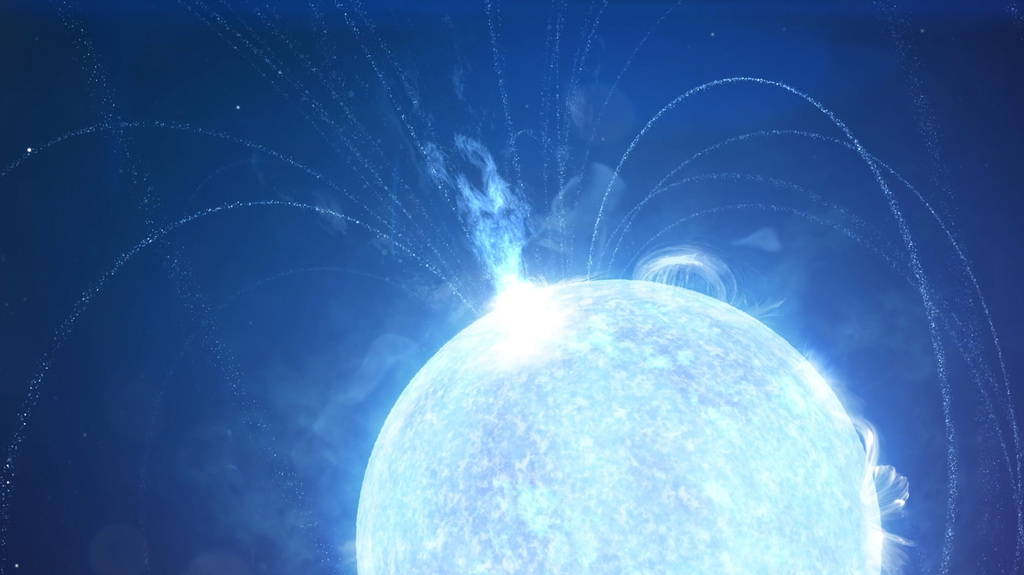
The age of the new host matters because different proposed sources operate on different clocks. A magnetar can appear soon after a massive star forms, lives briefly, and explodes. A merger between two neutron stars usually requires the pair to lose orbital energy and spiral together over a much longer period. A galaxy dominated by very recent star formation therefore provides a natural setting for a young magnetar, while a long-delay merger is harder to fit.
That is evidence, not a final identification. Researchers did not watch a particular magnetar emit FRB 20240304B, and one event cannot prove that every FRB shares the same engine. Some bursts repeat; many have been seen only once. Their host galaxies and detailed radio behavior also vary. The safest conclusion is narrower and more useful: this burst appeared in a place where a rapidly formed stellar remnant is plausible, and its youthful surroundings make a long-delay merger unlikely for this case.
The burst also maps matter between galaxies
An FRB carries information about everything its radio waves crossed. Free electrons along the route create dispersion, while magnetic fields can rotate the orientation of the waves’ polarization. Together, those effects can turn brief flashes into probes of the thin gas spread through and between galaxies. Much of the universe’s ordinary matter is difficult to see directly because it is too diffuse to shine brightly, but it can still leave a measurable fingerprint on a passing radio signal.
For FRB 20240304B, the researchers identified contributions associated with two intervening structures: the nearby Virgo Cluster and a previously unknown galaxy cluster at redshift 0.3, roughly 3.5 billion light-years away. Those foreground structures complicate a simple distance estimate because they add electrons of their own. Once recognized, however, the same complication becomes data. A growing sample of well-localized FRBs could help astronomers measure how ordinary matter is distributed through the cosmic web of clusters, filaments, and vast low-density regions.
This is why a fast radio burst is valuable even when its source remains uncertain. Its arrival time across different frequencies records the amount of ionized material along the path. Its precise sky position connects that measurement to known galaxies and clusters. With many bursts at known distances, astronomers can compare different sightlines rather than trying to reconstruct the universe from a single flash.
What the discovery changes, and what comes next
The Webb and MeerKAT result connects three kinds of evidence that are often separated: a millisecond radio pulse, an accurately measured host galaxy, and the intervening matter between that galaxy and Earth. The young host supports a magnetar origin for this event. Its redshift shows that FRBs were already occurring during cosmic noon, the era when star formation across the universe was near its peak. Its dispersed signal demonstrates how one transient event can reveal structures encountered over most of cosmic history.
Future progress depends less on finding another headline record than on building a larger, carefully measured sample. The research team estimates that MeerKAT may localize several bursts each year beyond redshift 1, while newer radio facilities should increase the pace. Radio arrays can catch and position the flashes; infrared observatories such as Webb can characterize host galaxies too faint for ordinary visible-light surveys. Each pairing adds a data point about where FRBs occur, how quickly their sources form, and what lies along the route.
FRB 20240304B does not close the case on fast radio bursts. It makes the investigation sharper. A flash that lasted milliseconds has linked a young dwarf galaxy, a likely class of stellar remnant, and billions of light-years of diffuse matter. The source may be brief, but the information carried by its journey is remarkably deep.