Akshay Dinesh
A brown dwarf can be warmer than an oven, colder than Antarctica, or anywhere in between. It forms from a collapsing cloud of gas, much as a star does, yet it never becomes massive enough to shine by fusing ordinary hydrogen for billions of years. Some brown dwarfs have clouds, storms, water vapor, and methane that make them resemble giant planets. That mixed identity is exactly why astronomers value them: brown dwarfs provide a natural laboratory for studying the uncertain territory between stars and planets.
A 2026 study led by Zafar Rustamkulov of Caltech’s IPAC used NASA’s SPHEREx space telescope to examine nearby brown dwarfs across nearly the full range of known temperatures. Instead of treating them as dim points, the team split their infrared light into spectra and found fingerprints of water, carbon dioxide, carbon monoxide, and methane. The broad chemical trends made sense, but individual objects repeatedly challenged the atmosphere models meant to explain them. Brown dwarfs may occupy a boundary on a classification chart, but their real value comes from showing how complicated that boundary is.
Brown dwarfs form like stars but cool like planets
Stars begin when gravity pulls gas and dust together inside a cold cloud. As the clump contracts, pressure and temperature rise at its center. If the growing object collects enough mass, the core eventually becomes hot and dense enough for sustained hydrogen fusion. That reaction converts hydrogen into helium and supplies the outward pressure that lets a main-sequence star shine steadily.
A brown dwarf follows the same opening steps but runs out of available material too soon. Its contracting interior heats up, and the most massive brown dwarfs can briefly fuse deuterium, a heavy form of hydrogen. They cannot maintain the ordinary hydrogen fusion that powers stars such as the Sun. The often-quoted dividing region is roughly 13 to 80 times Jupiter’s mass, although age, chemical composition, formation history, and the definition being used make the edges less tidy than those numbers suggest.
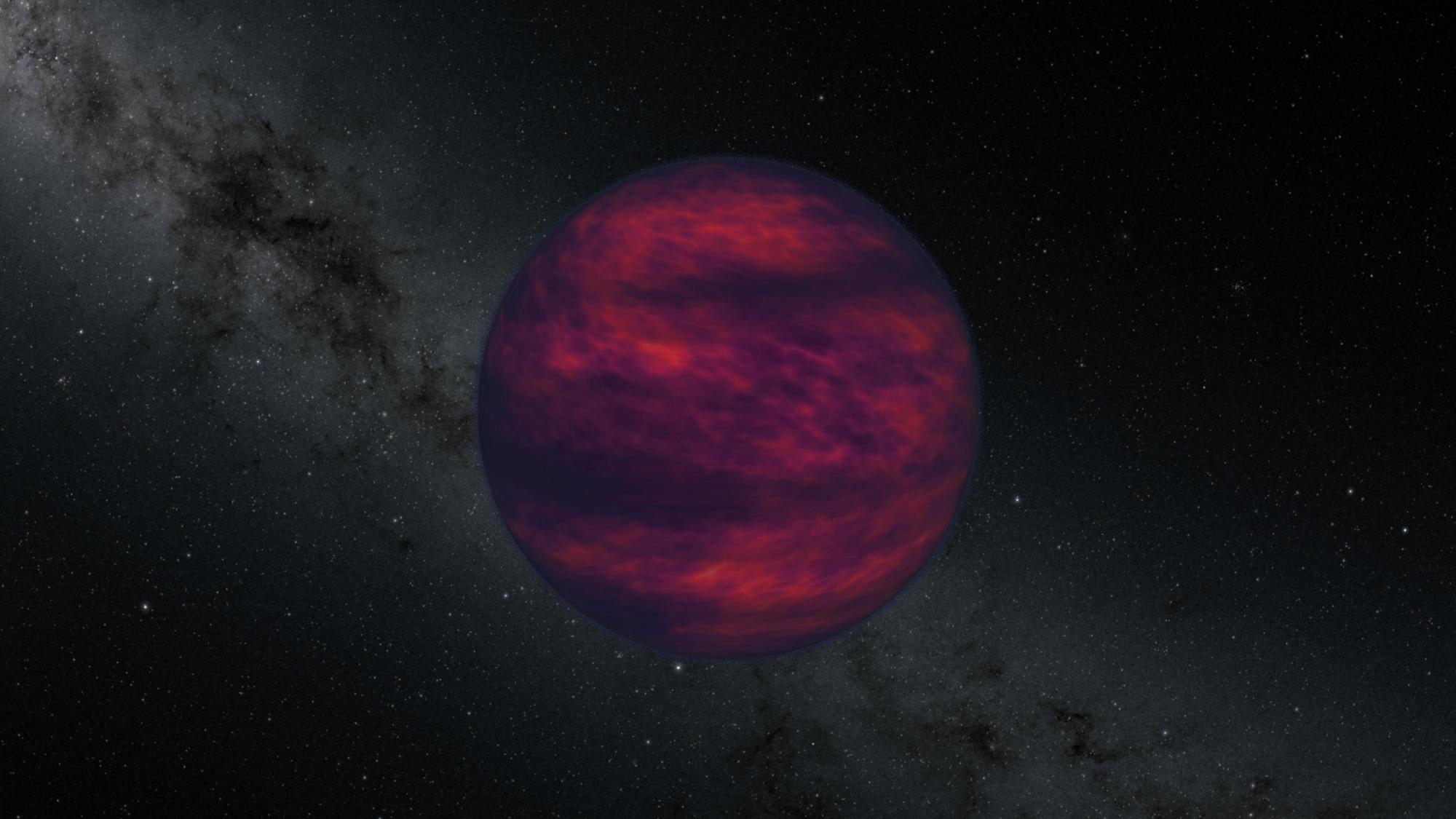
Without long-lasting fusion, a brown dwarf gradually releases the heat left from its formation and grows dimmer and cooler. Mass alone therefore does not determine what an observer sees. A young, low-mass brown dwarf can be hotter and brighter than an older, heavier one. Astronomers must combine temperature, luminosity, gravity, composition, motion, and age clues rather than relying on a single measurement.
Why the planet comparison is useful but incomplete
Brown dwarfs and giant planets can have similar sizes and atmospheric ingredients. Jupiter is mostly hydrogen and helium, and cool brown dwarfs can also contain water vapor, ammonia, and methane above deep layers of compressed gas. Both can develop bands, turbulent circulation, and patchy clouds. A brown dwarf’s brightness may change as it rotates, allowing astronomers to infer that brighter and darker weather systems are moving across its visible face.
The resemblance does not make a brown dwarf simply an oversized planet. Planets generally form in disks around young stars by building solid cores or gathering gas and dust. Brown dwarfs appear to form more directly from collapsing clouds and can travel through space without orbiting a star. Formation history is difficult to reconstruct for an isolated object, however, which is one reason mass-based and origin-based definitions do not always produce a perfectly clean boundary.
This ambiguity is scientifically productive. A free-floating brown dwarf is easier to observe than many exoplanets because its faint light is not buried beside the glare of a host star. Its atmosphere can act as a stand-in for the atmosphere of a young giant exoplanet, while its independent origin lets researchers test which properties come from temperature and gravity rather than irradiation by a nearby star.
SPHEREx turns faint infrared light into chemistry
SPHEREx, launched in March 2025, repeatedly maps the entire sky in 102 wavelength channels extending from visible red light into the near infrared. A normal image records how bright each location appears through a broad band of wavelengths. A spectrum instead measures brightness across many narrower channels. When molecules absorb particular wavelengths, they leave dips and shapes in the spectrum that work like chemical fingerprints.
The Rustamkulov team assembled SPHEREx spectra for a sequence of nearby brown dwarfs spanning classes from relatively warm L dwarfs to extremely cool Y dwarfs. Across that sequence, the researchers could follow changing signatures from water, methane, carbon monoxide, and carbon dioxide. SPHEREx observes from above Earth’s atmosphere, which matters because water vapor in our own air blocks several of the infrared wavelengths astronomers want to measure.
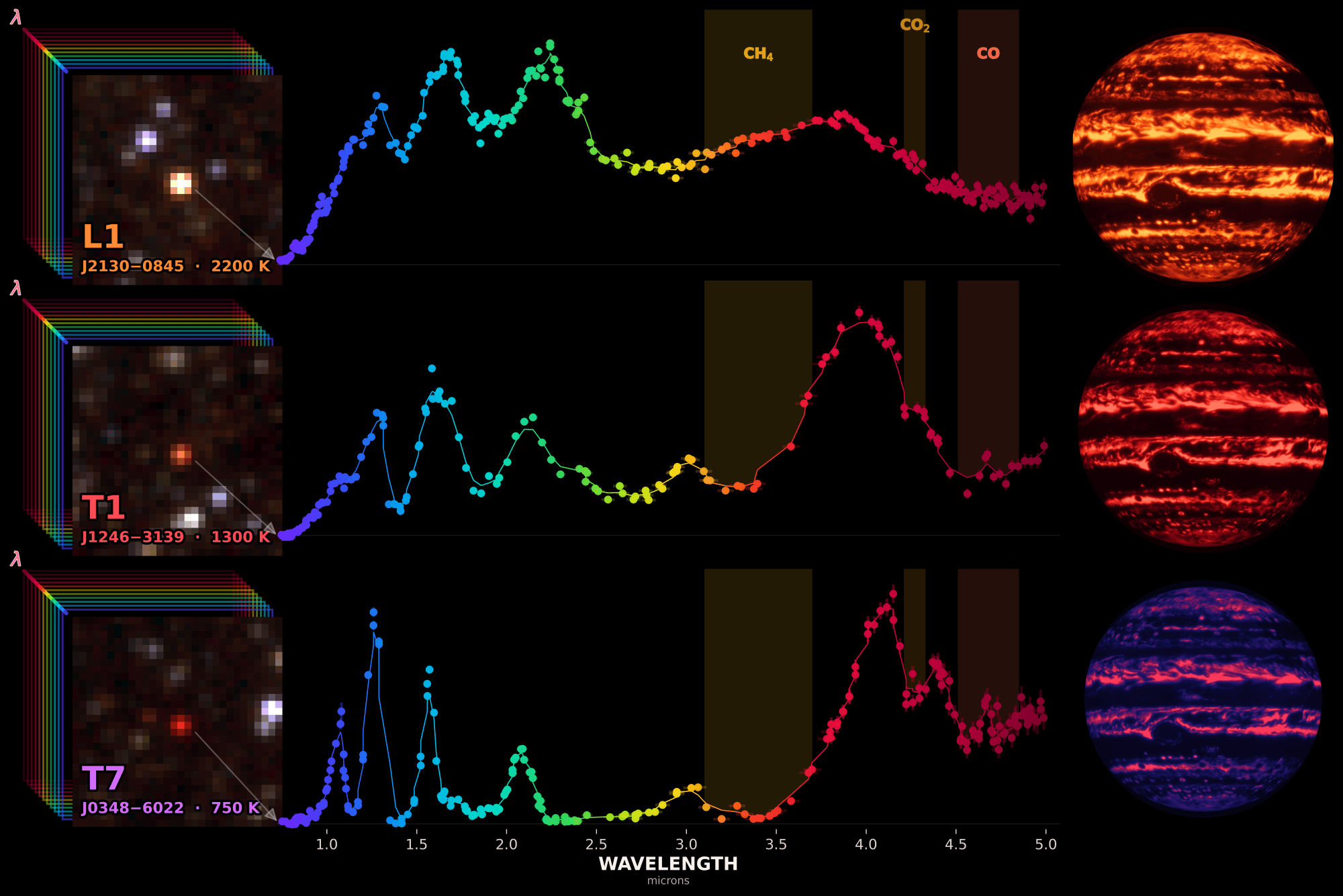
The telescope is not designed to take sharply detailed portraits of each world. Its strength is breadth and consistency. It can gather comparable spectra for thousands of brown dwarfs while carrying out its larger all-sky survey. That turns a field built partly on a few exceptional objects into one where scientists can ask population-level questions: Which atmospheric patterns are common? Which are rare? How much variety exists among objects with similar temperatures?
The hardest transition happens when clouds break apart
A cooling brown dwarf does not merely become a fainter version of its younger self. Its atmospheric chemistry and cloud structure change. Warm L dwarfs can carry thick clouds made from hot mineral condensates, including silicate particles. As the object cools toward the L-to-T transition, those clouds sink, thin, or break into patches. Deeper and hotter layers then become visible through gaps, while methane becomes increasingly prominent in the atmosphere.
That transition produces a stubborn modeling problem. The 2026 paper compared the observations with several widely used model grids, including Sonora Diamondback, Elf Owl, BT-Settl, and versions of ATMO. The models broadly reproduced the overall chemical progression, but they struggled to match all parts of the measured spectrum at once, particularly through the cloudy L-to-T transition. Some of the largest disagreements appeared near carbon dioxide and carbon monoxide features and in infrared windows where radiation escapes from deeper layers.
Two brown dwarfs at similar effective temperatures can therefore display noticeably different spectra. Cloud thickness, particle size, surface gravity, metallicity, and vertical mixing can each alter which molecules are present and how deeply an observer can see. Vertical mixing is especially important because moving gas can carry carbon monoxide or other species into layers where simple equilibrium chemistry predicts different abundances. The study found that weaker-mixing versions of one model family fit the field sample better than stronger-mixing versions, but no single model erased the broader discrepancies.
Better brown-dwarf models improve the study of exoplanets
An atmosphere model is more than an illustration. Astronomers use it to translate a measured spectrum into estimates of temperature, radius, gravity, cloud properties, and chemical composition. If a model fits the wrong combination of clouds and molecules, it can return a convincing number that does not accurately describe the object. A large, varied set of brown-dwarf spectra provides a demanding reality check because researchers can compare model predictions with objects across age, temperature, and composition.
Those improvements carry over to giant exoplanets. Directly imaged exoplanets and cool brown dwarfs can occupy similar temperature and gravity ranges, and both can contain clouds and molecules that shape their infrared spectra. The comparison is not perfect: a planet may receive energy from its star, and its formation history may change its composition. Even so, a model that cannot reproduce an isolated brown dwarf’s spectrum deserves caution when it is applied to a planet whose light is harder to separate and measure.
The first SPHEREx sample is a beginning rather than a final census. The mission is collecting spectra for thousands of brown dwarfs, including objects that may expose unusual gravity, composition, or weather. Follow-up observations from more powerful telescopes can then examine the most interesting cases in greater detail. The result will be a feedback loop: wide surveys reveal the range of nature, detailed observations probe individual atmospheres, and improved models return to the full population.
Brown dwarfs resist a simple label because nature does not have to honor the categories people draw. They begin in a star-like collapse, develop planet-like weather, and spend their lives cooling through a long sequence of atmospheric changes. By reading their infrared light across many wavelengths, astronomers are turning that awkward middle ground into one of the clearest tests of how clouds, chemistry, and heat shape worlds beyond the solar system.