 Rishay Dinesh
A black hole is not an empty tunnel or a cosmic vacuum cleaner. It is a concentration of mass so compact that it curves spacetime into a region from which nothing can escape once it crosses a boundary called the event horizon. Black holes cannot be seen directly because they emit no light of their own, yet their effects are visible across the universe: stars race around hidden masses, gas glows as it falls inward, and colliding black holes send ripples through spacetime. Those clues have turned an idea once known mainly from equations into an observable part of modern astronomy.
What Makes a Black Hole Black?
Gravity is often described as a pull, but Albert Einstein’s general theory of relativity gives a deeper picture. Mass and energy curve spacetime, and objects follow paths through that curved geometry. A black hole packs enough mass into a small enough region that all future paths inside the event horizon lead farther inward. Escaping would require moving faster than light, which the laws of physics do not allow.
The event horizon is a boundary, not a solid surface. Nothing dramatic must be sitting on it, and a large black hole could have relatively mild local tidal forces at that boundary. The decisive change is causal: after crossing the horizon, no signal can reach the outside universe. A distant observer would see light from an infalling object become increasingly delayed, redshifted, and faint. The falling object, however, would cross the horizon in a finite amount of time according to its own clock.
General relativity predicts a singularity deeper inside, where the theory produces infinite curvature. Physicists do not know whether this is a literal point of infinite density or a warning that relativity is incomplete under such extreme conditions. A successful theory of quantum gravity may eventually provide a fuller description. For now, the horizon and the behavior of matter outside it can be tested far more directly than the hidden interior.
How Black Holes Form and Grow
Stellar-mass black holes can form when very massive stars exhaust the nuclear fuel in their cores. Fusion had supplied pressure that helped resist gravity. When that support fails, the core collapses, while the outer layers may be expelled in a supernova. NASA notes that a star beginning with roughly 20 times the Sun’s mass or more can leave a core massive enough to continue collapsing into a black hole, although the exact outcome also depends on how much mass the star loses during its life.
A stellar-mass black hole may contain several to dozens of solar masses. At the other end of the scale, supermassive black holes hold hundreds of thousands to billions of solar masses and occupy the centers of most large galaxies. The Milky Way’s central black hole, Sagittarius A*, has about four million times the Sun’s mass. Astronomers have also found evidence for intermediate-mass black holes, which help bridge the gap between the two better-established groups, though many candidates remain difficult to confirm.
Black holes gain mass by accreting gas, capturing material from nearby stars, and merging with other black holes. The origin of the earliest supermassive black holes remains an active research problem because some grew to enormous sizes when the universe was still young. Primordial black holes, sometimes proposed as objects formed from unusually dense regions soon after the Big Bang, are still hypothetical rather than an observed fourth class.
What Happens Near a Black Hole?
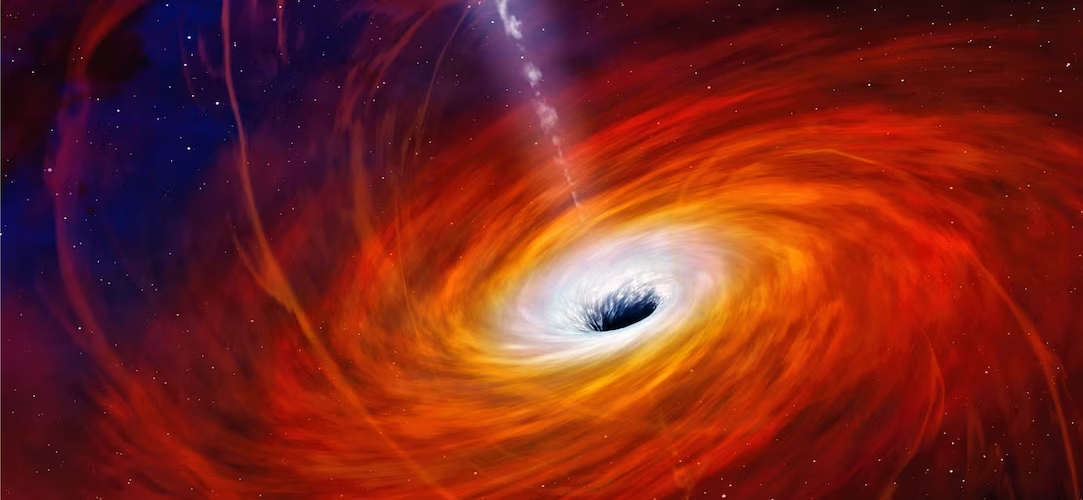
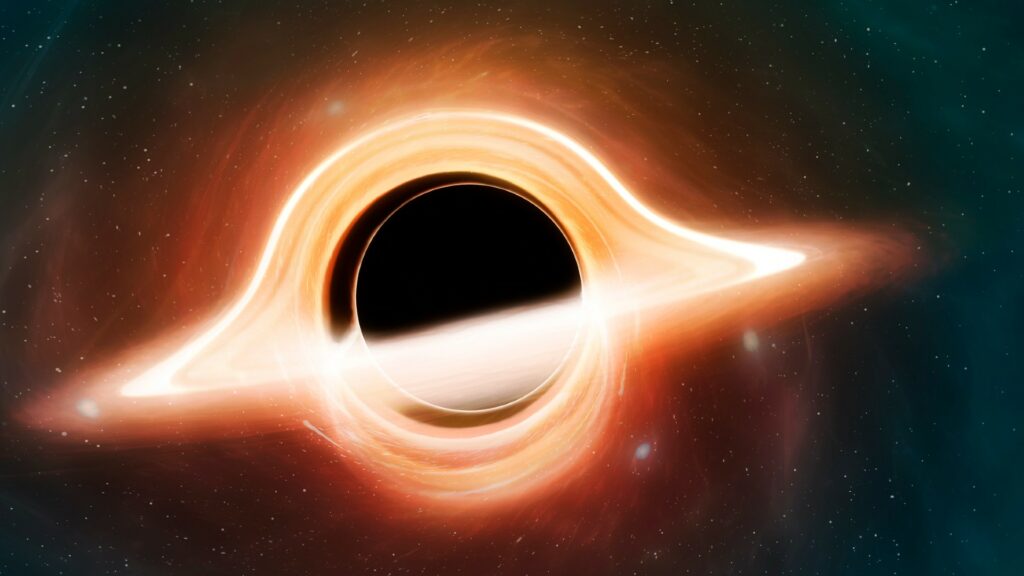
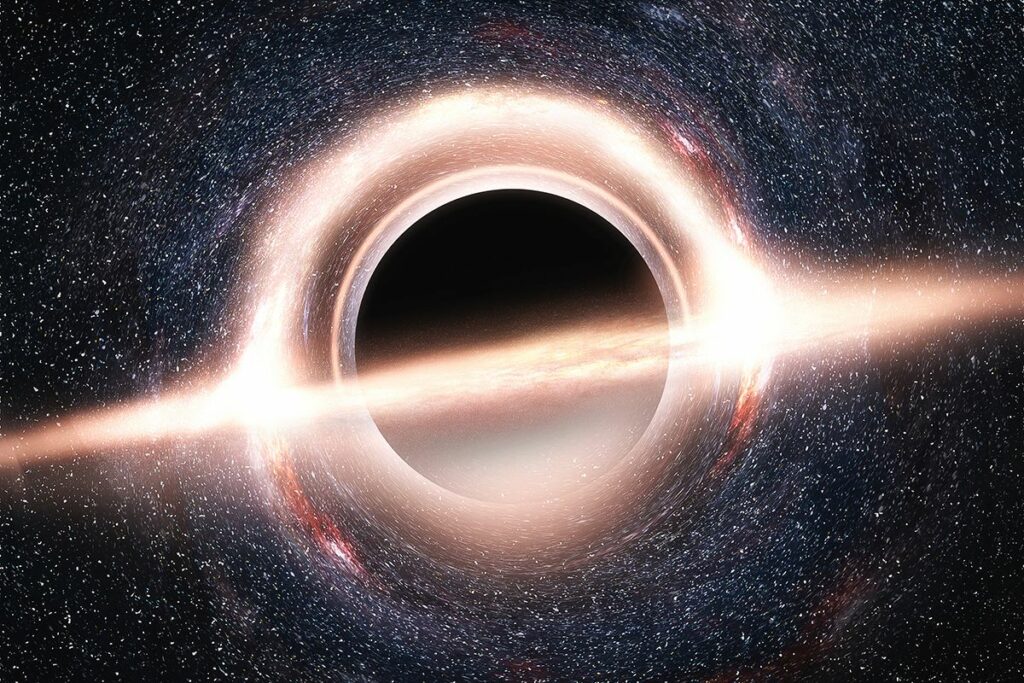
The brightest features associated with a black hole usually lie outside it. Gas and dust can settle into a rotating accretion disk, where collisions, compression, and magnetic turbulence heat the material until it radiates visible light, ultraviolet light, or X-rays. The black hole itself remains dark. When astronomers describe a bright black hole system, they are usually talking about this hot environment rather than light emerging from behind the event horizon.
Some feeding black holes also produce narrow jets that travel at nearly the speed of light. Matter does not shoot back out from inside the horizon. Instead, powerful magnetic fields near the inner accretion disk redirect a fraction of the infalling material before it crosses the boundary. Jets from active supermassive black holes can extend hundreds of thousands of light-years and influence the gas from which galaxies form new stars.
Extreme gravity changes the passage of time relative to observers farther away. It also creates tidal forces because the side of an object closer to the black hole feels a different gravitational effect from the side farther away. Near a stellar-mass black hole, that difference could stretch and compress an approaching object in a process nicknamed spaghettification. Around a much larger black hole, the horizon is wider and the tidal gradient there may be gentler, even though escape after crossing is still impossible.
Black holes do not pull on distant objects more strongly than any other object of the same mass. If the Sun could somehow be replaced by a black hole with exactly one solar mass, Earth’s orbit would remain nearly the same. The loss of sunlight would be catastrophic, but the planet would not suddenly spiral inward. Objects are captured only when their paths carry them close enough to lose energy or cross the horizon.
How Astronomers Detect Something That Emits No Light
One method is to measure motion. For decades, teams led by Reinhard Genzel and Andrea Ghez tracked stars orbiting an unseen, compact object at the center of the Milky Way. The orbit of a star called S2 showed that millions of solar masses must be concentrated in a remarkably small region. That work helped establish Sagittarius A* as a supermassive black hole and contributed to the 2020 Nobel Prize in Physics.
Astronomers also observe radiation from material outside black holes. X-ray telescopes can detect superheated gas in a binary system as a black hole pulls matter from a companion star. Radio observatories can map jets and active galactic centers. These measurements reveal mass, spin, magnetic fields, and the rate at which a black hole is feeding without requiring light from the black hole itself.
The Event Horizon Telescope added an extraordinary kind of evidence by linking radio observatories across Earth into one virtual telescope. In 2019, the collaboration released the first image of a black hole’s shadow, in the galaxy M87. In 2022, it released the first image of Sagittarius A*. Neither picture shows the hidden interior. Each shows a dark central shadow framed by radiation from hot gas whose light has been bent by intense gravity.
Gravitational waves provide another route. On September 14, 2015, the twin LIGO detectors recorded GW150914, a signal produced when two black holes spiraled together and merged about 1.3 billion light-years away. Announced in 2016, it was the first confirmed detection of gravitational waves and the first direct evidence of a binary black hole merger. Later detections have revealed a population of black holes that cannot be studied through light alone.
Why Black Holes Matter to Physics and Galaxies
Black holes place general relativity under conditions far more extreme than those found in the solar system. Stellar orbits around Sagittarius A*, the shapes of black hole shadows, and the gravitational waves from mergers all let researchers test whether Einstein’s predictions remain accurate in strong gravity. So far, these observations have agreed closely with relativity, while still leaving open questions about the interior of black holes and the quantum nature of gravity.
They also help explain how galaxies change. A quiet central black hole has little direct effect on most distant stars, but a rapidly feeding one can power an active galactic nucleus. Radiation, winds, and jets from the surrounding material can heat or remove a galaxy’s gas, altering the supply available for future star formation. The relationship works in both directions: galaxies deliver material to their central black holes, and black hole activity can reshape galactic environments.
Stephen Hawking’s calculations added another unresolved connection. Quantum theory predicts that black holes should emit an extremely faint form of radiation and slowly lose mass. Hawking radiation has not been detected directly from an astronomical black hole, and stellar or supermassive black holes would evaporate over timescales vastly longer than the universe’s present age. The prediction matters because it brings gravity, quantum physics, and thermodynamics into the same problem.
Black holes are therefore valuable not because they simply consume matter, but because they make hidden physics measurable. Their surroundings reveal how matter behaves near a point of no return; their mergers turn spacetime into a signal detectors can record; and their growth is tied to the history of galaxies. Every new observation narrows the gap between what equations predict and what the universe actually does.

 Akshay Dinesh