

 Akshay Dinesh
A map full of dots can feel messy at first. One dot might be a hospital, another a fire station, another a cell tower, a school, a store, or a weather sensor. The natural question is simple: which dot is closest to each place on the map? A Voronoi diagram answers by drawing borders around the dots, so every region belongs to the nearest one.
That makes Voronoi diagrams more than a clever pattern. They are a way to turn scattered locations into territories of influence. Instead of guessing which facility serves which neighborhood, or which weather station best represents a nearby area, the diagram gives a geometric rule: distance decides. Once that idea clicks, the strange-looking mosaic of polygons starts to read like a map of nearest choices.
The Basic Idea: Every Region Has a Nearest Point
A Voronoi diagram begins with a set of points. Mathematicians often call them sites, but they can stand for almost anything: stores, wells, airports, trees, sample locations, charging stations, schools, or people. Around each site, the diagram draws a cell. Every location inside that cell is closer to its site than to any other site in the set.
Imagine three libraries on a city map. If you live inside Library A’s cell, Library A is the closest of the three by straight-line distance. If you cross a boundary into Library B’s cell, Library B becomes closer. The boundary itself is special because points on it are tied: they are the same distance from two neighboring sites.
The word Voronoi comes from Georgy Voronoy, a mathematician who studied these kinds of space divisions. The same idea also appears under the name Thiessen polygons, especially in geography and meteorology. The names differ by field, but the central question stays the same: how can a space be divided by nearest point?
Why the Borders Are Perpendicular Bisectors
The easiest way to understand a Voronoi boundary is to start with only two sites. If two points are marked on a page, the places equally far from both points form one straight line. That line cuts the segment between the two sites exactly in half and meets it at a right angle. In geometry, it is called the perpendicular bisector.
On one side of that line, every location is closer to the first site. On the other side, every location is closer to the second. The line is the exact switching point. It is not chosen because it looks balanced; it is forced by distance.
With three or more sites, the same rule repeats many times. Each site competes with every nearby site, and the final cell is the part of the plane that survives all those comparisons. That is why Voronoi cells often look like irregular polygons. Their edges come from perpendicular bisectors, but the shape depends on where the neighboring sites are placed.
A site surrounded by many nearby sites usually gets a small cell. A site that is far from others often gets a large one. This is one reason Voronoi diagrams are so useful: they show spacing at a glance. Crowded areas create tight cells, while isolated points create broad regions.
A Small Example With Stores
Suppose a town has four grocery stores. A simple map with only the store locations does not immediately show which store is nearest to each home. A Voronoi diagram turns that question into regions. Every address inside Store 1’s region is closer to Store 1 than to Stores 2, 3, or 4. Every address inside Store 2’s region is closest to Store 2, and so on.
This does not mean every shopper will choose the nearest store. People care about price, traffic, parking, inventory, habits, and personal preference. Geometry cannot know those details. What it can do is give a clean starting point: if distance were the only factor, this is how the town would be divided.
That starting point can still be powerful. A business might compare its Voronoi cell with its actual customer area. If customers regularly cross into another store’s nearest-distance region, something besides distance is attracting them. If a large neighborhood is far from every store, it may reveal a service gap. The diagram does not make the decision, but it makes the distance pattern visible.
Where Voronoi Diagrams Show Up in Real Life
Voronoi thinking appears anywhere people need to connect places to their nearest source. In geography, Thiessen polygons can estimate which rain gauge best represents different parts of a watershed. In emergency planning, nearest-facility maps can help analysts think about ambulance stations, hospitals, or shelters. In wireless networks, a rough Voronoi view can show which tower might be closest to a phone or sensor, even though real signal strength also depends on buildings, hills, weather, and equipment.
Scientists use the same kind of partitioning in less obvious settings. Materials scientists may use Voronoi-like patterns to describe grains in metals or crystals. Biologists may use them to model how cells pack together in tissue. Computer scientists connect them to nearest-neighbor searching, image processing, robotics, and other problems where distance shapes a decision.
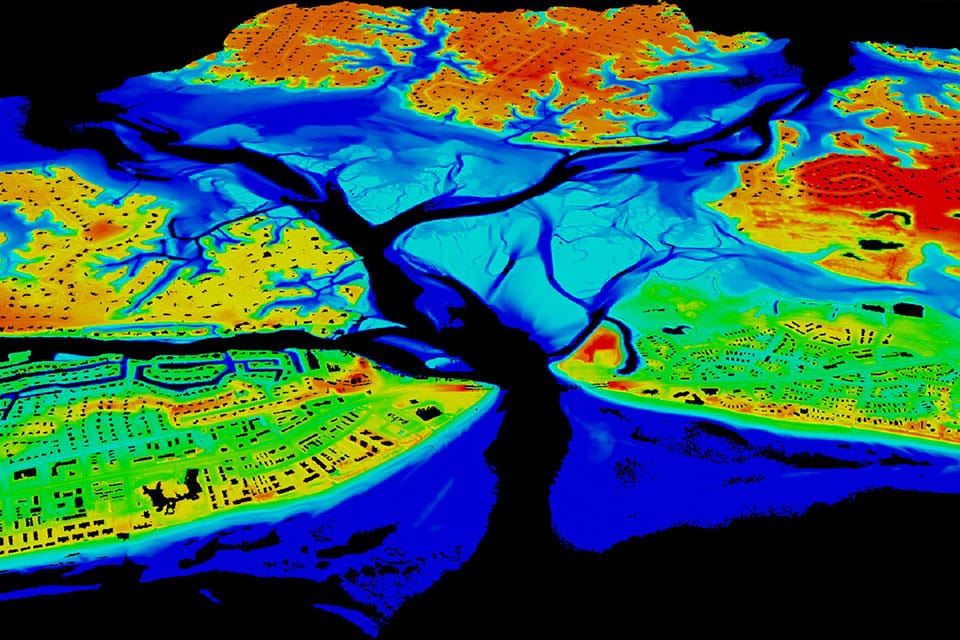
The map examples are especially easy to picture because they match everyday experience. If a delivery company wants to divide a city among depots, nearest-distance regions are a logical first draft. If a school district studies how far families live from campuses, Voronoi cells can reveal which school is geometrically closest to each area. If a park agency maps the nearest visitor center or ranger station, the same structure can organize the landscape.
The diagram also appears behind some digital tools even when users never see it directly. A nearest-location search starts with a point and asks which known place is closest. A Voronoi diagram answers that question for every possible starting point at once. Instead of solving one distance problem, it builds a full map of answers.
What the Diagram Leaves Out
A basic Voronoi diagram usually uses straight-line distance. That is useful for learning the idea, but real travel rarely happens in straight lines. Roads curve. Rivers, mountains, rail lines, restricted areas, and traffic patterns change how long a trip takes. A location that is closest as the crow flies may not be fastest by car, bus, bike, or walking route.
That is why professionals often adapt the idea. A map can use travel time instead of straight-line distance. It can weight some sites differently, giving a larger service area to a major hospital or a smaller one to a limited clinic. It can account for barriers, road networks, or capacity limits. The basic Voronoi diagram is the clean geometry version; real planning often asks a messier version of the same nearest-place question.
There is also a data warning. If the starting sites are incomplete, misplaced, or outdated, the regions will look precise while still being misleading. A missing station or closed store can change the map. So can using the wrong distance measure. The crisp lines are only as trustworthy as the assumptions behind them.
Why This Geometry Is Worth Learning
Voronoi diagrams are satisfying because they reveal a hidden order in ordinary location problems. The math starts with something familiar: distance between points. From there, it builds a full system of borders, cells, and regions. A student who understands perpendicular bisectors already has the key to the whole construction.
They also show why geometry is not limited to shapes on worksheets. The same idea can help explain delivery areas, emergency coverage, weather-station influence, digital maps, biological patterns, and computer search methods. A small geometric rule becomes a tool for organizing space.
The next time a map shows scattered locations, it is worth asking what the nearest-region pattern would look like. Which areas are crowded? Which point has the widest reach? Where would the boundaries fall if distance alone made the decision? Those questions are exactly where Voronoi diagrams shine: they turn a cloud of points into a map that can be read, questioned, and improved.





Add comment