
 Akshay Dinesh
Few soccer calls create more instant argument than offside. A forward times a run, a pass slips through the defense, the crowd rises, and then a flag or video review turns a possible goal into a geometry problem. The rule can feel mysterious because it is not only about where a player stands. It is about where several moving objects are at one exact instant: the attacker, the ball, the second-last defender, the halfway line, and sometimes a shoulder or foot that is only slightly ahead.
That is why offside is a useful way to see geometry outside a classroom. The decision depends on lines, distances, angles, and perspective, but it also depends on time. The field is a grid in motion. Players are constantly trying to bend that grid to their advantage, while officials and technology try to freeze one moment clearly enough to judge it.
The rule starts with a reference line
The International Football Association Board’s Law 11 says that being in an offside position is not automatically an offence. A player is in that position only if a legal scoring body part, such as the head, body, or feet, is in the opponents’ half and nearer to the opponents’ goal line than both the ball and the second-last opponent. Hands and arms do not count for judging the line, even for goalkeepers.
In geometric terms, the goal line acts like a fixed baseline. The offside question asks which relevant point is closer to that baseline at the moment a teammate plays or touches the ball. If the second-last defender’s closest relevant body part is the reference point, the offside line is drawn across the field through that point, parallel to the goal line. If the ball is closer to the goal line than that defender, the ball becomes the reference instead.
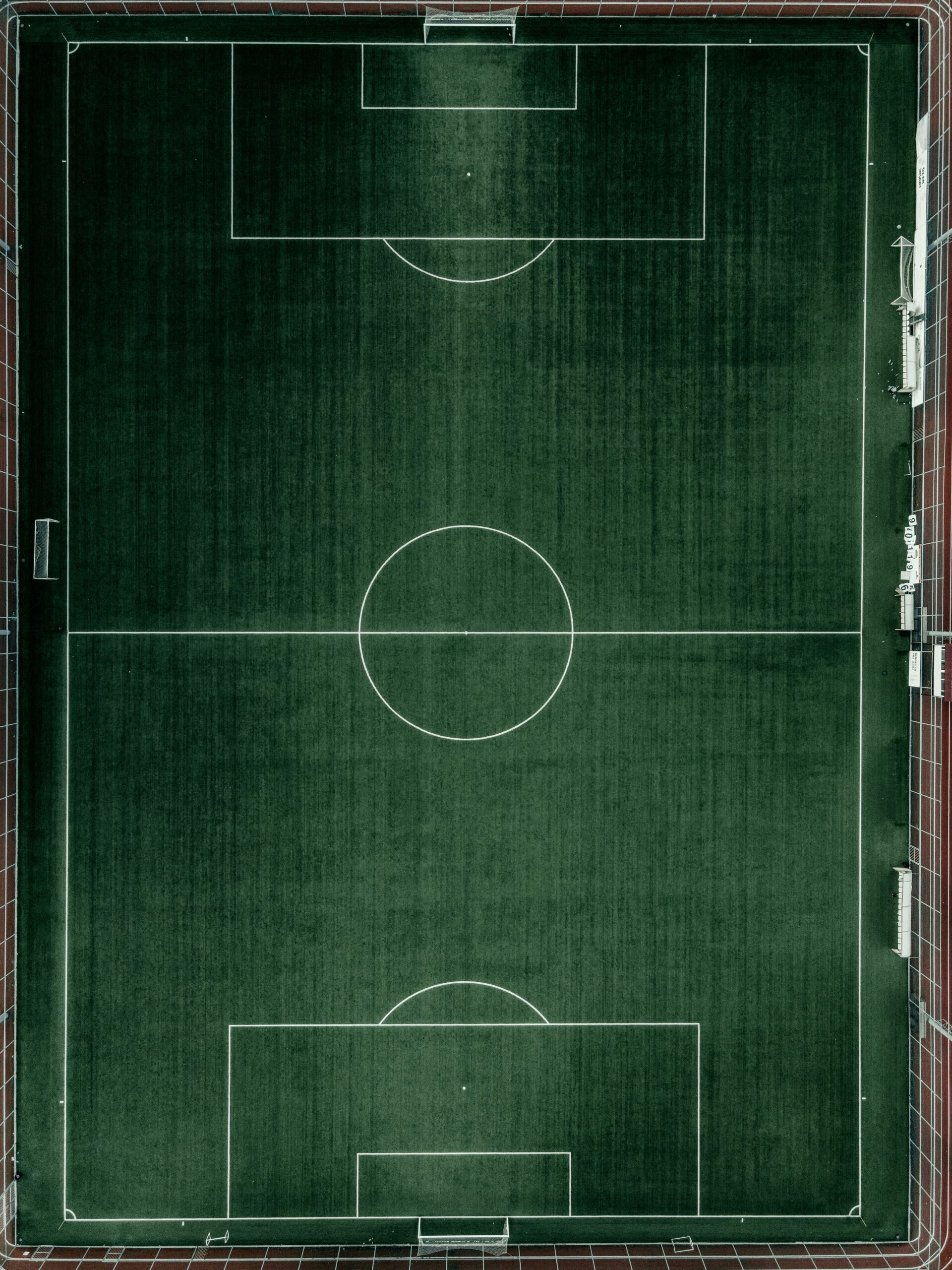
This is why the phrase “level with the defender” matters so much. Level does not mean the players look side by side from a television angle. It means the attacker’s relevant body part has not crossed the reference line toward the goal. A player can appear ahead from one camera view and still be level when measured against the actual field lines.
Why the second-last defender matters
Many beginners learn offside as “do not stand behind the last defender,” but that shortcut can mislead. The law uses the second-last opponent because the goalkeeper is often the last opponent, but not always. If a goalkeeper rushes out or a defender drops onto the goal line, the order can change quickly. The rule is not naming a position; it is comparing attackers with the two opponents closest to the defending goal line.
Imagine the field as a coordinate plane. If the attacking team is moving toward the right, every player has a horizontal position that can be compared with the goal line. The second-last opponent creates a moving boundary. Attackers can stand behind that boundary safely if the ball is even closer to goal, if they are still in their own half, or if they receive the ball directly from a throw-in, goal kick, or corner kick.
The boundary also changes with every step. A defender who moves forward pulls the line away from goal. A forward who curves a run tries to stay just on the safe side until the pass is made, then sprint beyond the defenders after the ball has left the passer’s foot. That tiny difference between before and after is the heart of the call.
The timing problem is just as important as the line
An offside decision is not made when the receiver touches the ball. It is judged at the moment a teammate plays or touches it. That creates a timing problem: officials must identify the right frame of the pass, then compare positions at that frame. A forward may be onside when starting the run, offside when receiving the ball, and still legal if the forward was level when the pass was played.
This is where the geometry becomes four-dimensional in a practical sense. The field has length and width. Players have body positions. The decision also needs a timestamp. A still image taken half a second too late can make a legal run look illegal because fast players may cover several feet in that time.
Close calls are hard because the ball and the players move at different speeds. The passer’s foot may be contacting the ball across more than one video frame. A defender may be stepping up while an attacker leans forward. One shoulder, knee, or foot can become the most advanced legal body part. To judge the play fairly, the line and the instant must match.
Camera angles can fool the eye
Television viewers often see offside from a camera placed above the sideline, not directly in line with the second-last defender. That angle creates parallax, the same effect that makes a nearby object seem to shift when you close one eye and then the other. If the camera is not square to the offside line, players at different depths on the field may appear ahead or behind in ways that do not match the measurement.
Assistant referees are trained to stay even with the second-last defender partly for this reason. The closer the view is to the reference line, the less misleading the angle becomes. Even then, the job is difficult because the official must watch the passer and the defensive line at nearly the same time. Human judgment has to connect a sound, a touch, a run, and a line across a wide field.
The geometry also explains why grass-cutting patterns can help but cannot decide the call by themselves. Mowed stripes often run parallel to the goal line, so they give the eye a useful guide. But stripes are too wide and not precise enough for tight decisions. They can show the general shape of the play; they cannot replace an exact line through the correct body part.
How technology draws the line
Video assistant referee systems made offside decisions more reviewable, but early reviews often depended on manually choosing the kick point and drawing lines on the image. FIFA’s semi-automated offside technology was designed to speed up that process by tracking the ball and multiple body points on each player. For the 2022 World Cup system, FIFA described 12 dedicated tracking cameras, up to 29 data points per player, and tracking at 50 times per second, with ball data helping identify tight kick points.
The important idea is not that the technology changes Law 11. It tries to measure the geometry that the law already requires. The system estimates relevant body points, selects a likely kick point, and creates an offside line from the measured positions. Video officials still validate the decision, especially when the question is not just position but involvement in active play.
For the 2026 World Cup, FIFA announced an advanced version intended to send clear positional offside alerts directly to match officials more quickly. FIFA also noted an important limit: the system can help identify positional offside, but it does not settle every judgment about whether an offside-positioned player interfered with an opponent or became involved in active play. Measurement can answer where players were; the referee still has to apply the rule to what happened.
Why offside rewards smart movement
Offside is sometimes described as a technical nuisance, but it shapes the way soccer is played. Without it, attackers could wait near the goal for long passes, stretching the game into something less connected. With it, forwards have to read defenders, time runs, and use curves, hesitations, and sudden acceleration. Defenders have to hold a line together, step forward at the right instant, and avoid leaving one teammate too deep.
The best attacking runs often look like geometry drawn at speed. A forward may start wide, bend inward to stay level with the defender, and then cut diagonally behind the line after the pass. The passer may delay just long enough for the run to stay legal. The defending line may compress the safe space by stepping forward together. Everyone is working with distance, angle, and timing, even if no one is naming it that way during the match.
That is what makes offside more than a rulebook detail. It turns open space into a contest of measurement and anticipation. The line is invisible until someone challenges it, but players feel it constantly. When a replay shows an attacker barely level or barely ahead, the drama comes from the same idea students meet in geometry: a small change in position can change the whole answer.




Add comment