
 Akshay Dinesh
Some numbers are awkward before they are even hard. The distance from Earth to the Sun is about 149,600,000 kilometers. A red blood cell is only about 0.000007 meters wide. Neither number is especially mysterious, but both are easy to misread because the important idea is buried inside a long line of zeros. Scientific notation solves that problem by separating a number into two parts: the meaningful digits and the power of ten that tells how large or small the number is.
That small change makes numbers easier to compare, easier to estimate, and easier to use in calculations. Instead of asking your eyes to count zeros, scientific notation asks you to read the size of the number from its exponent. It is one of those math tools that looks formal at first but quickly becomes practical, especially in science, engineering, medicine, astronomy, and any situation where ordinary decimal notation gets bulky.
The problem with long strings of zeros
Place value works beautifully when numbers stay within a familiar range. A number like 4,500 is easy to picture because the commas help, the digits are few, and the size is familiar. But the same system becomes clumsy when a number stretches across many places. With 4,500,000,000,000, a reader may need to pause just to decide whether the number is in the billions or trillions. With 0.0000000045, the same problem appears in the other direction: the meaningful digits are there, but they are pushed far away from the decimal point.
Scientific notation compresses that place-value information without changing the value of the number. The number 4,500,000,000,000 becomes \(4.5 \times 10^{12}\). The number 0.0000000045 becomes \(4.5 \times 10^{-9}\). In both cases, the coefficient 4.5 carries the main digits, while the exponent tells how many powers of ten are involved. A positive exponent moves the value into the large-number side of the number line. A negative exponent moves it into the small decimal side.

The key is that scientific notation is not a trick for changing numbers into something new. It is a different way of writing the same amount. That distinction matters. When students first meet the notation, the exponent can feel like an extra operation waiting to happen. Really, it is a place-value label. It tells where the decimal point belongs if the number is written out in ordinary decimal form.
How scientific notation is built
A number in standard scientific notation has the form \(a \times 10^n\), where \(a\) is at least 1 but less than 10, and \(n\) is an integer. The first part, \(a\), is often called the coefficient. The second part, \(10^n\), is the power of ten. For example, \(6.02 \times 10^{23}\) has a coefficient of 6.02 and an exponent of 23. The coefficient gives the readable digits; the exponent gives the scale.
To write a large number in scientific notation, move the decimal point until only one nonzero digit is left before it. Then count how many places the decimal moved. For 72,000,000, the decimal point starts at the end of the number. Moving it seven places left gives 7.2, so the number is \(7.2 \times 10^7\). The exponent is positive because the original number was larger than 10.
Small decimals work in the opposite direction. For 0.00038, move the decimal point four places right to get 3.8. That means \(0.00038 = 3.8 \times 10^{-4}\). The exponent is negative because the original number was between 0 and 1. A negative exponent does not mean the number itself is negative. It means the number is a fraction of 1, written using repeated division by 10.
This is where many mistakes begin. The sign of the exponent describes size, not direction on the number line. The number \(5 \times 10^{-3}\) is positive if the coefficient is positive; it equals 0.005. A number becomes negative only if there is a negative sign on the coefficient, as in \(-5 \times 10^{-3}\).
Why exponents make comparison faster
Scientific notation is especially useful because exponents let you compare scale almost instantly. Compare \(3.1 \times 10^8\) and \(7.4 \times 10^6\). The coefficient 7.4 is bigger than 3.1, but the exponent 8 is larger than 6. Since each increase of 1 in the exponent represents another factor of 10, \(3.1 \times 10^8\) is much larger. The exponent usually settles the question before the coefficient matters.
The same idea helps with tiny measurements. Compare \(2.5 \times 10^{-6}\) and \(8.0 \times 10^{-9}\). Both are small, but \(10^{-6}\) represents millionths while \(10^{-9}\) represents billionths. Millionths are larger than billionths, so \(2.5 \times 10^{-6}\) is larger even though 2.5 is less than 8.0. Negative exponents can feel backward at first because -9 is less than -6, but \(10^{-9}\) is farther to the right of the decimal point and therefore smaller.
This comparison skill is one reason scientific notation appears so often in science. It helps readers see order of magnitude, meaning the rough scale of a quantity by powers of ten. A measurement around \(10^3\) is in the thousands. A measurement around \(10^6\) is in the millions. A measurement around \(10^{-6}\) is in millionths. Once that scale is visible, a number becomes easier to judge before any detailed calculation begins.

Order of magnitude thinking also prevents unreasonable answers from slipping by unnoticed. If a calculation about a classroom desk produces a length of \(2 \times 10^5\) meters, the exponent alone should raise concern. That value is 200,000 meters, far beyond any ordinary desk. Scientific notation does not replace careful calculation, but it gives a quick reality check.
Calculating without losing the size of the answer
Multiplication and division are where scientific notation begins to feel efficient. Because powers of ten follow exponent rules, the scale part can be handled separately from the coefficient. For example, \((3 \times 10^4)(2 \times 10^5)\) can be grouped as \((3 \times 2) \times (10^4 \times 10^5)\). The coefficients give 6, and the powers of ten combine to make \(10^9\). The answer is \(6 \times 10^9\).
Division works in a similar way. With \((8 \times 10^7) \div (2 \times 10^3)\), divide the coefficients to get 4 and subtract the exponents to get \(10^4\). The result is \(4 \times 10^4\), or 40,000. This method keeps the calculation organized because the digits and the place value are not tangled together.
Addition and subtraction require more care. You cannot simply add the exponents. The numbers must first be written with the same power of ten, just as ordinary decimals must line up by place value. For example, \(3.2 \times 10^5 + 4.5 \times 10^4\) is easier if the second number becomes \(0.45 \times 10^5\). Then the coefficients can be added: \(3.2 + 0.45 = 3.65\). The sum is \(3.65 \times 10^5\).
This rule makes sense if you think about units of place value. You can add 3.2 hundred-thousands and 0.45 hundred-thousands because they are measured in the same size group. But adding exponents directly would mix up the scale and produce an answer that is far too large.
Common mistakes and a better way to check your work
The most common mistake is placing the decimal in the wrong direction. A reliable check is to ask whether the original number was large or small. If it was larger than 10, the exponent should usually be positive. If it was between 0 and 1, the exponent should usually be negative. This simple question catches many errors before they become habits.
Another mistake is leaving the coefficient outside the standard range. A number like \(42 \times 10^6\) is mathematically equal to \(4.2 \times 10^7\), but only the second version is standard scientific notation because the coefficient is between 1 and 10. Standard form makes comparison easier because every number follows the same pattern.
A third mistake is forgetting that scientific notation should still make sense as an estimate. If \(9.8 \times 10^4\) is converted to 980,000, something went wrong. Since \(10^4\) is 10,000, a coefficient close to 10 should give a number close to 100,000, not nearly one million. Estimation is not a separate skill from scientific notation; it is one of the best ways to use it well.
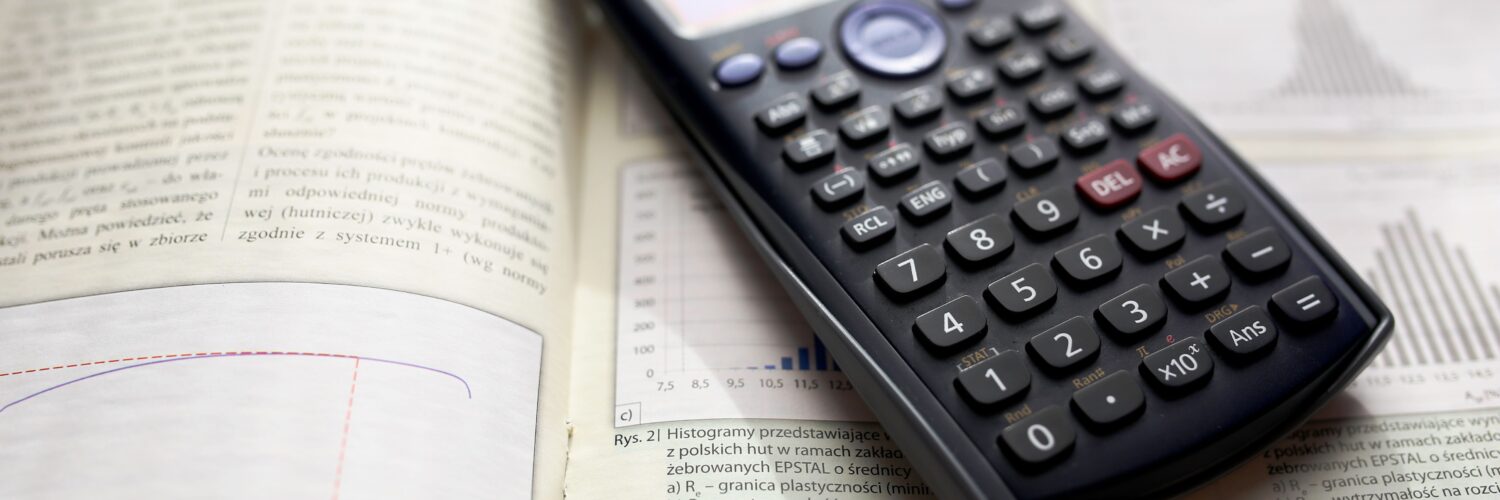
Calculators can introduce another source of confusion because many display scientific notation with an E. For example, 3.6E8 means \(3.6 \times 10^8\), not 3.6 times 8. The E stands for the power-of-ten exponent. Reading calculator notation correctly is especially helpful in science classes, where measurements may appear in compact digital form.
Why the notation is worth learning
Scientific notation earns its place because it turns scale into something visible. It lets a student compare the size of planets, cells, populations, wavelengths, computer storage, and chemical quantities without drowning in zeros. It also gives calculations a structure: coefficients show the main digits, while exponents carry the place value.
The larger lesson is that notation can change how a problem feels. A long decimal may look intimidating even when the idea behind it is simple. Scientific notation removes the clutter and leaves the number’s size exposed. Once that happens, huge and tiny quantities become easier to read, easier to compare, and much harder to mistake for something they are not.




Add comment