
 Akshay Dinesh
Absolute value equations can look like a strange algebra rule at first: remove the bars, write two equations, solve both, and check the answers. That procedure works, but it can feel like a trick unless the distance idea underneath it is clear. Absolute value is not mainly about making a negative number positive. It is a way to describe how far a number or expression is from a target, usually zero, without caring which direction it lies.
That small change in meaning explains the whole method. If a number is 6 units from zero, it could be 6 or -6. If an expression is 6 units from zero, the expression could equal 6 or -6. Absolute value equations split into two cases because distance can usually be measured to the right or to the left on a number line. Once that is visible, the algebra becomes much less mechanical.
Absolute Value Is Distance, Not Just a Sign Change
The simplest absolute value statement is \(|x|=5\). Read aloud as a distance statement, it says that \(x\) is 5 units away from 0. There are two places on the number line that fit: \(5\) and \(-5\). Both are equally far from zero, so both solve the equation.
This is why absolute value outputs are never negative. A distance of -5 units would not make sense in ordinary measurement. You can walk 5 steps left or 5 steps right, but the amount of distance covered is still 5. Direction can be negative or positive; distance itself is not.
The same idea works when the expression inside the bars is more complicated. In \(|x-3|=4\), the expression \(x-3\) measures how far \(x\) is from 3. The equation asks for numbers that are 4 units away from 3. On the number line, those numbers are \(7\) and \(-1\), because \(7-3=4\) and \(-1-3=-4\). The absolute value bars turn both distances into 4.
Why One Equation Becomes Two
The standard rule comes straight from the distance interpretation. If \(|A|=k\), and \(k\) is positive, then the inside expression \(A\) can equal \(k\) or \(-k\). Written as a method:
- If \(|A|=k\), solve \(A=k\) or \(A=-k\).
- If \(k<0\), there is no solution, because absolute value cannot equal a negative distance.
- If \(k=0\), there is only one case to solve: \(A=0\).
For example, solve \(|2x-1|=9\). The expression inside the bars, \(2x-1\), must be 9 units from zero. That means it could be \(9\) or \(-9\):
\(2x-1=9\) gives \(2x=10\), so \(x=5\).
\(2x-1=-9\) gives \(2x=-8\), so \(x=-4\).
Checking both answers keeps the method honest. If \(x=5\), then \(|2(5)-1|=|9|=9\). If \(x=-4\), then \(|2(-4)-1|=|-9|=9\). Both work because each one makes the inside expression the same distance from zero.
Solving With a Shifted Center
Some absolute value equations are easier to understand when they are treated as distance from a center point. The expression \(|x-a|\) represents the distance between \(x\) and \(a\). So \(|x-8|=3\) means \(x\) is 3 units away from 8. The two answers are easy to see: \(11\) and \(5\).
This interpretation is especially useful because it reduces the temptation to memorize too many separate cases. The equation \(|x+2|=7\) can be rewritten mentally as \(|x-(-2)|=7\). It asks for numbers 7 units away from \(-2\). One is \(5\); the other is \(-9\). Solving algebraically gives the same result: \(x+2=7\) or \(x+2=-7\), so \(x=5\) or \(x=-9\).
Distance also helps with equations that have a number added outside the absolute value. Consider \(|x-4|+2=10\). The absolute value part is not 10 units; it is 8 units, because the outside \(+2\) must be removed first. Subtract 2 from both sides to get \(|x-4|=8\). Now the equation says \(x\) is 8 units away from 4, so \(x=12\) or \(x=-4\).
The order matters. You isolate the absolute value expression before splitting into two cases. Splitting too early often creates extra errors because the equation has not yet become a pure distance statement.
A Worked Example With Fractions
Fractions do not change the logic. They only ask for careful arithmetic. Solve \(|3x+6|=12\). The inside expression must equal \(12\) or \(-12\):
\(3x+6=12\) gives \(3x=6\), so \(x=2\).
\(3x+6=-12\) gives \(3x=-18\), so \(x=-6\).
Now try one with a coefficient outside the bars: \(2|x-1|=14\). First divide both sides by 2, giving \(|x-1|=7\). The equation now says \(x\) is 7 units from 1. So \(x-1=7\) or \(x-1=-7\), which gives \(x=8\) or \(x=-6\).
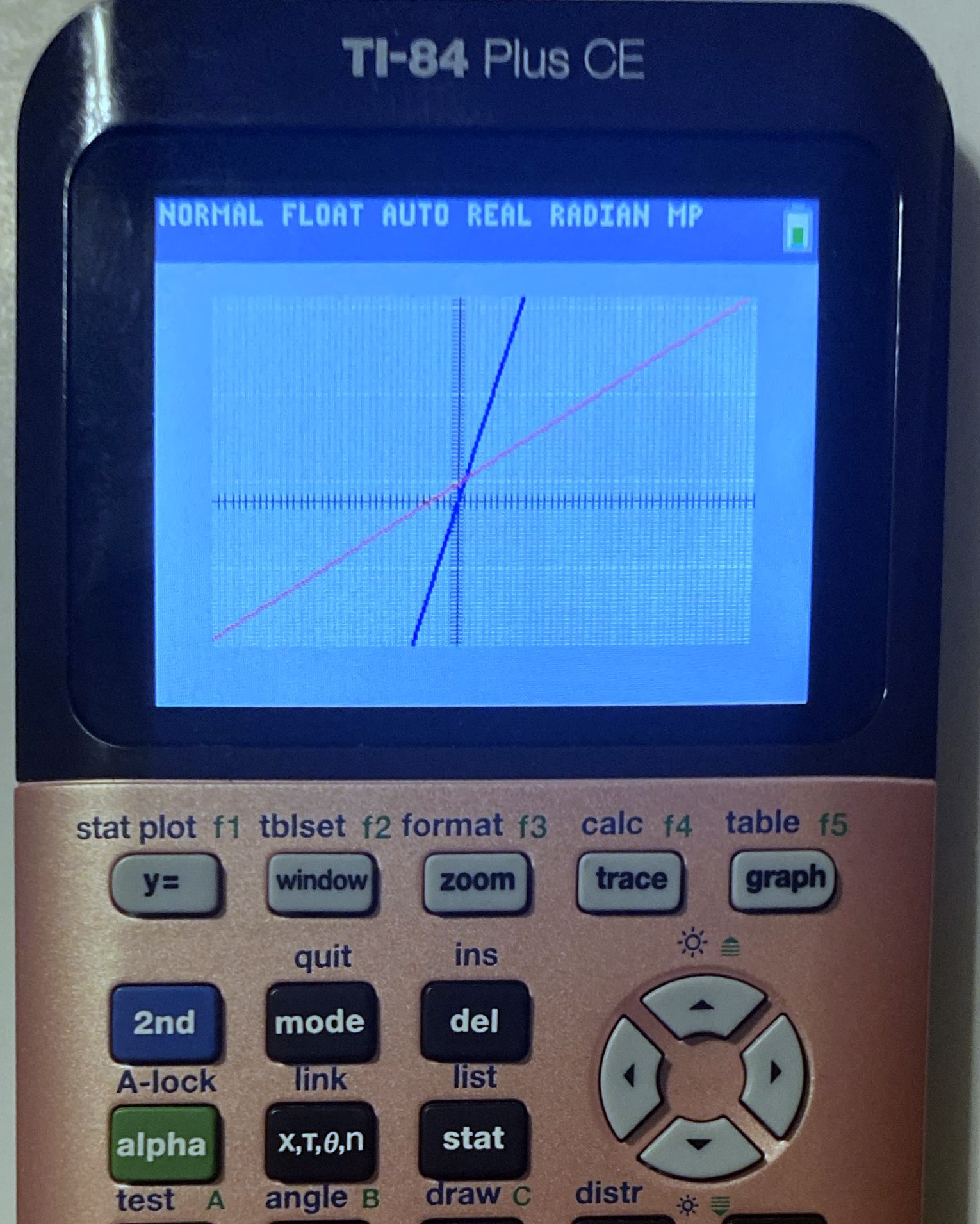
Graphing gives another way to check the answer. The graph of \(y=|x-1|\) is a V-shaped graph with its lowest point at \(x=1\). The line \(y=7\) crosses that graph at two points, one on each side of the vertex. Those crossing points match the two solutions, \(x=8\) and \(x=-6\).
Common Mistakes That Change the Meaning
The most common mistake is forgetting the negative case. If \(|x|=5\), writing only \(x=5\) misses the point that \(-5\) is also 5 units from zero. The equation is not asking which number is positive. It is asking which numbers have a certain distance.
Another mistake is allowing an absolute value expression to equal a negative number. An equation such as \(|x+4|=-3\) has no solution. There may be tempting algebra to do, but the distance interpretation stops the error immediately. No value of \(x\) can make a distance equal \(-3\).
A third mistake is distributing the absolute value bars as if they worked like parentheses. In general, \(|a+b|\) is not the same as \(|a|+|b|\). For example, \(|3+(-3)|=|0|=0\), but \(|3|+|-3|=6\). The bars describe the value of the whole expression inside them, so the inside expression must be handled as one unit until it is time to split cases.
Checking answers is especially important when an absolute value equation has extra terms outside the bars or expressions on both sides. Some equations can produce an answer during algebra that does not actually satisfy the original equation. Substitution is a quick way to confirm that each solution fits the starting statement, not just a later line of work.
Where Absolute Value Equations Show Up
Absolute value equations appear whenever a problem cares about distance from a target rather than direction. A temperature might be within a certain number of degrees from a target value. A manufacturing measurement might be allowed to differ from a standard size by a fixed tolerance. A score, balance, or elevation might be described by how far it is from a reference point.
For instance, suppose a machine part should be 20 millimeters long, and a measurement is exactly 0.3 millimeters away from the target. That situation can be written as \(|x-20|=0.3\), where \(x\) is the measured length. The two possible measurements are \(20.3\) and \(19.7\). One is above the target, one is below it, and both are the same distance from 20.
That is the heart of absolute value equations. The bars do not hide a mysterious operation. They mark a distance question. Once the distance is isolated, the two-case method is simply the algebraic version of looking both directions on a number line. A solution can sit to the right or to the left of the target, and good algebra keeps both possibilities in view.




Add comment