
Division by zero is undefined because no quotient can reverse the operation. See why infinity fails and what the rule changes in algebra.

Division by zero is undefined because no quotient can reverse the operation. See why infinity fails and what the rule changes in algebra.

Interval notation uses brackets, parentheses, endpoints, and infinity to show solution sets, domains, and ranges clearly.

Geometric sequences use a constant multiplier to model patterns that grow, shrink, or alternate step by step.

Arithmetic sequences use a constant difference to turn repeating number patterns into clear formulas, graphs, and predictions.

Coordinate planes use x- and y-values to turn location into numbers, helping students graph points, equations, and real situations.

Slope-intercept form shows a line's starting point and rate of change, helping students move between equations, tables, and graphs.
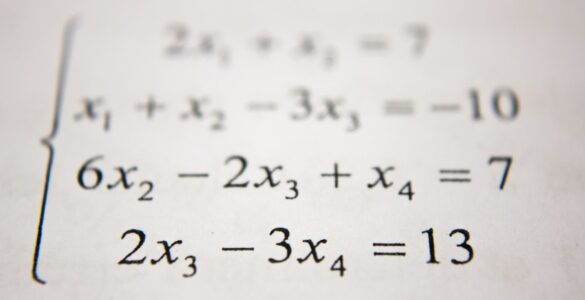
The distributive property turns one expression into equal parts, making multiplication, area models, and algebraic rewriting easier to understand.

Order of operations keeps expressions consistent by setting when to handle grouping, powers, multiplication, division, addition, and subtraction.

Rational functions use excluded values, asymptotes, and holes to show how algebra controls graph behavior.
Absolute value inequalities describe how far a number can be from a target, turning distance limits into intervals on a number line.
Inverse functions reverse an input-output rule, connecting equations, graphs, domains, and reliable ways to check your work.

The repeating decimal 0.999... equals 1 because infinite place value leaves no gap between the two numbers.
Absolute value equations make more sense when they are read as distance problems that can point in two directions.
Scientific notation turns long strings of zeros into powers of ten, making huge and tiny numbers easier to write, compare, and calculate.
Function transformations let you shift, reflect, stretch, and compress graphs by reading small changes in the formula.


Copyright © 2026 Novo Learner
 Akshay Dinesh