
 Akshay Dinesh
The Great Depression was not just a bad year for banks or a sudden collapse on Wall Street. It was a worldwide economic crisis that began in 1929 and shaped daily life through most of the 1930s. Factories slowed or closed, farms lost income, banks failed, and millions of families had to rethink how they would eat, work, save, and survive. The crisis began in the United States, but it spread through trade, banking, debt, and the international gold standard, reaching Europe, Latin America, Asia, and other parts of the world.
Its causes were not simple. The stock market crash of October 1929 became the most famous symbol, but the deeper problem was a chain reaction: falling demand, weak banking protections, tight monetary policy, high debt, shrinking trade, and public fear. By 1933, the United States had reached the worst point of the crisis. The FDR Presidential Library notes that nearly one-quarter of the labor force was unemployed when Franklin D. Roosevelt took office, while the banking system had largely broken down. Understanding the Depression means looking at both the economic machinery and the human cost.
Why the Depression Became So Severe
The American economy looked strong during much of the 1920s. Consumer products, cars, radios, and new forms of credit created a sense of growth and confidence. Underneath that confidence, however, many households and businesses were more fragile than they appeared. Farmers had already struggled through much of the decade because crop prices were low and debts were hard to repay. Some industries produced more goods than customers could buy, and many investors bought stocks with borrowed money, hoping prices would keep rising.
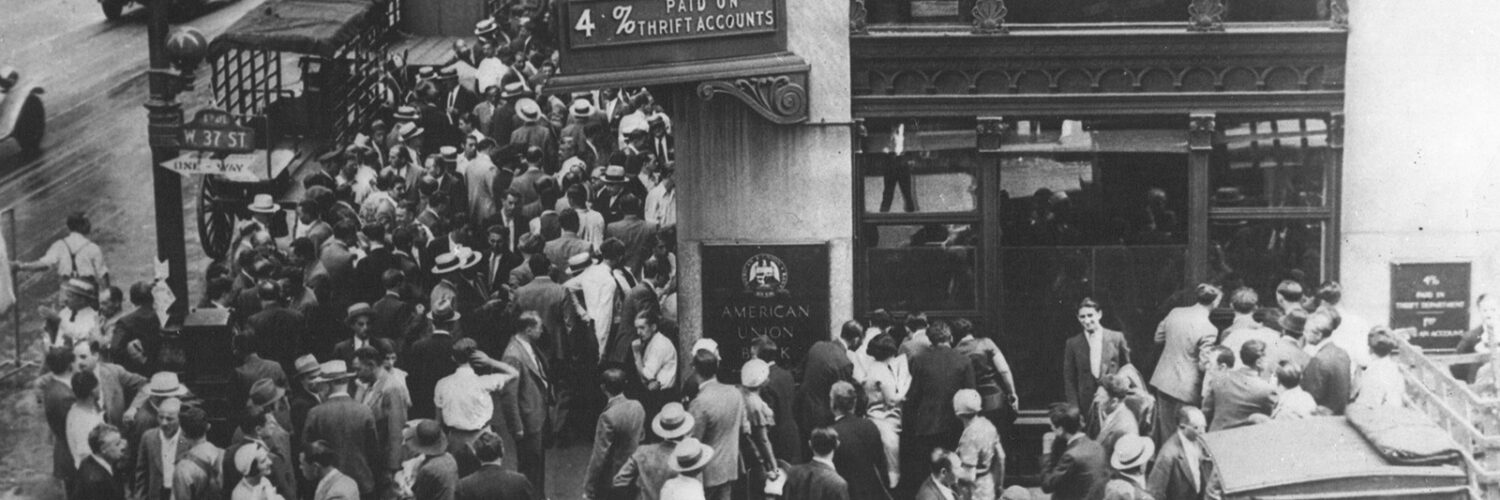
When spending slowed, the weakness spread quickly. Factories cut production, which meant workers lost hours or jobs. Those workers then spent less, which caused more businesses to suffer. Banks were especially vulnerable because deposits were not protected by federal insurance at the start of the crisis. If depositors feared that a bank might fail, they rushed to withdraw their money. A bank run could destroy even a bank that might otherwise have survived.
The Crash, Bank Panics, and the Gold Standard
The stock market crash did not create the Great Depression by itself, but it made the economy’s problems harder to ignore. On Black Thursday, October 24, 1929, heavy selling shook Wall Street. The panic deepened on Black Monday and Black Tuesday, when stock prices fell sharply again. Many investors lost savings, businesses became more cautious, and confidence in the financial system weakened.
Federal Reserve History describes the Depression as a series of connected crises rather than a single event: the 1929 crash, regional banking panics in 1930 and 1931, and national and international financial crises from 1931 through 1933. The international gold standard made the damage travel faster. Countries tied their currencies to gold, so governments often felt pressure to defend gold reserves instead of expanding credit or lowering interest rates. As money became harder to get, businesses and households had less room to recover.
Trade policy also made matters worse. In 1930, the United States passed the Smoot-Hawley Tariff, which raised taxes on many imported goods. Other countries responded with their own trade barriers. Instead of protecting prosperity, these policies helped reduce international trade at a time when countries needed markets, income, and cooperation.
What the Crisis Meant for Ordinary People
The Depression was measured in unemployment rates and production figures, but people felt it through rent, food, clothing, school, and family decisions. By 1933, millions of Americans were out of work. Some families doubled up with relatives. Others lost farms or homes. In cities, breadlines and soup kitchens became visible signs of hardship. In rural areas, falling crop prices made debt harder to carry, and drought on the Great Plains created the Dust Bowl, forcing many families to leave land that could no longer support them.
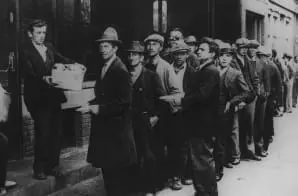
The effects were not the same everywhere. Industrial cities faced factory shutdowns and mass layoffs. Farming regions faced debt, falling prices, and environmental disaster. African American, Mexican American, immigrant, and migrant workers often faced the harshest job competition and discrimination. The Depression also changed childhood for many young people, who left school early, worked odd jobs, or watched parents struggle to keep the family together.
How the New Deal Changed Government’s Role
Franklin D. Roosevelt took office in March 1933 and moved quickly to restore confidence. One of his first actions was a temporary bank holiday, followed by emergency banking legislation meant to stabilize the financial system. Roosevelt also used radio addresses, later known as fireside chats, to explain government action directly to the public. That communication mattered because fear itself had become part of the crisis.
The New Deal did not solve every problem, and historians still debate which policies helped most. Still, it changed the relationship between Americans and the federal government. Relief programs put people to work or provided direct support. Recovery programs tried to restart agriculture, industry, and banking. Reform laws created long-term protections, including federal deposit insurance through the FDIC and new rules for securities markets. Social Security, passed in 1935, became one of the most lasting changes from the era.
The Lasting Effects of the Great Depression
The Great Depression ended the easy confidence of the 1920s and changed how people thought about banks, markets, government, and security. It showed that a modern economy could fail not only from one bad decision, but from linked weaknesses across finance, policy, trade, and public trust. It also revealed how quickly economic distress could affect politics. In Germany and other countries, Depression-era hardship helped strengthen extremist movements and deepened the instability that preceded World War II.
The Depression’s legacy is still visible in financial regulation, deposit insurance, unemployment relief, public works, and debates over how governments should respond to economic crises. Its most important lesson may be that economies are not abstract systems floating above ordinary life. When banks fail, prices fall, and work disappears, the consequences reach dinner tables, classrooms, farms, city streets, and political institutions. That is why the Great Depression remains one of the central events of modern history.




Add comment