
 Arya Rane
Ancient Egypt grew from a narrow river valley into one of the most recognizable civilizations in world history. Its story begins with the Nile, whose annual floods made farming possible in a landscape bordered by desert. Over thousands of years, Egyptians built cities, temples, tombs, irrigation systems, trade networks, and a writing tradition that helped preserve ideas across generations. The civilization changed many times as dynasties rose and fell, but its central patterns remained powerful: a river-fed economy, a sacred kingship, a complex social order, and a culture deeply concerned with life, death, and memory.
The Nile and the Geography That Shaped Egypt
The Nile was the foundation of ancient Egyptian life. Most of Egypt receives very little rainfall, so the river supplied water for drinking, farming, travel, and trade. Each year, the Nile’s floodwaters left behind dark, fertile silt along the riverbanks. Farmers used that soil to grow wheat, barley, flax, vegetables, and other crops that supported dense communities.
Geography also gave Egypt a measure of protection. Deserts to the east and west, the Mediterranean Sea to the north, and cataracts along parts of the southern Nile made invasion more difficult, though not impossible. This relative isolation helped Egyptian culture develop strong continuity over time. At the same time, Egypt was never completely cut off. Trade routes linked it with Nubia, the Levant, the Red Sea, and the wider Mediterranean world.
Because the river was so central, many important settlements grew near the Nile Valley and the Nile Delta. Memphis became an early political center, while later cities such as Thebes and Alexandria played major roles in religion, government, and trade. The landscape did more than feed people; it shaped the way Egyptians understood order. The predictable return of the Nile’s flood helped inspire a worldview in which balance, cycles, and stability mattered deeply.
Society, Work, and Daily Life
Egyptian society was hierarchical, with the pharaoh at the top as both ruler and religious figure. Below the pharaoh were high officials, priests, nobles, military leaders, and scribes. Scribes held special status because reading and writing were difficult skills that connected them to government, taxation, law, and record keeping. Merchants, craftspeople, soldiers, farmers, laborers, and servants made up much of the rest of society.
Farmers formed the backbone of the economy. Their work followed the rhythms of the river: planting after the flood, tending crops, and harvesting when the fields were ready. During flood seasons, when farming was limited, labor could be redirected toward building projects, canal maintenance, or work for the state. Craftspeople produced pottery, jewelry, linen, tools, furniture, and stone carvings. These goods supported both everyday life and the grander world of temples, palaces, and tombs.
Women in ancient Egypt generally had more legal rights than women in many other ancient societies. They could own property, make contracts, inherit wealth, and seek divorce. Daily life was still shaped by social class, family expectations, and male-dominated political power, but women could hold influence in households, religious life, business, and occasionally royal rule. Hatshepsut, for example, ruled as pharaoh and supported major building and trade projects.
Pharaohs, Government, and Power
Egyptian political power centered on the pharaoh, who was expected to defend the land, honor the gods, maintain order, and oversee prosperity. The pharaoh was not simply a king in the modern sense. Egyptian religion connected royal power with divine order, especially the concept of ma’at, meaning balance, truth, justice, and cosmic harmony. A successful ruler was supposed to keep that balance intact.
No pharaoh governed alone. The vizier acted as a powerful administrator, supervising officials, tax systems, legal matters, and state projects. Local governors, often called nomarchs, managed provinces known as nomes. Priests controlled temple lands and rituals, while scribes kept the records that made taxation, labor organization, and long-distance administration possible. This bureaucracy allowed Egypt to coordinate large projects, including irrigation works, temples, tombs, and military campaigns.
Egypt’s long history included periods of unity, division, foreign rule, and imperial expansion. Rulers such as Ramses II projected power through campaigns, monuments, and diplomacy. Later, Nubian, Assyrian, Persian, Greek, and Roman influence reshaped Egypt in different ways. In 332 BCE, Alexander the Great took control of Egypt, and his general Ptolemy founded the Ptolemaic dynasty. Cleopatra VII, the last ruler of that dynasty, became part of Rome’s political struggles before Egypt was annexed as a Roman province.
Religion, Pyramids, and Writing
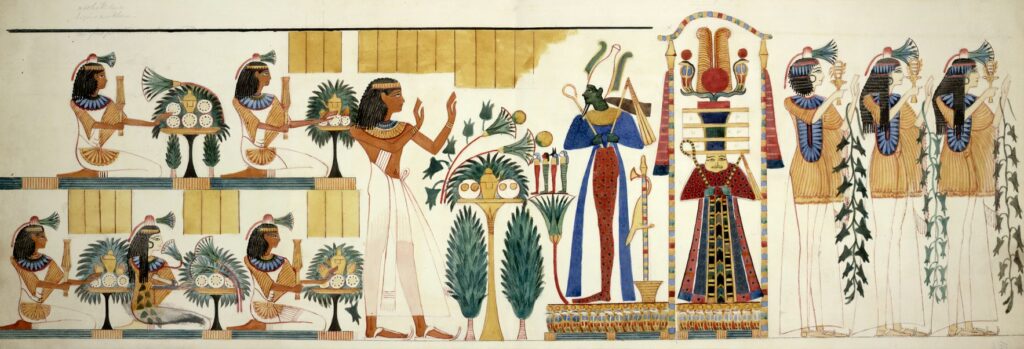
Religion reached into nearly every part of ancient Egyptian culture. Egyptians worshiped many gods, including Ra, Osiris, Isis, Horus, Hathor, Anubis, and Thoth. These gods were associated with the sun, kingship, protection, writing, fertility, death, and the afterlife. Temples were not only places of worship; they were also centers of landholding, wealth, ritual authority, and local identity.
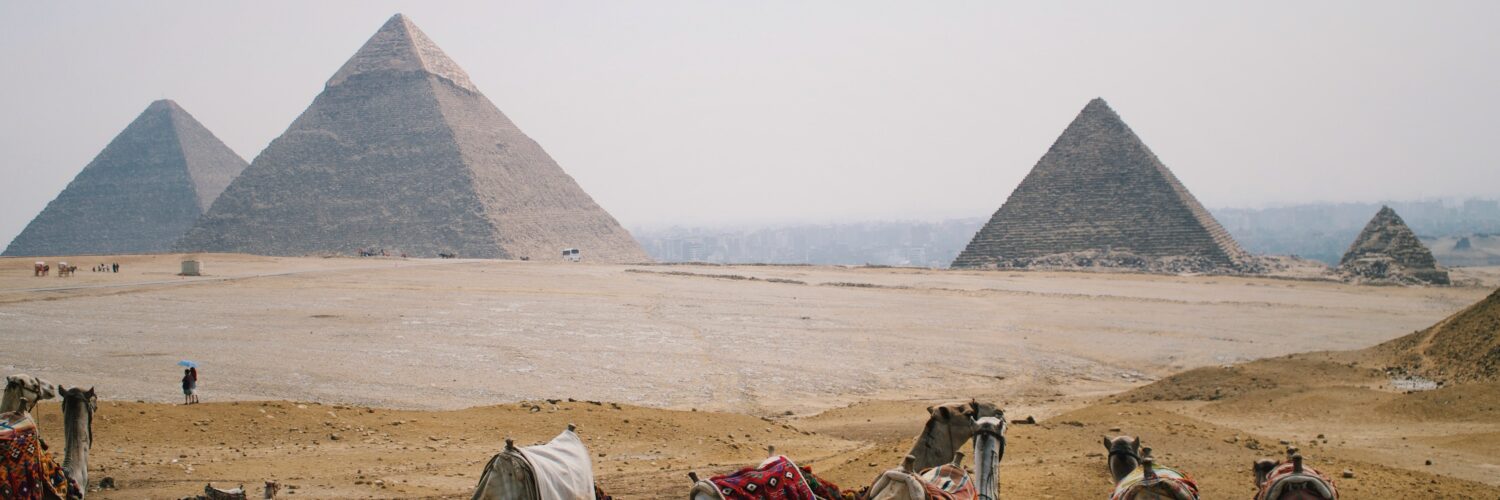
The pyramids are among Egypt’s most famous monuments, but they were part of a broader burial tradition. Egyptians believed the dead needed care, ritual, and preservation for the afterlife. Mummification, tomb paintings, carved inscriptions, grave goods, and funerary texts all reflected this concern. The largest pyramids of the Old Kingdom, especially those at Giza, required careful planning, skilled labor, food supply systems, and command over enormous resources.
Writing helped Egyptians preserve religious texts, legal records, royal achievements, tax information, and stories. Hieroglyphics appeared on temple walls, monuments, and tombs, while hieratic and later demotic scripts were used for more practical writing. Papyrus, made from reeds along the Nile, became an important writing material. The ability to record information gave Egyptian society a powerful tool for administration, memory, and cultural continuity.
Trade, Change, and Lasting Legacy
Ancient Egypt’s economy depended heavily on agriculture, but it also included trade, craft production, mining, and taxation. Egyptians traded grain, linen, papyrus, gold, stone, and manufactured goods. In return, they acquired materials such as cedar wood, incense, silver, horses, and luxury items from neighboring regions. Boats on the Nile made internal transport easier, while sea and desert routes connected Egypt with wider networks.
The civilization did not remain frozen in time. New rulers, foreign contacts, military pressures, religious changes, and economic shifts all changed Egypt across the Old, Middle, and New Kingdoms and the later periods. Yet many symbols endured: the Nile, the pharaoh, the temple, the pyramid, the mummy, and the written sign. These images became powerful because they were tied to real systems of farming, labor, government, belief, and memory.
Ancient Egypt still matters because it shows how geography, belief, political authority, and technology can combine to sustain a civilization for an unusually long time. Its monuments are impressive, but the deeper lesson is not only about stone. Egypt’s legacy also lives in its writing, mathematics, medicine, art, architecture, statecraft, and historical imagination. The civilization’s survival in records and ruins gives modern readers a rare view of how people thousands of years ago organized work, explained the universe, honored the dead, and tried to make human life fit into a larger order.


 Akshay Dinesh


Add comment