Akshay Dinesh
A fossil is not simply an old bone. It is the result of a long chain of unlikely events: an organism must die in the right place, escape scavengers and decay, become buried, survive chemical change and pressure, and remain intact while rock moves, folds, cracks, and erodes. Break any link in that chain and the organism disappears without entering the geologic record.
That is why fossilization is rare and why the fossils we do find are not a balanced sample of past life. Shells, teeth, bones, pollen, and organisms that lived near water have much better odds than soft-bodied animals or creatures that died on exposed land. Reading fossils well means understanding both what was preserved and what probably went missing.
Preservation begins with a race against decay
Most remains are recycled quickly. Bacteria and fungi break down tissues, scavengers scatter bones, insects consume flesh, and sun, rain, waves, or flowing water wear away what is left. A carcass on an open plain may vanish long before sediment has a chance to cover it. Even a skeleton can be trampled, transported, dissolved, or weathered into fragments.
Rapid burial changes the odds. Mud settling on a lakebed, sand moving across a river channel, ash from a volcanic eruption, or sediment accumulating on the seafloor can isolate remains from some scavengers and slow the supply of oxygen. Burial does not guarantee a fossil, but it protects the remains during the most vulnerable stage. The National Park Service describes quick burial after death as the most important early step in ordinary fossil formation.
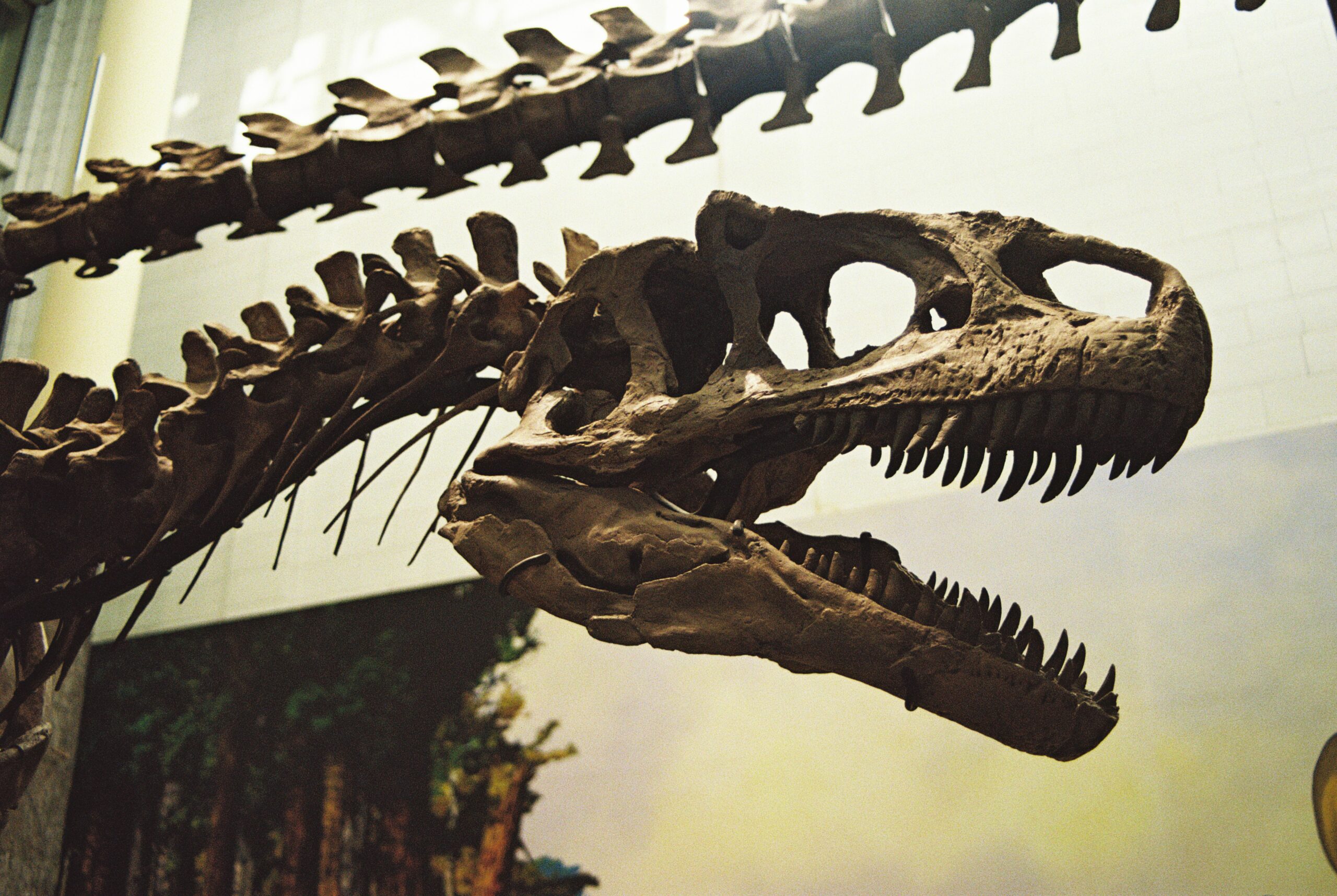
Hard parts also help. Teeth contain durable minerals, shells resist decay, and bone lasts longer than skin or muscle. This creates a built-in imbalance: animals with shells or skeletons are far more visible in the fossil record than worms, jellyfish, and other soft-bodied organisms. Exceptional deposits can preserve feathers, leaves, skin outlines, or whole soft-bodied communities, but they are exceptional precisely because the usual process destroys such details.
How buried remains become part of rock
After burial, layers of sediment continue to accumulate. Their weight squeezes water from the lower layers, while dissolved minerals act as cement between grains. Loose mud may become shale, sand may become sandstone, and shell-rich sediment may contribute to limestone. The remains are caught inside this changing material as sediment slowly becomes sedimentary rock.
Groundwater can then move through tiny spaces in bone, wood, or shell. Minerals carried by the water may fill pores without completely replacing the original structure, a process called permineralization. In other cases, original material dissolves and new minerals take its place. The fine internal pattern can survive even though much of the original substance has changed.

Pressure and chemical change do not turn every buried object into a perfect stone copy. Fossilization is a family of processes, not a single recipe. Temperature matters too. The heat that forms igneous rock and the intense heat and pressure that alter metamorphic rock usually destroy biological evidence, which is why the U.S. Geological Survey notes that fossils occur almost entirely in sedimentary rocks.
A fossil can be a body, an imprint, or an action
Some fossils preserve parts of an organism itself, such as a tooth, shell, leaf, or bone. These are body fossils. A body fossil may retain original material, contain mineral-filled spaces, or consist largely of replacement minerals. Amber, ice, dry caves, tar, and low-oxygen sediments can preserve remains in other ways, sometimes keeping details that ordinary rock formation would erase.
A shell can also disappear after burial and still leave evidence. If sediment hardens around it before the shell dissolves, the empty space is a mold. Minerals or sediment may later fill that mold to make a cast. A compressed leaf can leave a thin carbon film, while an impression can preserve its outline and veins without keeping the leaf itself.
Other fossils record behavior rather than bodies. Footprints, burrows, nests, bite marks, root traces, and coprolites, or fossilized droppings, are trace fossils. They can reveal how an animal moved, fed, rested, or interacted with its surroundings. A skeleton shows that an animal existed; a trackway may show its stride, direction, speed, and companions during one brief moment.
The fossil record has strong biases
Imagine trying to describe a modern forest using only the objects most likely to survive burial. Snail shells, animal teeth, sturdy seeds, and pollen might remain. Mushrooms, earthworms, flowers, and soft fruits would usually disappear. The resulting collection would contain real evidence, but it would not reproduce the living community in equal proportions.
The same problem shapes our view of deep time. Marine environments often accumulate sediment continuously, so ocean organisms with hard shells are especially well represented. Upland forests, tropical soils, and exposed grasslands are much less likely to preserve remains. Large animals attract attention in museums, yet the U.S. Geological Survey points out that shells and microscopic plant and animal remains make up much of the fossil record.
Preservation is only the first filter. A fossil-bearing layer must avoid being melted, deeply metamorphosed, dissolved, or eroded away. It must later become exposed or reached by drilling, and someone must recognize the evidence. Collecting history adds another bias: researchers have not searched every rock unit, country, or habitat equally.
Paleontologists call the study of what happens from death through burial and discovery taphonomy. Taphonomic clues include broken bones, tooth marks, abrasion, mineral staining, the orientation of shells, and whether parts of a skeleton remained connected. These details help researchers decide whether remains were buried where the organism lived, carried by water, accumulated by predators, or disturbed long after death.
What an incomplete record can still reveal
An incomplete record is not a useless one. Rock layers give fossils context. Under ordinary conditions, a lower sedimentary layer formed before the layer above it, so position can establish a relative sequence. Radiometric dating of suitable minerals, often in nearby volcanic ash rather than in the fossil itself, can place parts of that sequence on a numerical timescale. Matching characteristic fossils across separate rock exposures helps geologists connect layers that formed during the same interval.
Fossils also preserve environments. Corals point to marine conditions; pollen records surrounding vegetation; leaf shapes can reflect climate; and assemblages of freshwater shells, fish, and plants can identify a former lake or wetland. The strongest interpretation rarely depends on one spectacular specimen. It comes from combining many fossils with sediment grain size, rock chemistry, layer geometry, and evidence of ancient currents or soils.
The 2026 National Fossil Day artwork highlights a striking example at White Sands National Park. More than 20 sedimentary horizons preserve human and animal tracks from a landscape that once held wetlands and lake margins. According to the National Park Service, radiocarbon dating of seeds associated with the oldest human track layers places them roughly 21,000 to 23,000 years ago. The footprints are valuable not because a body turned to stone, but because soft ground captured actions and later sediment protected them.
Every fossil is therefore both evidence and survivor. It records an organism or behavior, while its condition records burial, chemistry, movement, and time. The gaps matter as much as the specimens: they remind us that ancient ecosystems were richer than the fragments left behind. Fossils do not offer a complete film of life on Earth, but with careful geological context they provide something remarkable: scattered frames that can still be arranged into a coherent history.