 Akshay Dinesh
An earthquake begins out of sight, often kilometers below the surface, but the damage it causes depends on much more than the amount of energy released. Two places can experience the same earthquake very differently because distance, soil, building design, population, and preparedness all shape the outcome. That distinction is central to understanding earthquake risk: the geological event cannot be stopped, but many of its worst consequences can be reduced.
Earthquakes also expose a common weakness in the way natural hazards are discussed. A large magnitude does not automatically mean a catastrophe, while a smaller event near a crowded city can be devastating. The useful questions are not only “How strong was it?” but also “Where did the rupture occur, how did the ground respond, and what stood in the path of the shaking?”
What Causes an Earthquake?
Most earthquakes occur when stress builds in rock along a fault, a fracture where blocks of Earth’s crust can move relative to one another. Friction may hold the blocks in place even as tectonic forces continue to push or pull them. When the stress becomes greater than the frictional resistance, the fault slips suddenly. Stored elastic energy travels outward as seismic waves, producing the motion we feel as an earthquake.
The rupture begins underground at the hypocenter, also called the focus. The epicenter is the point on Earth’s surface directly above it. These terms are sometimes confused, but they describe different locations. Damage is often severe near the fault, although the strongest effects are not always centered neatly around the epicenter because the rupture may extend for many kilometers and local ground conditions can amplify shaking.
Seismometers record several kinds of waves. Fast P waves compress and expand material in the direction they travel. Slower S waves move the ground from side to side or up and down and cannot pass through liquids. Surface waves travel along the crust and can produce prolonged rolling or sideways motion. Their combined effect, rather than one wave type alone, determines how a structure moves during an earthquake.
Where Earthquakes Occur and How Scientists Measure Them
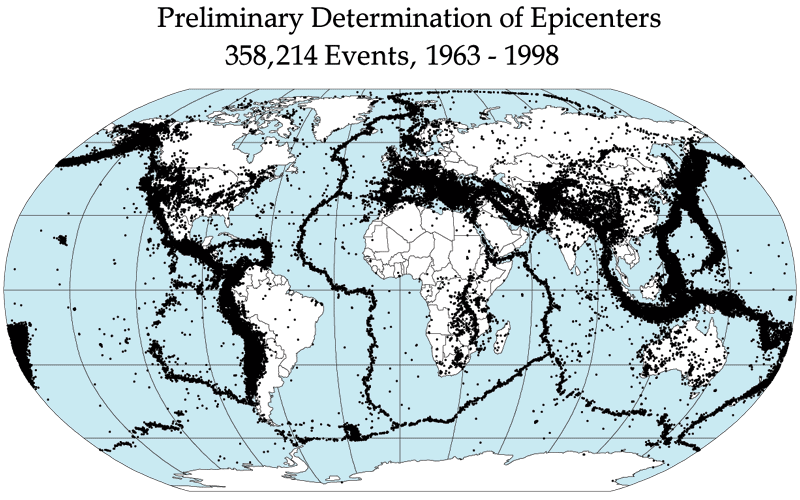
Earthquakes cluster along tectonic plate boundaries, especially around the Pacific Ring of Fire. At convergent boundaries, one plate may descend beneath another and produce powerful subduction-zone earthquakes. At transform boundaries, plates slide horizontally past each other. At divergent boundaries, plates move apart. Earthquakes can also occur within plates on older faults, so distance from a plate boundary does not eliminate risk.
Magnitude describes the size of an earthquake at its source. The value most often reported for significant modern earthquakes is moment magnitude, which is based on seismic moment: the area of the fault that slipped, the amount of slip, and the strength of the rocks. The older Richter scale was designed for a particular range of local earthquakes and instruments, so calling every modern magnitude a “Richter number” is inaccurate. A fuller explanation appears in why earthquake magnitudes are not really Richter numbers.
Magnitude is logarithmic. An increase of one whole number corresponds to ten times the recorded wave amplitude and roughly 32 times the energy release. Intensity, by contrast, describes what people and structures experience at a particular place. The Modified Mercalli Intensity Scale uses observations ranging from barely noticeable movement to extreme damage. One earthquake has one magnitude on a chosen magnitude scale but produces many intensities across the affected region.
The U.S. Geological Survey’s National Earthquake Information Center locates about 20,000 earthquakes around the world in a typical year, or roughly 55 per day. Many more are too small or remote to enter that global catalog. Improved instruments also detect events that older networks would have missed, so a larger catalog does not necessarily mean that Earth is becoming more seismically active.
Why the Same Magnitude Can Cause Different Damage
Magnitude matters, but it is only the starting point. Shaking generally weakens with distance from the rupture, and a shallow earthquake near a city can be more destructive than a larger but deeper event far offshore. The direction and duration of rupture also matter. A long rupture can send especially strong motion toward some communities while others at a similar distance experience less.
The ground beneath a building changes the motion that reaches it. Firm bedrock often shakes differently from deep, soft sediment, which can amplify certain frequencies and extend the duration of shaking. In water-saturated, loose sand or silt, shaking can raise pore-water pressure until the soil temporarily loses strength. This process, called liquefaction, can make buildings tilt, roads buckle, and buried pipes rise or break.
Buildings respond according to their height, shape, materials, connections, foundation, and maintenance. A structure is most vulnerable when the rhythm of the ground motion is close to its natural period of vibration. Seismic design therefore aims to manage movement rather than make a building perfectly rigid. Ductile frames, shear walls, bracing, base isolation, and energy-dissipating devices can help a structure deform without sudden collapse.
Social conditions turn physical hazards into unequal human losses. Weak construction, crowded housing, damaged roads, limited medical capacity, and interrupted water or power can multiply the effects. Time of day also changes exposure: schools, offices, homes, and transit systems hold different populations at different hours. Earthquake risk is therefore a combination of hazard, exposure, and vulnerability, not a simple ranking by magnitude.
Shaking Can Trigger a Chain of Hazards
Ground shaking is usually the most widespread direct hazard, but it can begin a longer chain of failures. Surface rupture can tear across roads, railways, canals, and pipelines. Steep slopes may fail as landslides or rockfalls. Liquefaction can undermine foundations and port facilities. Damaged electrical equipment and gas lines can ignite fires at the same time broken water mains make those fires harder to control.
Undersea earthquakes can displace the seafloor and generate tsunamis, although not every ocean earthquake does so. The most dangerous cases usually involve large vertical movement over a broad area. Coastal communities may then face destructive waves after the shaking has stopped. Earthquake-triggered landslides, including underwater slides, can also produce local tsunamis.
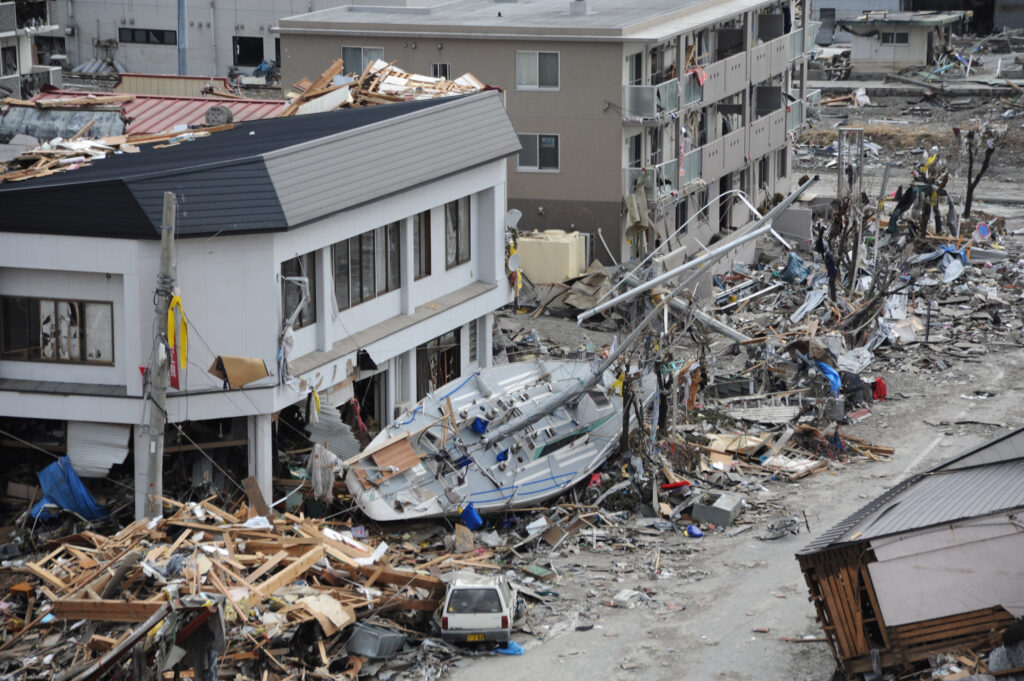
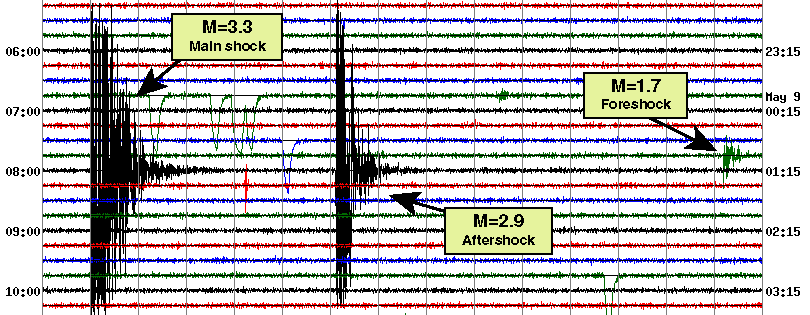
Aftershocks add another layer of danger. They occur as the crust adjusts after the main rupture and can bring down structures already weakened by the first shock. Their frequency usually decreases with time, but a damaging aftershock can arrive before inspections, repairs, or rescue work are complete. This is why emergency guidance warns people to expect more shaking and to avoid visibly damaged buildings.
Prediction Is Not Possible, but Risk Reduction Is
Scientists cannot currently predict the exact time, place, and magnitude of a future earthquake. Claims based on radon changes, unusual animal behavior, electrical signals, or small preliminary tremors have not produced a reliable, repeatable prediction method. The USGS distinguishes prediction from long-term forecasts, which estimate the probability of earthquakes in a region over years or decades, and from aftershock forecasts issued after a large event.
Earthquake early warning is different again. A system such as ShakeAlert detects an earthquake that has already begun, rapidly estimates the expected shaking, and sends a message faster than the seismic waves travel. Depending on distance and communication time, some users may receive seconds to tens of seconds of notice; people close to the rupture may receive little or none. Those seconds can still allow trains to slow, equipment to enter a safer state, and people to take protective action. The sequence is explained in how earthquake early warnings arrive before the shaking.
The largest gains come from preparation carried out before any alert. FEMA describes modern building codes and standards as one of the most effective ways to reduce future losses. Retrofitting vulnerable buildings, anchoring heavy furniture and water heaters, protecting utility connections, mapping unstable slopes and liquefaction zones, and planning for disrupted transport all reduce the chance that shaking becomes a disaster.
During shaking, official guidance is simple: Drop, Cover, and Hold On. Drop to hands and knees, cover the head and neck under sturdy furniture if possible, and hold on until the motion stops. Do not run outside during strong shaking, where glass, masonry, and other falling debris can cause injuries. Afterward, check for hazards, expect aftershocks, and follow local instructions, including tsunami evacuation guidance in coastal areas.
Earthquakes cannot be prevented, and precise prediction remains beyond current science. Yet the outcome is not fixed. Accurate hazard maps, honest communication about uncertainty, resilient construction, early warning, and practiced protective actions can turn geological knowledge into fewer deaths, less disruption, and faster recovery.