 Akshay Dinesh
When an earthquake begins, the instinct to run can feel sensible. The room moves, objects rattle, and a doorway or an exit seems like the quickest route to safety. Strong shaking changes the calculation: walking may become difficult, glass and masonry can fall near exits, and the few seconds spent crossing a room may expose the head and neck to the very hazards that cause many injuries. In most indoor settings, the safer response is to stay where you are and immediately Drop, Cover, and Hold On.
The phrase is short because an earthquake does not leave much time for decision-making. The U.S. Geological Survey, FEMA, and the Earthquake Country Alliance all recommend this action for most situations. It is also the central practice in the Great ShakeOut, a worldwide earthquake drill held in many regions each October. For 2026, many participants will practice on October 15, often at 10:15 a.m. local time, although a useful drill can be held whenever a household, school, or workplace is ready.
Three Steps Designed Around the Real Hazards
Drop means getting onto your hands and knees before the motion knocks you down. Strong ground movement can jerk sideways, so remaining upright is not a reliable plan. The hands-and-knees position lowers the chance of a hard fall while still allowing a short crawl toward nearby shelter. It is not a cue to cross a room; the goal is to become stable and protected as quickly as possible.
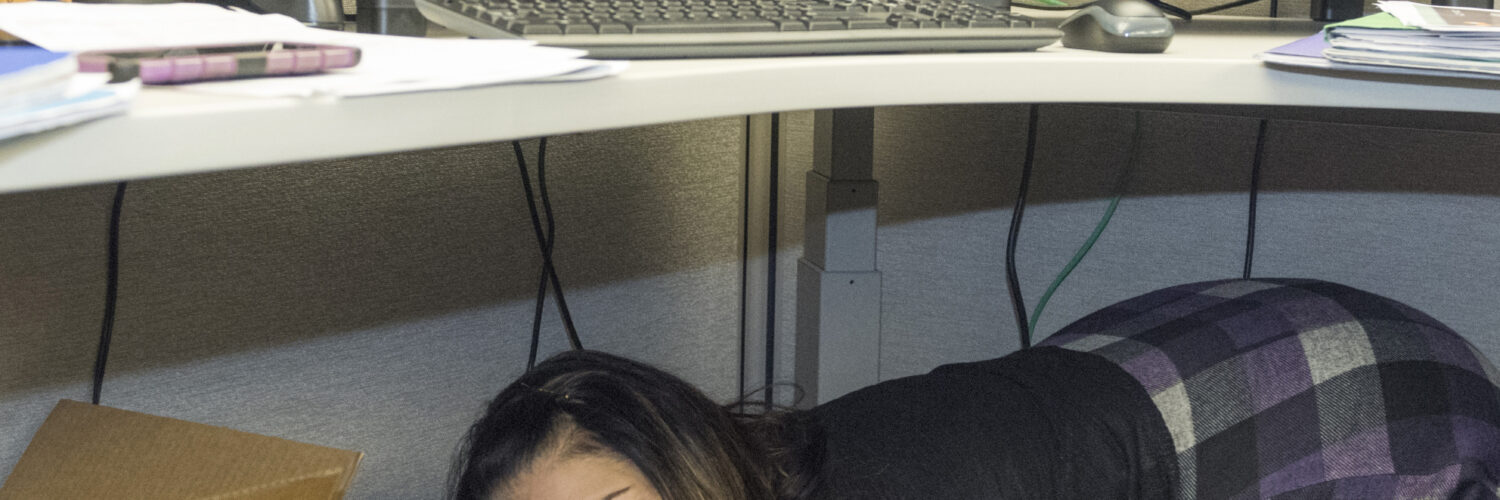
Cover means protecting the head and neck. If a sturdy desk or table is within a few feet, crawl underneath it. If no shelter is close, stay low beside an interior wall, away from windows, tall furniture, hanging objects, and cabinets that could open. Bend forward and use your arms and hands to shield the head and neck. A backpack, book, or cushion can add protection when it is already within reach.
Hold On means gripping the table or desk so it remains over you if it shifts. During severe shaking, furniture may slide across the floor. Moving with the shelter preserves the protection it provides. If there is no table, hold the head and neck with both arms until the shaking stops. The three steps form one continuous action, not a sequence that ends as soon as a person gets beneath a desk.

This guidance responds to what commonly happens inside buildings. Earthquake injuries often come from falls and from nonstructural objects such as glass, light fixtures, ceiling material, bookcases, and unsecured equipment. A person cannot predict which object will move first or where it will land. Getting low and shielding the most vulnerable parts of the body is a practical response to that uncertainty.
Why Running Outside Can Increase the Danger
An exit is not automatically a safe destination while the ground is moving. The area beside a building can collect broken windows, bricks, signs, roof tiles, and pieces of a facade. Reaching that area requires a person to stay upright, move past indoor hazards, pass through a door that may be swinging, and enter a zone where exterior material may fall. The USGS therefore advises people who are indoors to remain indoors during the shaking.
The advice changes after the motion stops. A damaged building may need to be evacuated, and fire, leaking gas, broken utilities, or visible structural damage can make staying inside unsafe. That is why “do not run outside” applies to the period of active shaking, not to every moment that follows. Once movement ends, use a planned route, avoid elevators, watch for debris, and follow directions from local officials or building staff.
The doorway idea comes from an older and narrower observation. In some collapsed adobe buildings, wooden doorframes remained standing when surrounding walls failed. That image helped create the belief that every doorway is reinforced. In most modern buildings, a doorway is no stronger than the nearby wall, offers little protection from flying objects, and may contain a door that swings violently. A sturdy table is usually the better target.
Another misleading claim, sometimes called the “triangle of life,” promises that a particular place beside heavy furniture will create a survivable void. Collapse patterns cannot be predicted that precisely before an earthquake. Rescue organizations and emergency managers continue to recommend Drop, Cover, and Hold On because it protects against the far more common hazards of falling, flying, and sliding objects while also placing a sturdy surface above the body.
The Response Changes With the Setting
The basic goal stays the same: avoid falling, protect the head and neck, and move as little as necessary. The exact posture depends on where a person is when the shaking begins.
- In bed: Stay there, turn face down if possible, and cover the head and neck with a pillow. Getting onto a floor that may contain broken glass can add risk.
- In a high-rise: Drop, Cover, and Hold On away from windows. Do not use an elevator during or immediately after the shaking.
- In a theater or stadium: Remain at the seat, bend forward, and protect the head and neck. Wait for the shaking to stop before moving toward an exit.
- Outdoors: Move to an open area only if it can be reached safely, then stay away from buildings, power lines, trees, signs, and other objects that may fall.
- In a vehicle: Pull over carefully, avoid bridges, overpasses, tunnels, signs, trees, and power lines, set the parking brake, and remain inside until the motion ends.
- Near the coast: Protect yourself during the shaking first. When strong or long shaking stops, move quickly to high ground or inland if the area has tsunami risk.
People with mobility disabilities should adapt the action rather than attempt a dangerous transfer. A wheelchair user can lock the wheels, bend forward, cover the head and neck with the arms, a book, or a pillow, and hold that position. Someone using a walker can lock its wheels if possible and get as low as is safe. A person who cannot get to the floor should remain seated, bend forward, and cover the head and neck. Planning should include caregivers, support equipment, and a way to retrieve canes or other mobility aids after the shaking.
Local guidance deserves priority where building practices create unusual risks. Some regions contain unengineered earthen buildings that behave differently from modern framed structures. A generic internet rule cannot replace instructions developed for those structures by local emergency managers and engineers. The broad recommendation remains useful precisely because it fits most ordinary settings, but preparedness works best when it is matched to the buildings people actually occupy.
A Drill Builds More Than Muscle Memory
A good earthquake drill lasts longer than the few seconds spent under a desk. It begins by choosing the action for each likely location: a classroom, kitchen, bedroom, office, bus, or sports venue. Participants should practice without crossing the room to reach an ideal table. That exposes a useful truth: the nearest workable protection matters more than a perfect spot that cannot be reached safely.
While under cover, look around. A tall shelf may need to be anchored. Heavy objects may belong on lower shelves. A hanging frame, laboratory instrument, television, or cabinet door may threaten a place where people sit. The ShakeOut drill broadcast specifically asks participants to notice what could fall, slide, break, or block an exit. The drill turns an abstract hazard into a room-by-room inspection.

The exercise should also test communication. Schools and workplaces need a way to account for people, assist anyone who needs support, and decide whether evacuation is necessary. Families should know how to reconnect if phone networks are crowded and which out-of-area contact can relay messages. None of these plans should encourage people to call emergency services merely to report that shaking occurred; those lines must remain available for fire, injury, entrapment, and other urgent needs.
Repetition matters because the first jolt creates surprise. A practiced response removes several decisions: whether to run, where to put the hands, and how to protect the neck. It can also correct habits learned from films, old advice, or mild earthquakes in which nothing fell. Experiencing one harmless tremor does not prove that standing still or moving toward a doorway will be safe during stronger motion.
What to Do When the Shaking Stops
Remain alert for aftershocks, which can arrive while people are checking damage or leaving a building. If another shock begins, Drop, Cover, and Hold On again. Put on sturdy shoes if they are available, check yourself and nearby people for injuries, and avoid touching damaged electrical equipment. If you smell gas or hear a blowing or hissing sound, move away and report it from a safe location; do not operate switches or create a flame.
Do not re-enter a visibly damaged building until authorities say it is safe. Stay clear of downed power lines and unstable walls. Use text messages when possible to reduce demand on phone networks, and rely on official local alerts rather than rumors. Coastal residents should follow tsunami evacuation signs and local instructions immediately after strong or prolonged shaking, because the first dangerous wave may arrive before a distant warning reaches everyone.
Drop, Cover, and Hold On does not prevent earthquakes, strengthen weak buildings, or replace an evacuation plan. It solves a narrower and urgent problem: how to protect the body during the seconds when the ground is moving and nearby objects become unpredictable. That is exactly why the action is worth practicing. In a real earthquake, the useful response is the one people can begin before fear has time to argue with it.