
 Akshay Dinesh
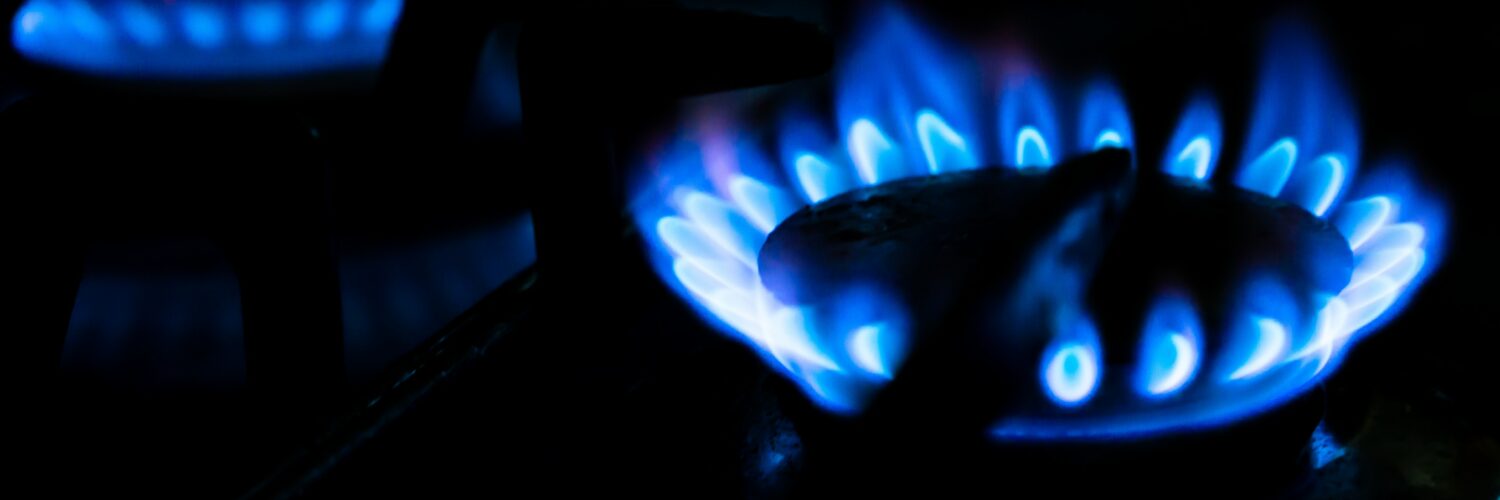
Alkanes are hydrocarbons made only of carbon and hydrogen, with single bonds between their carbon atoms. Methane is a major component of natural gas, while propane and butane are commonly found in liquefied petroleum gas (LPG). Their simple structures help explain their physical properties and reactions, including combustion and substitution.
What are Alkanes?
Open-chain alkanes are saturated hydrocarbons: they contain only carbon and hydrogen, and their carbon atoms are joined by single bonds. Their general formula is CnH2n+2, where n is the number of carbon atoms. Their names end in -ane, as in methane and propane. The formula also applies to branched open-chain alkanes.
Here are some of the simpler alkanes that we commonly encounter.
| n | Name | Molecular formula | Structural formula | Mr | Melting point / °C | Boiling point / °C | Physical state (r.t.p) |
| 1 | Methane | CH4 | CH4 | 16 | -182 | -162 | Gas |
| 2 | Ethane | C2H6 | CH3CH3 | 30 | -183 | -89 | Gas |
| 3 | Propane | C3H8 | CH3CH2CH3 | 44 | -188 | -42 | Gas |
| 4 | Butane | C4H10 | CH3(CH2)2CH3 | 58 | -138 | -0.5 | Gas |
| 5 | Pentane | C5H12 | CH3(CH2)3CH3 | 72 | -130 | 36 | Liquid |
| 6 | Hexane | C6H14 | CH3(CH2)4CH3 | 86 | -95 | 69 | Liquid |
Constitutional isomers have the same molecular formula but different arrangements of bonds. Butane, C4H10, is the smallest alkane with this kind of isomerism: its two isomers are straight-chain butane, CH3CH2CH2CH3, and branched 2-methylpropane, CH3CH(CH3)CH3. Propane has only one carbon skeleton. Pentane has three constitutional isomers.
What are Cycloalkanes?
Cycloalkanes are saturated hydrocarbons containing carbon atoms joined in a ring. A cycloalkane with one ring has the general formula CnH2n, two fewer hydrogen atoms than an open-chain alkane with the same number of carbons. The prefix cyclo- distinguishes names such as cyclopropane from propane.
Here are some of the simpler cycloalkanes that we often see.
| n | Name | Molecular formula | Structural formula | Mr | Melting point / °C | Boiling point / °C | Physical state (r.t.p) |
| 3 | Cyclopropane | C3H6 | △ | 42 | -128 | -33 | Gas |
| 4 | Cyclobutane | C4H8 | ◻ | 56 | -91 | 12.5 | Gas |
| 5 | Cyclopentane | C5H10 | ⬠ | 70 | -94 | 49 | Liquid |
| 6 | Cyclohexane | C6H12 | ⬡ | 84 | 6.5 | 81 | Liquid |
Properties of Alkanes
Melting and boiling points
Alkanes’ melting and boiling points differ based on whether it is a straight-chained or branched-chained alkane.
As the number of carbons in the hydrocarbon chain increases, more energy is needed to overcome the stronger instantaneous dipole-induced dipole (id-id) interactions between molecules. As such, the boiling point of the straight-chained alkanes increases. Therefore, the first four alkanes are gases at room temperature, whereas the next thirteen are liquids.
The increasing trend is also seen in the melting points of straight-chained alkanes. However, alkanes with odd-number carbon atoms tend to have a lower melting point than expected.
For isomers with the same molecular formula, branching generally lowers the boiling point: compact molecules tend to have weaker dispersion forces between them than their less-branched counterparts. Melting points do not follow this rule reliably because the way molecules pack in a solid also matters.
Other physical properties
Alkanes are colourless, non-polar molecules. They are insoluble in polar solvents but are soluble in non-polar solvents. This is due to the energy released between water molecules and alkane molecules being insufficient to overcome the strong hydrogen bonds between water molecules.
On top of that, alkanes are less dense than water. They also become more viscous and less flammable with more carbon atoms.
Preparing Alkanes
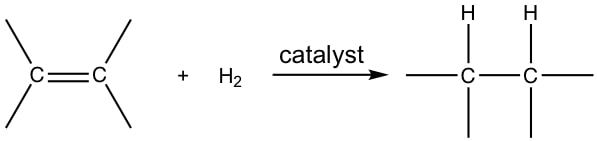
Alkanes are produced by reducing alkenes. This is done by heating the alkene with hydrogen gas in the presence of a nickel catalyst. However, we can also reduce alkenes using a platinum or palladium catalyst. This process is also known as hydrogenation.
Reactions
Combustion
Alkanes react with oxygen in a combustion reaction, with smaller alkanes igniting more easily. With a limited supply of oxygen, incomplete combustion can produce carbon monoxide (CO), soot, and water (H2O). However, with excess oxygen, the complete combustion of alkanes will produce carbon dioxide (CO2) and water (H2O).
Combustion reactions are exothermic: they release energy to their surroundings. As alkanes are easily burnt, many of them are used as fuels. One such example is methane (CH4), which can burn with little soot when sufficient oxygen is available. Its combustion still releases carbon dioxide.
The complete combustion of alkane has the general equation:
CxHy + (x + y/4) O2 → xCO2 + y/2 H2O
Halogenoalkanes
Alkanes form halogenoalkanes when reacted with halogens in a free-radical substitution reaction. This is done under UV light or high temperatures, substituting hydrogen atoms with halogen atoms in the alkanes.
We will be using the chlorination of ethane as an example of a free-radical substitution reaction.
In the initiation step, free radicals Cl• are generated. This occurs when UV light or high temperatures provides energy for the homolytic fission of the Cl–Cl bond.
Cl–Cl → 2Cl•
There is a chain reaction involving the consumption and generation of Cl• radicals in the propagation step. This is due to the consumption of a Cl• radical in one step and the generation of another Cl• radical in the next step.
CH3CH3 + Cl• → CH3ĊH2 + HCl
Cl2 + CH3ĊH2 → CH3CH2Cl + Cl•
In the termination step, free radicals continue to be consumed but are no longer generated. There are many possible termination steps:
Cl• + Cl• → Cl2
CH3ĊH2 + CH3ĊH2 → CH3(CH2)2CH3
CH3ĊH2 + Cl• → CH3CH2Cl
This results in the overall equation of CH3CH3 + Cl2 → CH3CH2Cl + HCl.
Once a free radical is formed, the chain reaction can produce many product molecules. Substitution is not limited to one hydrogen: further chlorination can produce a mixture of products. The sequence for methane is:
| Monosubstitution | CH4 + Cl2 → CH3Cl + HCl |
| Disubstitution | CH3Cl + Cl2 → CH2Cl2 + HCl |
| Trisubstitution | CH2Cl2 + Cl2 → CHCl3 + HCl |
| Tetrasubstitution | CHCl3+ Cl2 → CCl4 + HCl |
Reactivity and Substitution
As we know, the reactivity of halogens decreases down the group. This makes fluorine and iodine unsuitable for free-radical substitution – fluorine is too reactive, whereas iodine is too unreactive. In addition, down the group, as halogens have a larger atomic radius, the energy released when the H–X bond is formed is less than that needed to break the C–H bonds in an alkane. This makes the first propagation step more endothermic, and thus it becomes increasingly harder to substitute the halogen.
When halogens substitute hydrogen atoms on different carbon atoms, other products are formed. However, this is more commonly seen in higher alkanes.
Occurrence of Alkanes
When I first learnt about this, I was a little surprised – we can also find alkanes in the atmospheres of other planets! Jupiter, Saturn, Uranus, and Neptune have a small portion of methane and ethane in their atmospheres. Saturn’s largest moon, Titan, often encounters rains made of liquid methane.
Methane is also present in Earth’s atmosphere. It comes from natural sources such as wetlands and from human activities including livestock farming, landfills, and leaks in oil and gas systems. Methane is a greenhouse gas; burning methane produces carbon dioxide and water when combustion is complete. Many hydrocarbons in oil and natural gas formed from ancient organic matter transformed by heat and pressure over millions of years.



Add comment