

 Akshay Dinesh
Three bright stars make a large triangle in the winter night sky: reddish Betelgeuse, brilliant Sirius, and Procyon. Known as the Winter Triangle, this pattern is a useful starting point for finding your way among the stars. You do not need a telescope. Start with Orion’s three-star belt, use it as a pointer to Sirius, and then look for the other two corners.
The name comes from the Northern Hemisphere, where the pattern is especially familiar on winter evenings. It is visible from much of the Southern Hemisphere too, although the season, orientation, and convenient viewing times are different. Your latitude, the date, and the time of night all affect where it appears.
Start with Orion’s belt
From mid-northern latitudes, look toward the eastern or southeastern sky on a clear winter evening. Orion is recognizable by three moderately bright stars in a short, nearly straight row: Alnitak, Alnilam, and Mintaka. They mark the hunter’s belt in the traditional constellation figure. The row is a better starting point than trying to identify a triangle among every bright object in the sky.
Orion rises earlier as winter progresses. In November, you may need to look later at night; by January and February, the pattern is generally easier to find during the evening. The exact hour varies with location and with obstructions on the horizon. A local sky chart set to your date, time, and location can show you when all three stars are above the horizon.
Once you have the belt, look for a conspicuously orange-red star marking one of Orion’s shoulders. That is Betelgeuse, the first corner of the triangle. Rigel, a bright blue-white star on the opposite side of the belt, marks a foot of Orion; it is not a corner of the Winter Triangle. Comparing the two helps prevent a common mix-up.
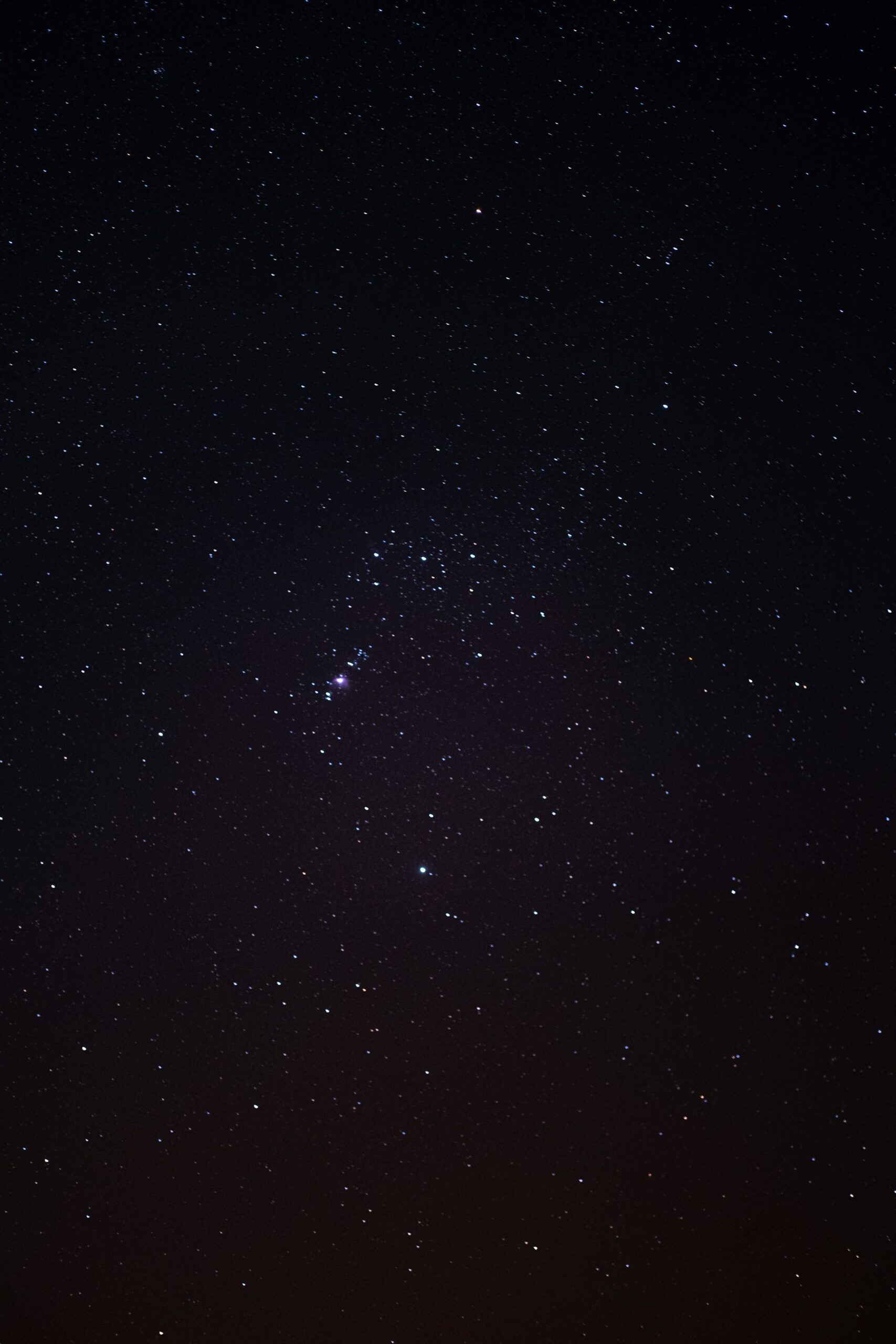
Follow the belt to Sirius and Procyon
Imagine extending the line of Orion’s belt toward the southeast, away from the belt’s other well-known neighbor, the orange star Aldebaran. From a typical mid-northern winter view with Orion rising in the east or southeast, the line runs roughly down and left to Sirius. NASA’s Jet Propulsion Laboratory recommends this same route in its December 2024 skywatching guide. Sirius is the brightest star in the night sky, although bright planets can occasionally outshine it.
Now look to the left and above Sirius in that same rising view for Procyon. Connect Procyon to Sirius and then to Betelgeuse, and you have the broad triangle. It occupies a much larger area than Orion’s belt, so give your eyes room to travel across the sky. The stars are the corners; there are no visible lines joining them.
These left-and-right directions describe a particular view, not a permanent orientation. As the sky appears to turn during the night, the pattern rotates; it also looks different from other latitudes and is inverted compared with many northern sky charts when viewed from much of the Southern Hemisphere. The connection between the stars remains the better guide. A chart can help distinguish Procyon from a bright planet or another star nearby.
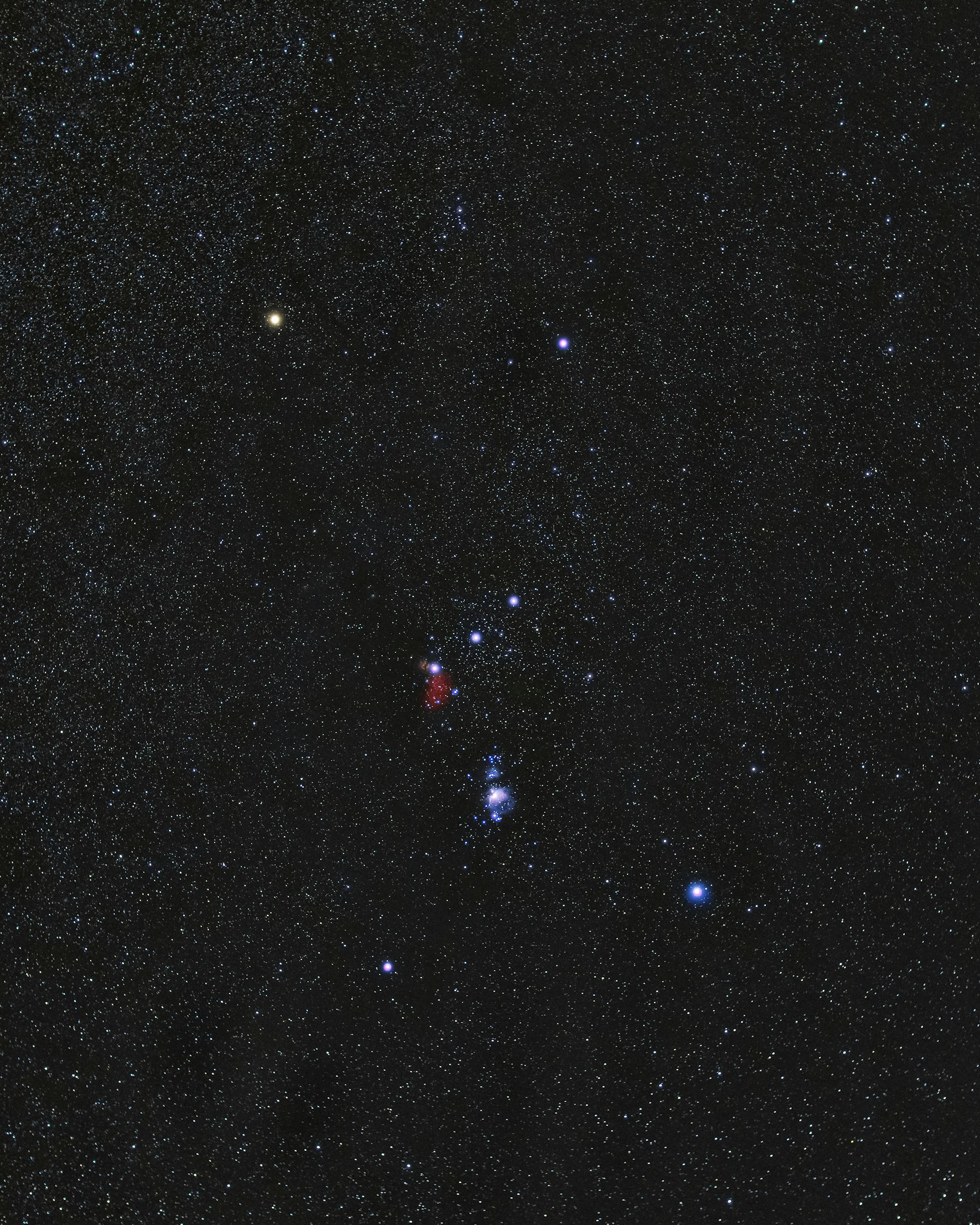
Three stars, three different neighborhoods
The Winter Triangle is an asterism: a recognizable pattern of stars rather than one of the 88 officially defined constellations. Its corners belong to three different constellations. Betelgeuse lies in Orion, Sirius in Canis Major, and Procyon in Canis Minor. NASA also uses the term asterism for familiar patterns such as Orion’s belt and the larger Winter Circle.
The stars appear together from Earth, but they are not a tightly connected triangle in space. Sirius and Procyon are relatively close neighbors of the Sun, at roughly 9 and 11 light-years away, respectively. Betelgeuse is hundreds of light-years distant, with its distance less precisely established. A light-year is a measure of distance: the distance light travels in a year.
The contrast in apparent brightness is not a simple ranking of how much light the stars produce. A star’s distance affects how bright it looks to us, as does the amount of light it emits. Sirius is conspicuous partly because it is nearby. Betelgeuse, a red supergiant, is immensely luminous but much farther away. Procyon is a bright star in its own right, even though it may look less striking than Sirius.
Color offers another clue. Betelgeuse often looks warm orange or reddish, while Sirius and Procyon appear whiter. Low in the sky, Sirius can seem to flash different colors as turbulent air bends its light. That flicker is an atmospheric effect, not a rapid change in the star itself.
When and where to look
For a first attempt from the Northern Hemisphere, choose a clear evening in January or February and find a place with a reasonably open view toward the south and east. Bright stars can be visible from towns, but nearby lights and haze make the fainter belt stars harder to recognize. Give your eyes time to adjust, and shield them from bright screens and lamps. Clouds, buildings, and trees can hide a corner even when the other two are visible.
In December the stars become increasingly accessible in the evening, while in late autumn they generally rise later. By spring, the triangle is shifting toward the western evening sky and eventually disappears into twilight. These are broad northern-hemisphere patterns, not a universal timetable: check a local chart before setting out, especially at high latitudes or in the Southern Hemisphere.
You can also use the triangle to find a larger pattern. Sirius and Procyon form two points of the Winter Circle, sometimes called the Winter Hexagon. NASA lists its other bright points as Pollux, Capella, Aldebaran, and Rigel. Betelgeuse sits within that broad region rather than serving as one of the six named points. On a clear night, tracing the smaller triangle first makes the larger shape less daunting.
Return on another night at a different hour and notice how the same three stars have turned together. Their familiar shape is a useful reminder that a sky map is not a fixed picture: it is a guide to a view that changes with Earth’s rotation, the season, and where you stand.



Add comment