

 Akshay Dinesh
Engineers often make structures reliable by repeating the same shape. Honeycombs, grids, and trusses are easy to model, manufacture, and test. Yet repetition has a weakness: once one cell buckles, nearby cells built the same way may concentrate the same stress and fail in sequence. A material designed for impact protection can end up crushing along a narrow band while much of the structure does little useful work.
A research team from MIT and Northeastern University has tested a different strategy. Instead of arranging identical building blocks, the researchers created web-like networks whose beams vary widely in length, thickness, direction, and number of connections. They call these structures scale-rich metamaterials. In experiments reported in Nature in November 2026, the irregular networks spread deformation through a larger part of the sample, absorbed impacts efficiently, and offered a wide range of adjustable stiffness. The work suggests that carefully designed disorder can be a feature rather than a flaw.
Why metamaterials depend on structure
A mechanical metamaterial is an engineered structure whose large-scale behavior comes partly from its internal geometry, not only from the substance used to make it. Two objects made from the same polymer can bend, compress, or transmit vibrations very differently if one contains a triangular lattice and the other a honeycomb. Engineers can therefore tune a material by changing the arrangement of its beams, pores, and joints.
Most architected materials begin with a unit cell, a small pattern copied across the design. Repetition brings order and predictability. It also means the structure has one or a few characteristic scales: its cells tend to have similar sizes, its struts similar lengths, and its junctions similar numbers of connections. Even hierarchical designs usually repeat a limited set of features at several levels.
That regularity can guide a crack or collapse. When a square lattice is compressed, for example, one row may buckle first. Stress then moves to the next similar row, producing a sequence of crushing bands. The deformation is localized because a small region carries most of the damage. For impact protection, localization is wasteful. A better cushion would involve more of its mass, slow the object over a longer distance, and avoid a sharp peak force.
What makes a network scale-rich
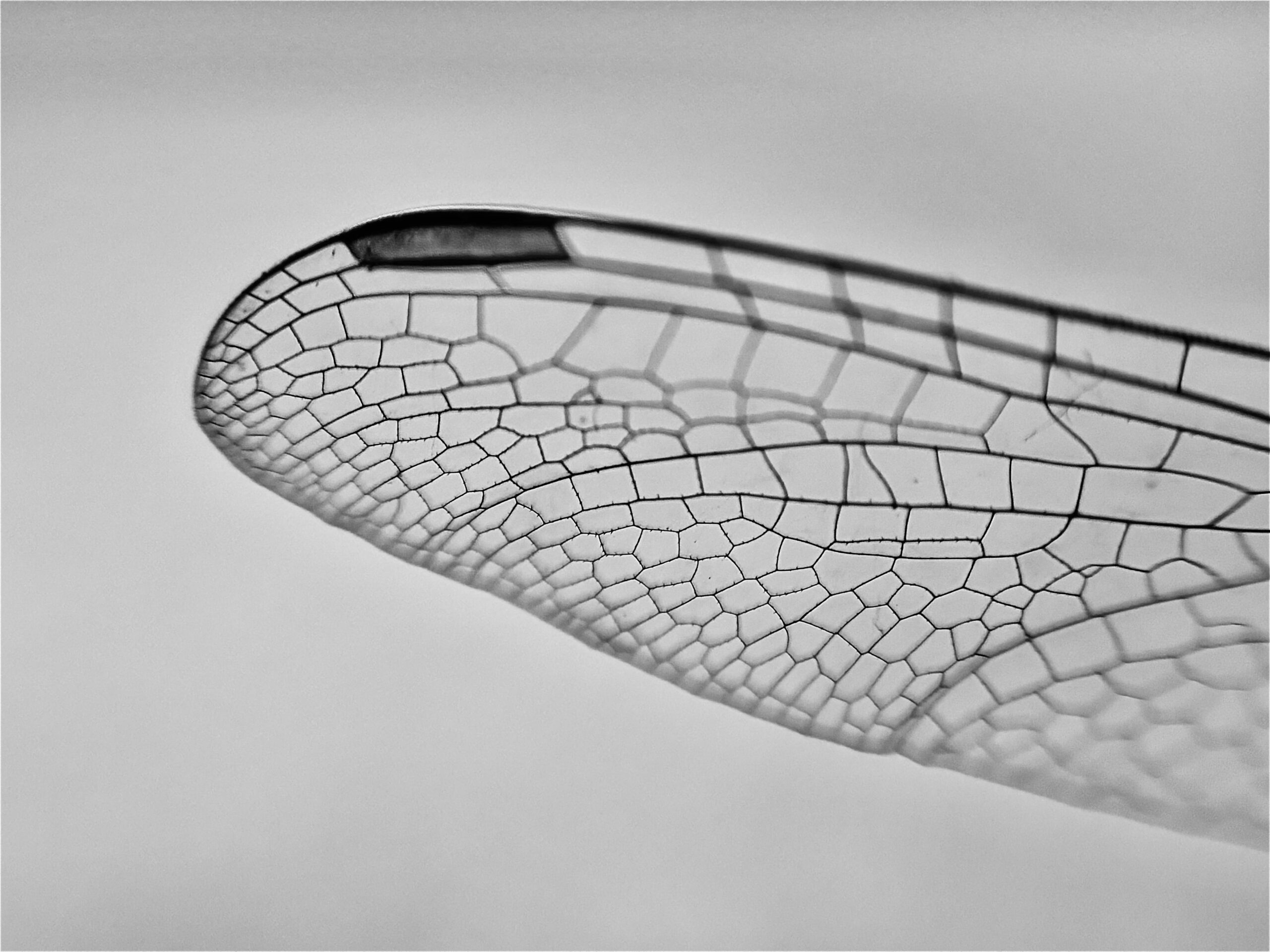
Networks in nature rarely look like a tiled floor. Leaf veins branch from thick channels into progressively smaller ones. A dragonfly wing contains cells of many sizes and junctions with different roles. The brain, the internet, and transportation systems also mix short local links with longer connections. Network science studies how such patterns distribute flow, information, and vulnerability.
The research team translated that idea into a material. A computer algorithm generated connected networks of beams, called ligaments, while controlling how varied their lengths and connections could become. The result was not random clutter. It was controlled heterogeneity: a design family in which features could span many sizes while the overall density and directional behavior remained adjustable.
The researchers then turned the digital networks into centimeter-scale polymer specimens using vat photopolymerization, a 3D-printing process that hardens liquid resin with light. According to the Nature paper, the smallest printed features were roughly 100 micrometers across. The team compared the samples with familiar square, triangular, hexagonal, Kagome, and disordered reference networks at matched relative densities.
Two design controls were enough to produce a broad range of structures. By changing them, the researchers could alter how strongly beams aligned in one direction and how widely their lengths, thicknesses, and connectivity varied. Across the tested designs, elastic anisotropy, the amount by which stiffness changes with direction, covered a 190-fold tunable range. The same framework could therefore produce a nearly direction-neutral cushion or a structure deliberately stiffer along one axis.
How disorder spreads the force of an impact
Under compression, a conventional square lattice tended to fail layer by layer. Its similar beams faced similar loads, so deformation gathered in narrow bands. In the scale-rich networks, a thick or highly connected beam could redirect force into several paths, while smaller surrounding beams bent and yielded at different moments. Damage spread through the network instead of racing along one predictable line.
The team also dropped a rigid impactor onto samples with a relative density of 40 percent and filmed the event with a high-speed camera. An effective impact absorber must do two things at once: dissipate much of the incoming energy and keep the peak transmitted force low. Among the periodic and disordered reference architectures tested, the scale-rich samples combined the highest energy dissipation per unit mass with the lowest peak force.
This does not mean disorder automatically makes a material tougher. A poorly connected random network could contain weak points, and unnecessary material could add mass without improving protection. The advantage came from engineering the distribution of sizes and connections. When the researchers selectively removed parts of that range, the network’s load-bearing ability declined, indicating that the mixture of scales was doing real mechanical work.
The structures also dissipated more energy during dynamic loading and changed how elastic waves moved through them. Simulations showed a much wider adjustable range of effective wave speed than square and hexagonal lattices of comparable density. That opens a second set of possibilities: a structure might both carry a load and steer sound or vibration, rather than being optimized for only one task.
From pomelo rind to protective equipment
To show how the method could protect a fragile object, the researchers borrowed an idea from the pomelo, a citrus fruit with an unusually thick, spongy rind. They programmed a denser network of beams around an embedded acrylic payload. When the structure was compressed, force traveled around the protected center instead of concentrating through it.
That demonstration matters because real protective equipment is rarely a uniform slab. A helmet must protect particular regions while staying light and wearable. Packaging may need extra support around corners or a delicate component. Vehicle and aerospace structures must manage impacts without sacrificing stiffness during normal use. A network that can vary smoothly from one location to another could put material where it changes the force path most.
The design framework may also suit inverse design. Rather than choosing a familiar lattice and seeing how it behaves, an engineer could specify goals such as maximum force, stiffness direction, weight, and protected zone. An algorithm could then search the scale-rich design space for a network that balances those requirements. Additive manufacturing is especially useful here because it can produce internal geometries that would be difficult to cut, mold, or assemble conventionally.

What the study has not proved yet
The experiments establish a design principle, not a finished commercial material. The samples were small polymer structures made under laboratory conditions. A bicycle helmet, shipping insert, or armor panel would face repeated impacts, temperature changes, moisture, manufacturing variation, aging, and loads from several directions. Each application would also require comparison with the best existing foams, lattices, and composites under standardized safety tests.
Three-dimensional performance is another open question. The paper’s experiments focus mainly on planar networks with beams arranged in a sheet-like geometry. A commentary published alongside the study in Nature identified experimental three-dimensional structures and density-matched comparisons with other porous materials as important next steps. Scaling production while preserving many fine ligament sizes may also prove difficult.
There is a useful distinction between being stronger and being better at protecting something. An impact absorber often needs to deform and dissipate energy rather than resist all motion. The scale-rich samples were promising because they distributed that deformation and limited the largest force while still carrying load. The right design would depend on what must remain intact and how much controlled crushing is acceptable.
The larger insight is broader than any one helmet or package. Engineers have spent decades exploiting order because repeated cells are understandable and manufacturable. Network science now offers tools for making irregularity understandable too. By controlling disorder across several scales, a future structure may bend, cushion, and guide waves in ways a perfectly repeating lattice cannot.