Akshay Dinesh
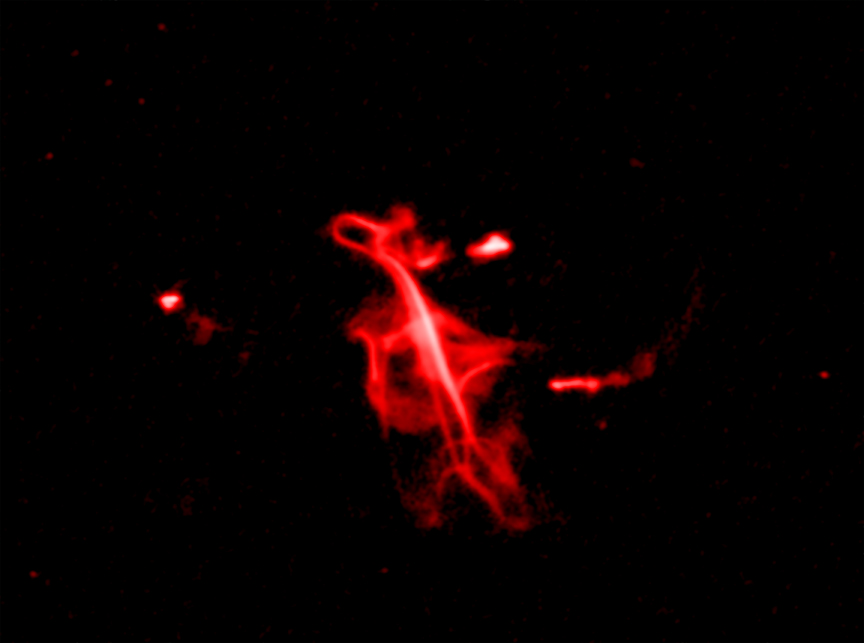
A strange red curve appears to float inside a blue cloud of hot gas, looping through space like a treble clef drawn in light. The resemblance is accidental, but the shape records a real sequence of cosmic events. Astronomers now think an outburst from a supermassive black hole filled the region with fast-moving electrons and magnetic fields. Much later, a collision between two galaxy clusters squeezed and disturbed that aging material, making it shine brightly at radio wavelengths again.
The object, catalogued as VLSS J0318.9+5755, lies about 1.55 billion light-years from Earth in the constellation Camelopardalis. It is difficult to study because it sits almost directly behind the crowded plane of the Milky Way. By combining radio, X-ray, and infrared observations, a team led by Andrea Botteon of Italy’s National Institute for Astrophysics reconstructed a story that no single telescope could reveal.
A hidden object with the wrong identity
The Treble Clef first stood out in radio surveys, but its location made the source hard to classify. It lies only about half a degree from the Milky Way’s midplane, where foreground stars, gas, and dust obscure the more distant universe. Early observations even led astronomers to consider whether it might be a pulsar, a rapidly rotating neutron star whose beam can produce regular radio signals.
The source did not behave like an ordinary compact pulsar. Its emission is broad and filamentary, extending across a region far larger than a single star. Later radio data suggested that it might instead lie in a galaxy cluster hidden behind the Milky Way. The new investigation tested that possibility with NASA’s Chandra X-ray Observatory and the German-Russian eROSITA telescope, both of which can detect the extremely hot gas that fills the space between galaxies in a cluster.
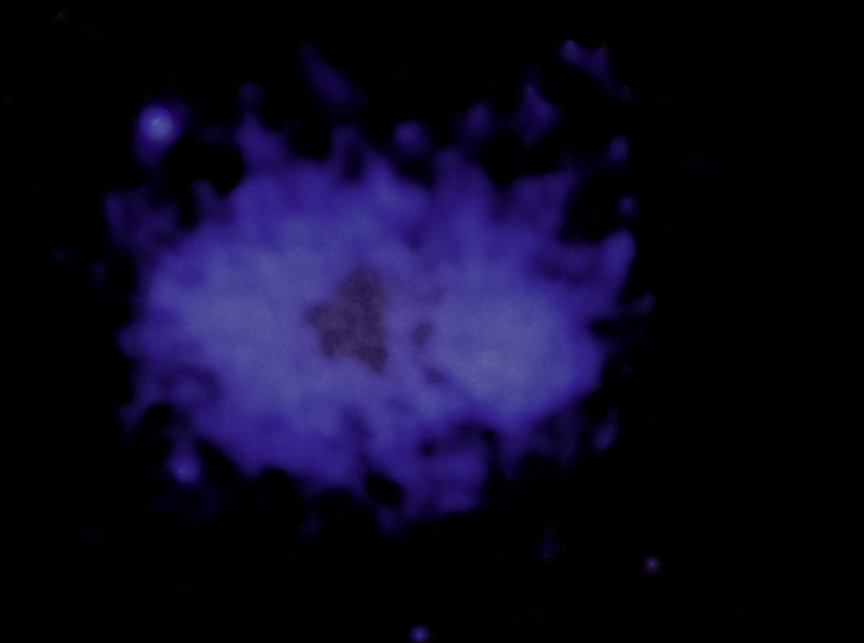
Those X-ray observations revealed a large reservoir of gas heated to millions of degrees. They also showed that the object is not sitting in a calm, settled cluster. Two galaxy clusters are merging there, and their encounter has disturbed the gas on an enormous scale. The full composite view spans roughly six million light-years, wide enough to contain the Milky Way many times over.
How a black hole leaves radio-emitting plasma behind
A supermassive black hole does not shine by itself, but matter falling toward it can form a hot, rapidly rotating disk. Magnetic fields near the black hole can redirect some of that energy into narrow jets. These jets carry charged particles and magnetic fields away from the central galaxy at speeds approaching the speed of light, inflating vast lobes of plasma far beyond the galaxy’s visible stars.
Electrons spiraling around magnetic-field lines release synchrotron radiation. That radiation can be detected by radio telescopes even when the source is too faint or too obscured to stand out in visible light. A fresh jet may produce a strong radio signal across a broad range of frequencies, but the electrons gradually lose energy. High-energy electrons fade first, so an old plasma cloud develops a steep radio spectrum: its brightness drops unusually fast as the observing frequency rises.
Botteon’s team combined measurements from the LOFAR low-frequency arrays and India’s upgraded Giant Metrewave Radio Telescope. Parts of the Treble Clef have an extraordinarily steep spectrum, with a spectral index greater than 4 between 400 and 650 megahertz. In practical terms, the source is far brighter at low radio frequencies than at higher ones. That is a fingerprint of ancient electrons rather than a black hole jet that is still being actively supplied.
Why the signal brightened again
Old radio plasma can become so faint that it nearly disappears from view. It does not necessarily vanish. If a pressure wave later compresses the cloud, the magnetic field strengthens and the electrons gain energy. Their spiraling motion once again produces detectable radio emission. Astronomers call such a revived fossil source a radio phoenix, borrowing the name of the mythical bird said to rise again after destruction.
The cluster merger provides a plausible source of that compression. When two galaxy clusters collide, their galaxies mostly pass one another because the distances between them are so large. The thin gas between those galaxies cannot pass through as freely. Huge flows and shock waves move through it, somewhat like a sonic boom moving through air, although the cluster gas is vastly hotter and more rarefied.
The team proposes a two-stage history. A central black hole first launched the particles and magnetic fields that became the Treble Clef. After the electrons aged and the radio glow weakened, gas motions associated with the cluster merger compressed or reenergized the plasma. That sequence explains why an old, steep-spectrum source can still appear remarkably bright and sharply filamented at low frequencies.
Reading a collision from several kinds of light
The colorful composite is not a natural-color photograph. Each layer represents a different physical clue. LOFAR radio data, shown in red, map the aging electrons and magnetic fields. X-rays from Chandra and eROSITA, shown mainly in blue, trace the hot gas in the galaxy clusters. Infrared observations from the United Kingdom Infrared Telescope show galaxies and foreground stars that remain visible through much of the Milky Way’s dust.
The X-ray image also required more than simply looking for a bright patch. Much of the hot gas forms an approximately oval glow. The researchers built a smooth model of that broad emission and subtracted it from the observations. The residual image exposed excess X-ray brightness to the left and right of the center, evidence that the gas is not symmetrical and undisturbed.
That pattern points to a collision moving roughly from left to right as seen from Earth. The team estimates that the clusters passed most directly through one another a few hundred million years ago and are now separating. A faint central radio halo may offer another sign of merger-driven turbulence, but the paper treats that halo as a tentative detection. The radio phoenix interpretation is the stronger result; some details of exactly how shocks and turbulent flows sculpted its curves remain open.
What the Treble Clef teaches astronomers
The source matters because it preserves two different eras of activity in one place. Its electrons were probably launched during an earlier episode of black hole feeding, while its present brightness was shaped by the later merger of galaxy clusters. Radio observations therefore act like a kind of cosmic archaeology, revealing energy released long after the original engine quieted down.
Objects like this also help researchers study magnetic fields in the thin gas between galaxies. Those fields are difficult to measure directly, yet they influence how charged particles travel and how energy moves through a cluster. The Treble Clef’s narrow filaments may trace stretched or compressed magnetic structures. Future observations at very low frequencies, especially with the upgraded LOFAR 2.0 system, could resolve those threads more sharply and test how old the emitting particles really are.
The musical shape itself is pareidolia, the human tendency to notice familiar forms in complex patterns. The useful discovery lies beneath the nickname. A radio telescope found elderly electrons, X-ray telescopes exposed a violent merger, and infrared data helped astronomers see through the Milky Way. Together, those observations turned an attractive curve into a physical history of black hole activity, fading radiation, and a collision powerful enough to make an ancient signal visible again.