Akshay Dinesh
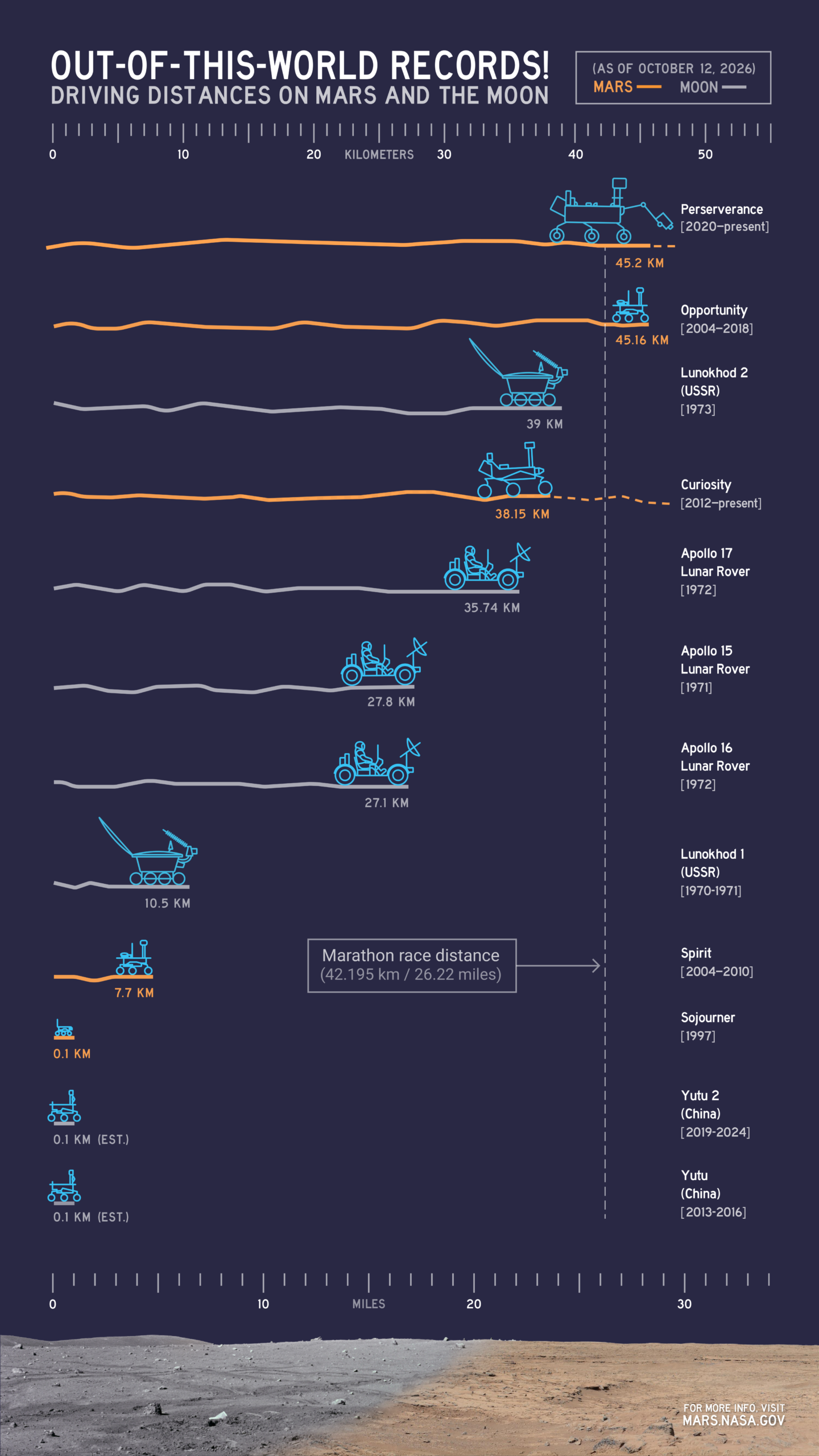
On October 11, 2026, NASA’s Perseverance rover rolled past a mark that had stood for more than a decade: 28.06 miles, or 45.16 kilometers, driven on another world. Its odometer reached 28.10 miles, edging beyond the total accumulated by Opportunity during nearly 15 years on Mars. Perseverance covered the same distance in about five and a half years. The difference is not simply that a newer rover has faster wheels. It shows how much planetary exploration changes when a machine can see hazards, choose a safe path, and keep track of its own position while people on Earth remain millions of miles away.
A distance record with a scientific purpose
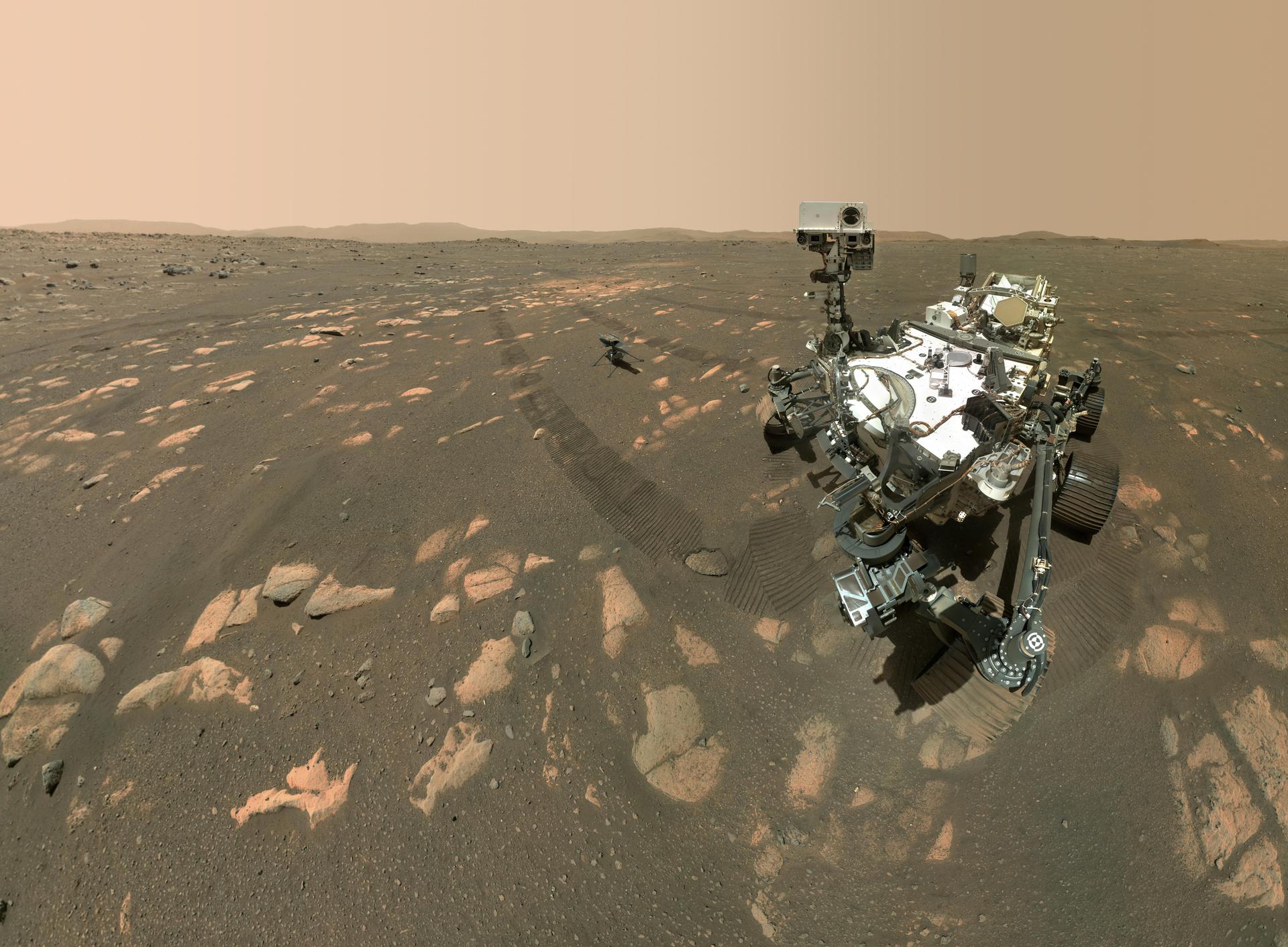
Every meter on Mars has a cost. Driving uses electrical power, takes time away from other activities, and exposes wheels and suspension parts to sharp rocks, soft sand, steep slopes, and repeated temperature swings. A long route is worthwhile only when it carries the rover toward better science. Perseverance landed in Jezero Crater in February 2021 to investigate an ancient lake and river delta, search for signs that Mars may once have supported microbial life, and collect carefully documented rock cores for possible future return to Earth.
The record arrived as the rover crossed terrain beyond Jezero’s western rim on its way toward an area named Idubi. NASA says some rocks there may be among the oldest terrain ever examined closely in the solar system. On Earth, erosion and moving tectonic plates have destroyed or altered most comparable rocks. Mars has no system of shifting plates like Earth’s, so very old crust can remain exposed. Scientists hope the route will lead to evidence of ancient hydrothermal activity, where heated water once moved through rock and created conditions that can preserve revealing chemical clues.
That makes the odometer a measure of access, not just endurance. Sojourner, NASA’s first Mars rover, traveled about 330 feet in 1997. Spirit reached 4.8 miles, Opportunity 28.06 miles, and Curiosity had passed 23.65 miles when Perseverance set the new mark. Each generation has expanded the area scientists can investigate, but Perseverance’s biggest advance lies in how it covers ground.
Why Earth cannot steer the rover in real time
A driver on Earth cannot watch a live video feed and turn the rover around a rock. Earth and Mars continually change their positions as they orbit the Sun, so a radio command takes roughly 3 to 22 minutes to travel one way. Even at the short end of that range, a joystick response would arrive far too late. The rover might have reached the obstacle before an engineer even saw it.
Instead, mission planners study orbital maps and stereo images, choose science targets, set waypoints, and send a package of instructions. Perseverance then carries out the plan during the Martian day. Most science data travels first to an orbiter and then through NASA’s Deep Space Network to Earth. That relay is efficient, but it still does not turn the rover into a remote-controlled car.
Earlier rovers often moved in cautious stages. They would drive along a path specified by planners, stop to take pictures, send information home, and wait while the next route was prepared. The approach protected valuable spacecraft, but every stop could consume a large fraction of a working day. Traveling farther required giving the rover more responsibility without relaxing the safety rules.
How AutoNav turns images into a safe route
Perseverance’s onboard driving system is called AutoNav. Its left and right navigation cameras view the same scene from slightly different positions, much as two human eyes do. Software uses that difference to estimate distance and build a three-dimensional model of the ground ahead. It marks hazards such as large rocks, steep drops, and terrain the wheels may not cross safely, then selects a route toward the waypoint provided by the team.
The scale of the improvement is striking. NASA reports that Sojourner assessed 20 measurement points when examining a path. Perseverance processes about 600,000 points with each view. A dedicated Vision Compute Element handles the demanding image work, allowing the rover to analyze terrain as its wheels turn. Engineers describe this as “thinking while driving”: the rover does not need to stop for every cycle of imaging, mapping, and route selection.
Perseverance also uses visual odometry to check whether motion matches the plan. It photographs surface features, moves, photographs them again, and compares their apparent positions. If a wheel slips on loose soil, the wheel rotation alone may suggest the rover traveled farther than it really did. The camera comparison reveals that mismatch. AutoNav can then update the rover’s location and keep its hazard map aligned with the real landscape.
Why Perseverance moves faster than earlier rovers
“Faster” is relative on Mars. Perseverance’s maximum wheel speed is only about 4.2 centimeters per second, or roughly 150 meters per hour. The breakthrough is that useful movement occupies more of the available time. JPL’s robotics team reports that Perseverance can drive through terrain at about 110 meters per hour while evaluating hazards. Curiosity’s earlier system averages about 15 to 18 meters per hour under similar self-driving conditions because it must pause longer to gather and process stereo images.
The 2026 record announcement shows how thoroughly this capability has become part of normal operations. More than 90 percent of Perseverance’s total distance was driven while AutoNav evaluated the terrain, compared with about 5 percent for the first Martian version used by Spirit and Opportunity. Perseverance has covered as much as 412 meters in one sol. A technical report from the JPL robotics team noted that, on a record 2025 drive, 403 of 411 meters were completed with full onboard hazard avoidance.
Hardware still matters. Perseverance has six aluminum wheels with treads designed for traction and durability, plus more clearance beneath its body than Curiosity. Its suspension lets wheels climb over uneven ground while helping keep the rover stable. Yet stronger wheels alone would not produce the distance record. The key is the partnership between human judgment and onboard decision-making: people choose destinations and scientific priorities, while the rover handles the many small steering choices between them.
Finding a location where there is no GPS
Safe steering solves only part of the problem. Visual odometry accumulates tiny errors, just as counting footsteps eventually gives an imperfect estimate of where a walker stands. On a long drive, Perseverance’s calculated position could drift by more than 100 feet, or about 35 meters. If the rover became uncertain that a hazard was still where its map expected it to be, it might stop and wait for Earth to confirm its location.
In February 2026, the mission began using Mars Global Localization. The system compares a panorama from the navigation cameras with orbital terrain images carried onboard. According to JPL, it can place the rover within about 10 inches, or 25 centimeters, in roughly two minutes. The first operational test matched a panorama from an area called Mala Mala against imagery from the Mars Reconnaissance Orbiter.
The calculation runs on a fast commercial processor that had served as Perseverance’s base station for the Ingenuity helicopter. Engineers tested the location method against images from 264 earlier rover stops, and it correctly identified every one. They also built repeated checks into the process because the chip was not designed with the same radiation protection as the rover’s main computers. By letting Perseverance correct its own accumulated location error, the upgrade removes one of the main limits on how far it can travel between calls home.
What the record changes next
Perseverance was originally expected to drive no more than 12.4 miles during its primary mission. It has now traveled more than twice that distance, and NASA says all mobility systems remain operational. The agency approved a first mission extension beginning in October 2026, with exploration of the crater rim planned through about the end of 2028. Laboratory testing has also been used to evaluate motors and brakes for a much longer working life.
No distance record guarantees a discovery. A rover can cross barren ground, encounter terrain too risky to enter, or spend weeks examining a target only to find an ambiguous result. But mobility changes the questions a mission can ask. A machine that travels farther can compare more rock layers, reach exposures chosen from orbital data, and leave an unproductive site without sacrificing months to the journey.
Opportunity’s achievement came from extraordinary survival: a rover designed for 90 sols kept working for 5,111. Perseverance’s record tells a different story. Its endurance matters, but its pace comes from cameras, processors, maps, and software working together under rules set by human planners. The rover is still slow enough that a person could stroll beside it. Across the silence and delay between two planets, however, those careful meters add up to a new kind of exploration.