Akshay Dinesh
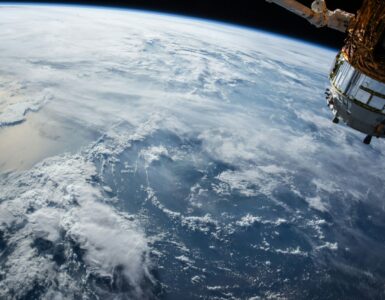
Astronauts aboard the International Space Station seem to drift as if gravity has been switched off. A pen released from a hand hangs nearby. Water gathers into floating spheres. A crew member can cross a module with one gentle push. Yet gravity at the station’s altitude is still close to 90 percent as strong as it is at Earth’s surface.
The missing piece is not gravity but support. On the ground, the floor stops your fall and pushes upward on your feet. In orbit, the station, its crew, and everything inside are falling together. That shared fall creates the weightless experience called microgravity.
Gravity is what keeps the space station in orbit
Space is not a place where gravity suddenly ends. Every object with mass attracts other mass, and Earth’s influence reaches far beyond the atmosphere. It holds the Moon in orbit about 384,000 kilometers away, so it certainly still acts on a station only about 400 kilometers above the surface.
NASA calculates that Earth’s gravitational field near a typical space-station altitude is about 89 percent of its surface strength. If the station could somehow hover there without moving sideways, it would fall directly toward Earth. It stays aloft because it is also moving sideways at roughly 28,000 kilometers per hour, or 17,500 miles per hour.
That combination of downward pull and enormous sideways speed produces an orbit. Gravity continually bends the station’s path toward Earth, while the curved surface drops away beneath it. The station does not escape gravity. It follows a path shaped by gravity every second of the trip.
An orbit is a fall that keeps missing the ground
Isaac Newton described the basic idea with a thought experiment. Imagine firing a cannonball horizontally from a very tall mountain. A slow cannonball travels some distance and hits the ground. A faster one travels farther before landing. At a high enough speed, its downward-curving path matches Earth’s curvature, so it keeps falling without reaching the surface.
A spacecraft in low-Earth orbit behaves in the same way. Its engines do not need to hold it up continuously. After launch gives it the needed speed and direction, gravity supplies the inward acceleration that curves its path. Small engine burns are still needed to adjust the orbit and counter thin atmospheric drag, but the basic motion is continuous free fall.
Inside the station, an astronaut and a loose object share almost exactly the same motion. Both accelerate toward Earth at the same rate. Neither has a floor pressing upward with the steady force familiar on the ground, so the object does not drop away from the astronaut. Relative to each other and the cabin, they appear to float.
A scale makes the distinction clear. On Earth, a bathroom scale does not directly measure the gravitational pull on your body. It measures the supporting force between you and the scale, then converts that force into a weight reading. If you and the scale fall together, that contact force disappears and the display can read zero even though gravity is accelerating both of you.
Why scientists say microgravity instead of zero gravity
The phrase zero gravity is catchy but misleading. Gravity remains the main force controlling an orbit, and a real spacecraft is never in a perfectly uniform free fall. Tiny disturbances come from atmospheric drag, crew movement, equipment vibrations, engine firings, and the fact that Earth’s pull is slightly stronger on the side of the station closest to the planet.
Scientists use microgravity for the environment in which these small residual accelerations remain while objects behave as though they are weightless. The word does not mean that Earth’s gravitational field itself has fallen to exactly one-millionth of its normal value. It describes the very small forces measured relative to the freely falling spacecraft.
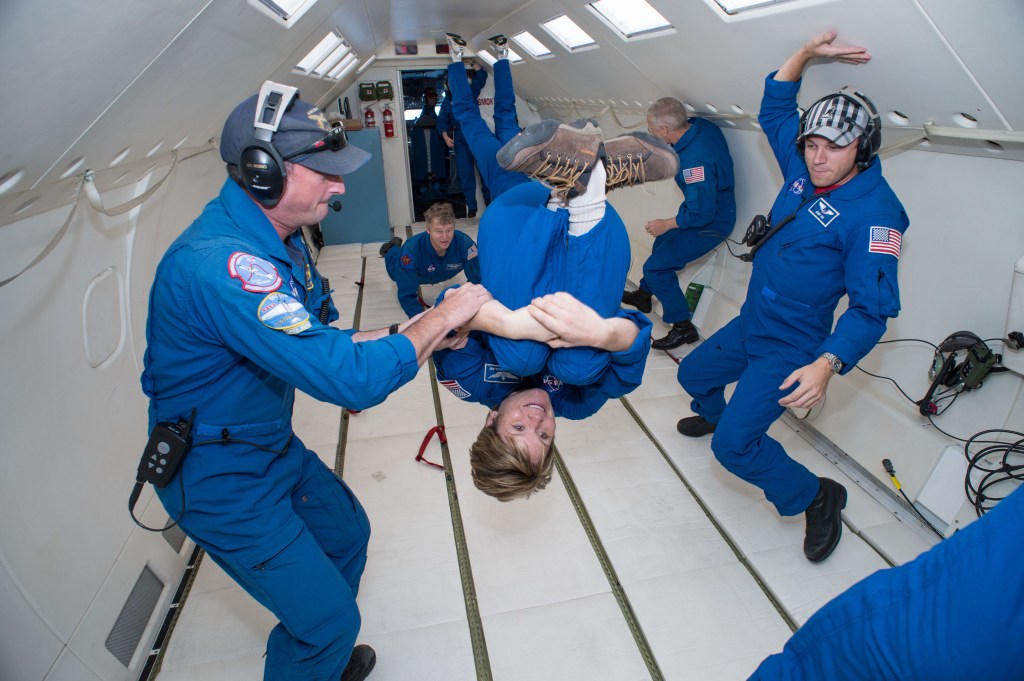
Microgravity can also be produced briefly without going into orbit. During a parabolic flight, an aircraft climbs steeply and then follows a carefully controlled arc. For around 20 seconds, the plane, passengers, and experiments fall together. Drop towers use the same principle for a few seconds by letting experiments fall through a shaft, often with air resistance reduced.
The effect also appears for an instant during an ordinary jump. From the moment your feet leave the ground until they land, gravity is accelerating your body downward. The experience is too brief, and air resistance and body motion are too noticeable, to feel like a space-station flight, but the underlying physics is the same.
Floating does not make mass or inertia disappear
A heavy object may be easy to lift in microgravity, but it is not easy to start or stop. Mass measures how much matter an object contains and how strongly it resists changes in motion. Weight depends on the forces acting on that mass. Remove the supporting force and an object can become weightless without losing any mass at all.
This is why astronauts must move large equipment carefully. A massive cabinet does not need to be hoisted against its Earth weight, but once pushed, it carries momentum. Stopping it requires force and time. A careless shove can send the cabinet into a wall or send the astronaut moving in the opposite direction.
Fluids and flames also behave differently. On Earth, warm air rises and cool air sinks, producing convection currents. In microgravity, there is no reliable up or down to drive that familiar circulation. Flames tend to become more spherical, bubbles do not automatically rise through liquids, and surface tension becomes far more visible. The International Space Station is valuable as a laboratory partly because it lets researchers separate these effects from the strong directional influence of weight.
The human body notices the missing load
The floating looks effortless, but the body pays a price for living without a constant supporting force. On Earth, standing and walking repeatedly load the hips, legs, and spine. In microgravity, those tissues do much less work. NASA reports that weight-bearing bones can lose about 1 to 1.5 percent of their mineral density per month during spaceflight without effective countermeasures, while muscles can also shrink and weaken.
Body fluids shift toward the head because gravity is no longer pulling as much fluid toward the legs. Astronauts may initially develop puffy faces, congestion, changes in balance, and space motion sickness. Longer exposure can contribute to vision changes and increases the challenge of readapting to gravity after landing.
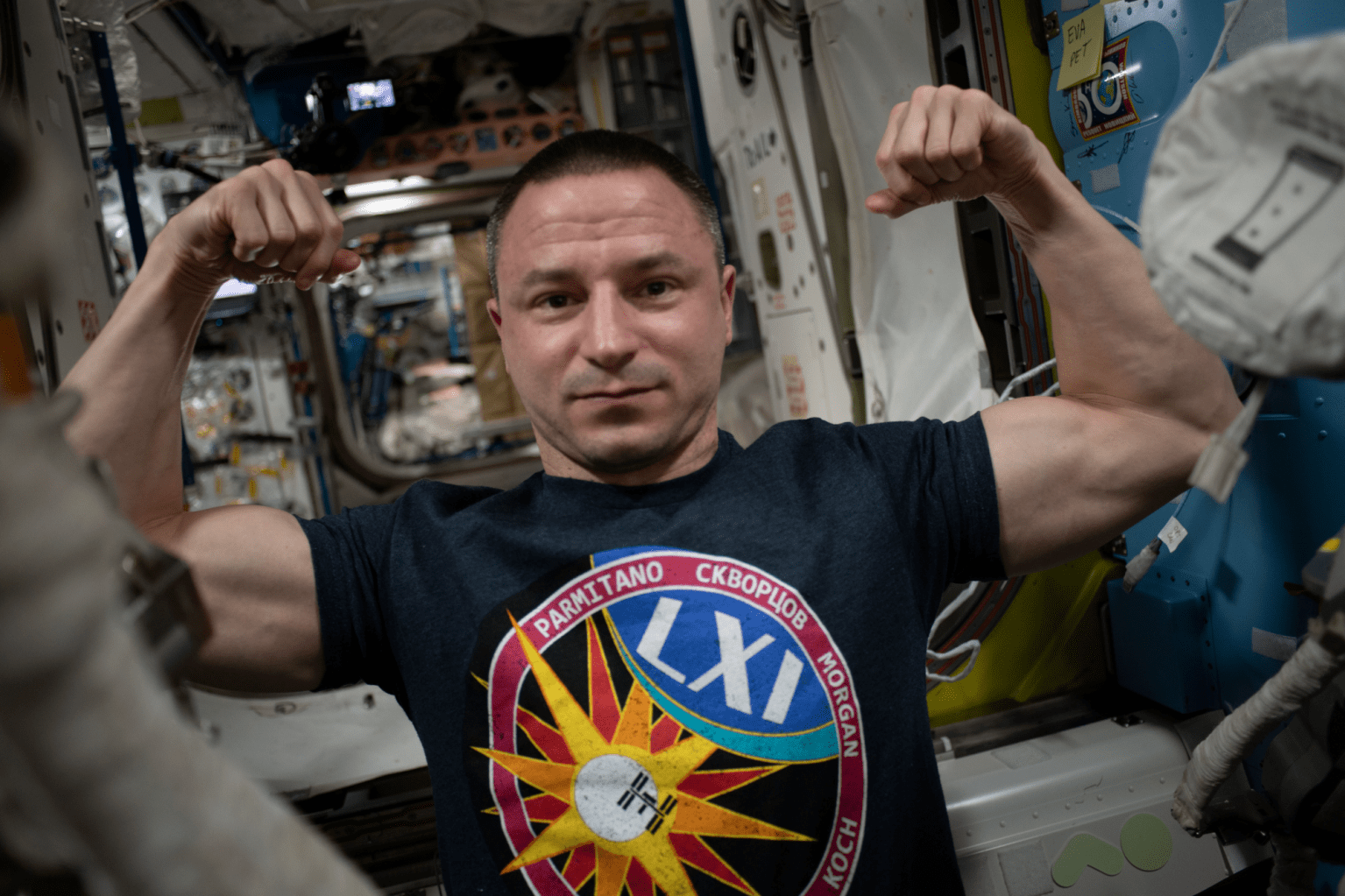
Exercise is therefore part of the job, not an optional break. Space-station crews typically spend about two hours a day on aerobic and resistance training. Harnesses hold them to treadmills, and specialized resistance equipment makes muscles and bones work without relying on hanging metal weights, which would float beside the user.
These responses also explain why microgravity research matters beyond the spectacle of floating. Studies of bone loss, muscle atrophy, fluid shifts, balance, combustion, materials, and plant growth help engineers plan longer missions to the Moon and Mars. Some of the same work can inform research on aging, limited mobility, and disease on Earth.
The simplest picture is shared free fall
When a video shows an astronaut floating, the most accurate mental picture is not a person beyond gravity’s reach. Picture the astronaut, the spacecraft, and every loose object falling side by side around a curved planet. They remain together because gravity gives them almost the same acceleration and their sideways speed keeps carrying them past the ground.
That is the central surprise of orbital flight: astronauts float not because gravity is absent, but because gravity is doing so much of the work. Weightlessness is the sensation of falling freely with nothing steadily pushing back. Microgravity turns that sensation into a lasting environment, revealing both the elegance of an orbit and how deeply life on Earth depends on the support we usually never notice.