 Akshay Dinesh
A raw egg looks simple: a clear white, a golden yolk, and a shell holding everything together. Put that egg in a hot pan or boiling water, though, and it changes fast. The clear white turns cloudy, then firm. The yolk thickens from a liquid into something creamy, crumbly, or chalky depending on how far the heat goes. That transformation is not just drying or freezing in reverse. It happens because heat changes the shape of egg proteins, and those changed proteins build a new structure that makes the egg feel solid.
The useful word is denaturation. In a raw egg, many proteins are folded into specific shapes and surrounded by water. Heating gives those molecules enough energy to loosen some of the weak attractions that keep them folded. Once they unfold, they can bump into one another and link into a wider network. That network traps water and other egg components, turning a loose liquid into a soft solid. The same basic idea explains why a gently cooked omelet feels tender, why overcooked scrambled eggs can seem rubbery, and why a custard needs careful heat instead of a rolling boil.
What a Raw Egg Is Holding in Place
Eggs are mostly water, but water alone would never set into a breakfast shape. The important ingredients are proteins. Egg white contains several proteins, including ovalbumin and ovotransferrin, dissolved in water. The yolk is richer and more complex, with water, proteins, fats, phospholipids, pigments, minerals, and tiny droplets held in a mixture that behaves differently from the white. That is why whites and yolks do not cook in exactly the same way.
Proteins are long chains of amino acids. A protein chain is not useful only because of its ingredients; its folded shape matters too. Parts of the chain may twist, loop, tuck inward, or face outward depending on how different chemical groups are attracted to water, repelled by water, or drawn to other parts of the molecule. In a raw egg, those folded proteins can move around freely enough that the white pours and the yolk flows.
Those protein folds are held together mainly by relatively weak interactions, not by the strongest bonds in the protein chain itself. That distinction matters. Cooking an egg does not chop its proteins into separate amino acids. Instead, it rearranges the shapes those proteins hold. The chain remains a chain, but the folded shape becomes less stable as temperature rises.
Heat Unfolds Proteins Before It Firms the Egg
When an egg warms, protein molecules move faster. At first, the change may be hard to see. A slightly warmed egg white can still look clear, and a yolk may still spread. But inside the egg, some proteins are beginning to lose the folded shapes they had at lower temperatures. Food scientists call that unfolding denaturation.
Different egg proteins denature at different temperatures, which is one reason eggs can pass through so many textures on the way from raw to hard-cooked. Some white proteins begin changing around the lower cooking range, while others need more heat. Yolks thicken in their own range because they contain fat and different proteins mixed together. The exact texture depends on temperature, time, stirring, acidity, salt, sugar, and how evenly heat reaches the egg.
At this stage, the egg is not solid simply because it is hot. Heat is the trigger, but the structure forms because unfolded proteins expose parts of themselves that were tucked away. Once those exposed parts meet other unfolded proteins, they can cling to one another. A single protein changing shape is small. Millions of proteins changing shape at once can transform the whole food.
Coagulation Builds a Protein Network
After proteins unfold, they begin to connect. This linking process is called coagulation. Picture a crowd of long, flexible strands that were once curled into compact shapes. As they uncurl, they catch on neighboring strands. Enough connections create a mesh, and that mesh holds water in place. A cooked egg is solid because it has become a water-filled protein network.
This is also why the white changes from transparent to opaque. In the raw egg white, light can pass through the dissolved proteins and water with little scattering. As the proteins unfold and gather into a network, they create many tiny boundaries that bend and scatter light. The egg white looks white for a similar reason that foam, clouds, or crushed ice can look white: light is being scattered in many directions.
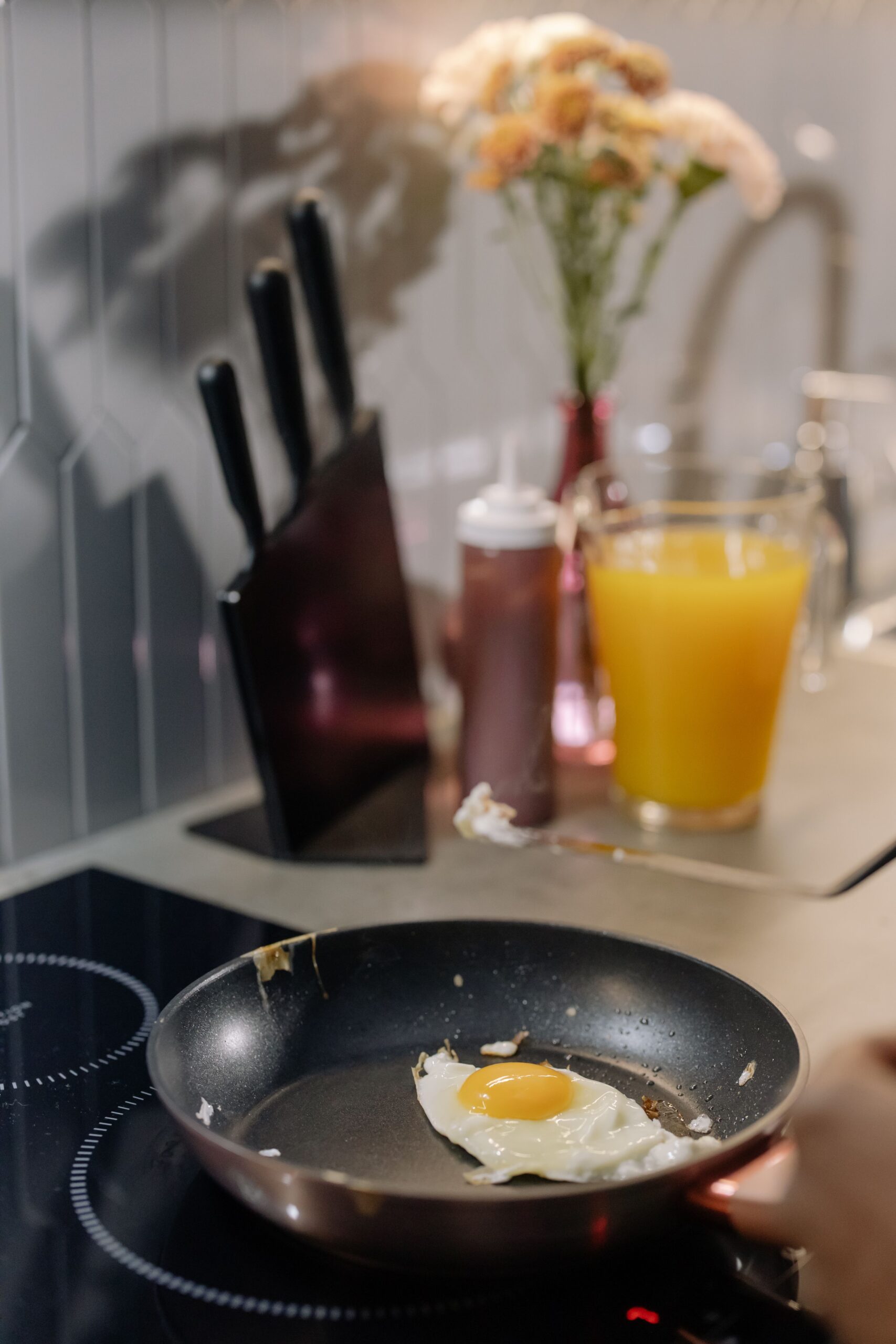
A tender cooked egg has a network that is set but still moist. The proteins have linked enough to hold their shape, but the mesh has not tightened too much. That is why soft scrambled eggs, a custardy French omelet, and a carefully cooked poached egg all depend on stopping the heat at the right moment. The egg keeps cooking for a short time from stored heat even after it leaves the pan, so the best texture often comes from pulling it slightly before it looks completely finished.
Why Overcooked Eggs Turn Rubbery or Dry
If heating continues, the protein network keeps tightening. As it contracts, it squeezes out some of the water it had trapped. In scrambled eggs, that water may show up as a watery puddle. In hard-cooked eggs, the white can become tough and bouncy. In baked custards, too much heat can make the mixture curdle because the proteins clump tightly instead of forming a fine, smooth network.
The same chemistry explains the difference between gentle heat and harsh heat. Low or moderate heat gives proteins time to unfold and connect gradually. Very high heat can make the outside of an egg set quickly while the inside is still runny, or it can force proteins into tight clumps before water is evenly held. Stirring changes the structure too. When scrambled eggs are stirred, curds form as the protein network breaks and reforms in pieces.
Acid can change the process as well. A small amount of lemon juice or vinegar can help proteins unfold and set in a different way, which is why acid matters in some egg preparations. Salt can affect how proteins interact with water and with each other. Sugar slows coagulation in custards and baked desserts because it competes for water and makes the protein network form more gradually. Cooks often learn these effects as kitchen habits, but they are chemical changes in disguise.
Why Whites and Yolks Set Differently
Egg whites and yolks behave differently because they are built differently. The white is mostly water with proteins dissolved in it, so its change from clear liquid to white solid is easy to see. The yolk contains fat droplets and emulsifiers along with proteins, so it thickens in a richer, creamier way. A soft-boiled egg can have a firm white and a runny yolk because heat reaches and changes those parts at different rates.
The shell and shape of the egg matter too. In a boiled egg, heat must move from the hot water through the shell, through the white, and then toward the yolk. The outer white sets before the center does. In a fried egg, heat comes strongly from the pan below, while the top may cook more slowly unless it is covered, basted, or flipped. In scrambled eggs, mixing spreads the yolk through the white, so the proteins and fats cook together instead of in separate layers.
That is why timing alone never tells the whole story. A cold egg from the refrigerator, a room-temperature egg, a crowded pan, a thin pan, a gentle simmer, and a hard boil can all give different results. The core chemistry is the same, but the path heat takes through the egg changes the final texture.
The Same Idea Shows Up Beyond Breakfast
Once the protein-network idea is clear, many other foods make more sense. Custards set because egg proteins thicken milk or cream into a delicate gel. Meringues depend on beating egg whites so proteins unfold around air bubbles before heat stabilizes the foam. Meat firms as its muscle proteins denature and coagulate. Yogurt, cheese, and tofu also rely on proteins forming networks, though acid, enzymes, salts, or minerals may be the main triggers instead of heat alone.
Eggs are useful because their transformation is visible. A clear liquid becomes opaque. A runny yolk becomes thick. A soft scramble becomes rubbery if heat goes too far. Those changes are everyday evidence that texture is not separate from chemistry. The feel of food comes from molecules changing shape, linking together, holding water, and sometimes squeezing it out.
Cooking an egg is a small experiment repeated in kitchens everywhere. Heat does not simply make the egg “dry” or “hard.” It gives folded proteins enough energy to open up, meet one another, and build a new network. The more gently that network forms, the more tender the egg feels. The longer and hotter it cooks, the tighter the network becomes. A good egg is chemistry stopped at the right moment.