 Akshay Dinesh
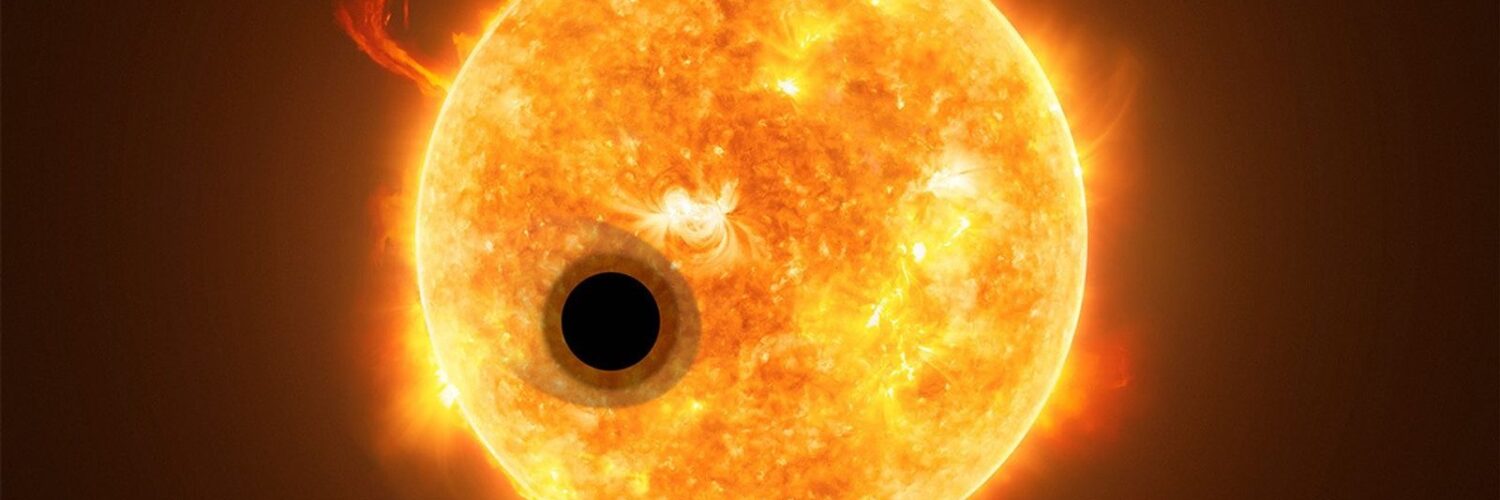
A planet orbiting another star is almost never visible as a little world in a telescope image. Its star is too bright, the planet is too faint, and the distance is hard to imagine. Yet astronomers have found thousands of these planets, called exoplanets, by noticing something much smaller than a picture: a slight, repeated dimming in starlight. When a planet passes in front of its star from our point of view, it blocks a tiny fraction of the star’s light. That crossing is called a transit, and the brightness pattern it leaves behind can turn a distant star into a measurable planetary system.
The transit method is powerful because it changes the question from Can we see the planet? to Can we measure the star carefully enough to notice the planet’s shadow? NASA’s Kepler Space Telescope used that idea on a huge scale by watching about 150,000 stars in one region of the sky for years, looking for small, regular dips. The same basic method also helps later telescopes study planets in more detail. A simple-looking dip can reveal a planet’s size, orbit, and sometimes even hints about the gases around it.
A Transit Is a Tiny Eclipse
A transit is like a miniature eclipse seen from far away. The planet does not usually cover the whole star, the way the Moon can cover the Sun during a total solar eclipse. It crosses only a small part of the star’s disk, so the star merely looks a little dimmer. For a large planet crossing a small star, the dip may be easier to spot. For an Earth-sized planet crossing a Sun-like star, the change is extremely slight, which is why space telescopes and careful statistics matter so much.
The key is repetition. One dip could be noise, a starspot, an instrument effect, or another kind of astronomical event. If the same kind of dip appears again and again at regular intervals, astronomers have stronger evidence that an orbiting body is passing between the star and the telescope. The time between dips tells them the planet’s orbital period: how long it takes to go around the star once. A planet with a short period makes frequent transits; one with a long period may require years of patient watching.
The shape of the dip also matters. As the planet begins to cross the star, the brightness falls. While the planet is fully in front of the star, the brightness stays lower. As the planet moves away from the star’s face, the brightness rises again. That brightness-over-time graph is called a light curve. To an astronomer, a light curve is not just a squiggle. It is a record of motion, alignment, and size.
What the Dip Can Tell Astronomers
The depth of a transit dip is closely connected to the planet’s size compared with its star. A larger planet blocks more light. A smaller planet blocks less. If astronomers know the star’s size, the percentage drop in brightness lets them estimate the planet’s radius. This is one reason stellar measurements are so important in exoplanet science: the planet’s numbers depend partly on how well the star is understood.
The timing of the dip gives another piece of the puzzle. If a planet transits every ten days, it is orbiting close enough to its star to complete a year in ten Earth days. If the transits come once every few hundred days, the planet is much farther out. With the star’s mass and the period of the planet’s orbit, astronomers can estimate the planet’s orbital distance using the same gravitational ideas that describe planets in our own solar system.
Transit data can also reveal whether a planet is part of a crowded system. If several planets orbit the same star, their gravitational tugs can make the timing of each transit shift slightly. These transit timing variations can help researchers infer the presence and masses of other planets, even when those planets are hard to measure directly. A star’s brightness record can become a kind of clock, and small changes in the clock can reveal hidden structure.
Still, the transit method has a built-in limitation: alignment. A planet must pass directly between its star and our telescope for us to see a transit. Many planets orbit at angles that never cross the star from Earth’s viewpoint, even though the planets are real. That means transit surveys find only a fraction of the planetary systems that exist. When they do find one, though, the information can be unusually rich.
Why Kepler Changed Planet Hunting
Before large transit surveys, many early exoplanet discoveries came from the radial velocity method, which measures how a planet’s gravity makes its star wobble. That method is still valuable, but it often favors massive planets close to their stars. Kepler changed the scale of the search by watching many stars at once with the patience needed to catch repeated dimming events. Instead of asking whether a single star had a detectable wobble, Kepler asked how often planets appeared when a large population of stars was monitored for transits.
The answer reshaped astronomy. Kepler data helped show that planets are common in the Milky Way, including planets smaller than Neptune and planets in systems very different from our own. Some stars have multiple planets packed into close orbits. Some planets are larger than Earth but smaller than Neptune, a size range absent from our solar system but common elsewhere. The transit method did not merely add a few strange worlds to a list. It revealed that planetary systems are a normal part of star formation.
Kepler’s discoveries also gave later missions better targets. NASA’s Transiting Exoplanet Survey Satellite, or TESS, searches much of the sky for transiting planets around relatively nearby bright stars. Bright host stars are valuable because follow-up telescopes can measure them more easily. Once a transit candidate is found, astronomers can use ground-based observatories, space telescopes, radial velocity measurements, and spectroscopy to test and refine the picture.
How Starlight Can Reveal an Atmosphere
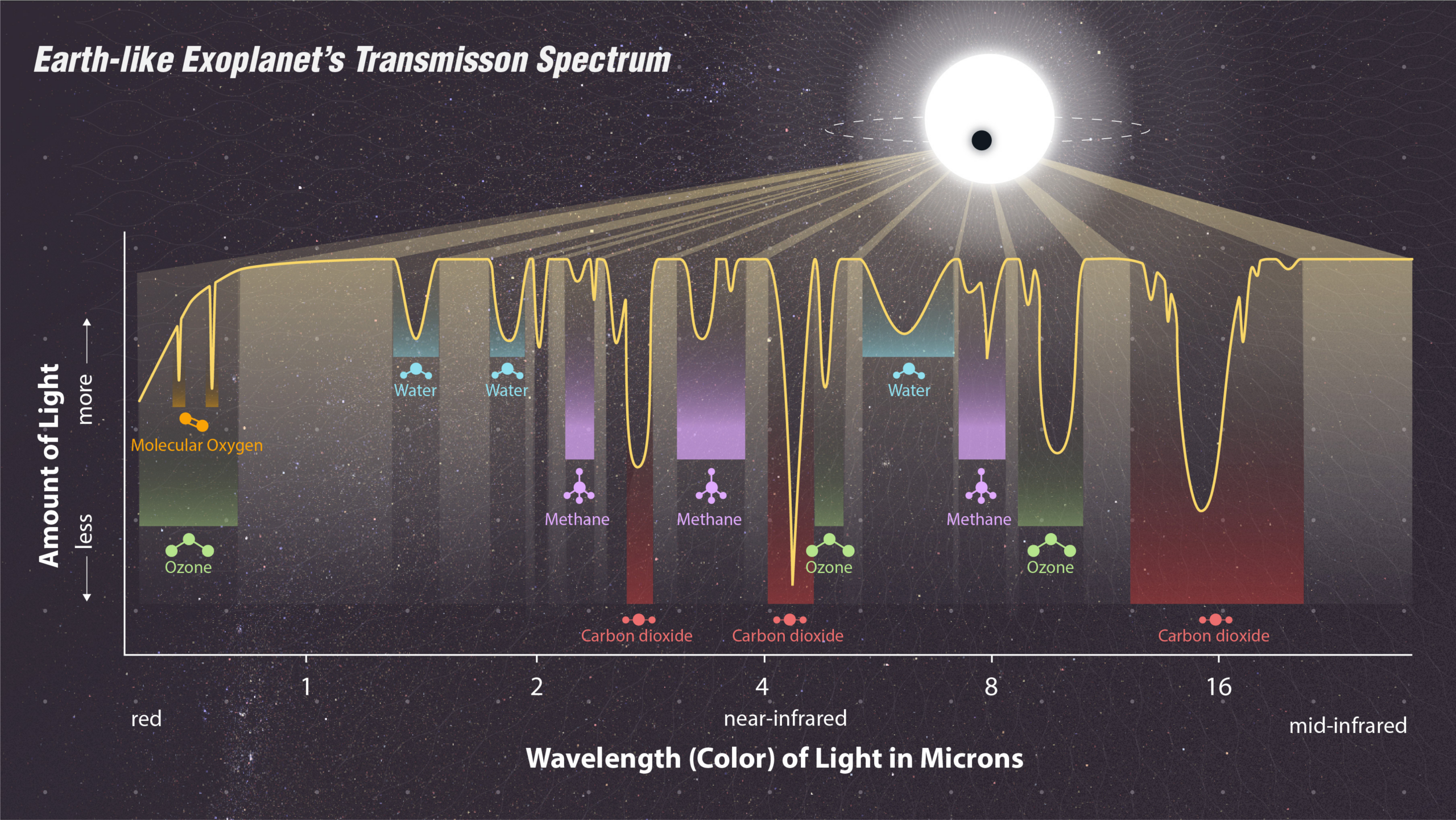
A transit can do more than announce that a planet exists. If the planet has an atmosphere, a small amount of starlight may pass through that atmosphere during the transit before reaching a telescope. Different gases absorb different wavelengths of light. When astronomers split the light into a spectrum, they can look for missing colors, or absorption features, that act like chemical fingerprints.
This technique is called transmission spectroscopy. NASA describes it as a careful comparison: first measure the star’s light, then measure the star plus the planet during transit, then subtract to isolate what the planet’s atmosphere absorbed. The James Webb Space Telescope is especially useful for this work because it observes infrared light with instruments designed to separate light into detailed spectra. Molecules such as water vapor, carbon dioxide, methane, and other gases can leave patterns that researchers compare with laboratory and model references.
The process is delicate. The planet is small compared with the star, the atmosphere is thinner still, and the signal can be faint. Clouds, hazes, star activity, instrument noise, and repeated observations all matter. A single spectrum rarely tells the whole story. Scientists build confidence by comparing data from multiple wavelengths, models, instruments, and observations. The result is not a travel poster of an alien world. It is a measured clue about temperature, composition, clouds, and chemistry.

What Transits Cannot Prove by Themselves
It is tempting to treat every dip as a planet, but astronomers have to be more careful. A smaller star crossing in front of a larger star can mimic a planetary transit. A blended background star can make a dip look shallower than it really is. Starspots can change brightness as a star rotates. Instruments can introduce patterns that are not astronomical at all. Good exoplanet science depends on ruling out these false positives.
That is why follow-up observations matter. If a transit appears promising, astronomers may check whether the star wobbles in a way consistent with a planet’s gravity. They may look at the star with higher-resolution imaging to see whether a nearby companion star is confusing the measurement. They may compare transits in different colors of light. A real planet-sized object should usually block starlight in a consistent way, while some stellar impostors behave differently.
The method also says more about some planets than others. Transits are easiest to catch when planets orbit close to their stars, because close-in planets cross more often. That can make hot, short-period planets easier to find than cooler planets with long years. A planet like Earth around a Sun-like star transits only once per Earth year and produces a very small dip. Finding such worlds is possible, but it requires patience, precision, and enough repeated evidence to separate a real pattern from noise.
Why a Small Dip Matters
The beauty of the transit method is that it turns an almost impossible direct view into a measurable pattern. A tiny loss of starlight can become a planet’s radius. A repeated schedule can become an orbit. A filtered spectrum can become a clue about atmospheric gases. Each piece is limited, but together they let astronomers study worlds that cannot be visited, photographed in detail, or separated easily from their stars.
That is why transits remain central to exoplanet science. They connect simple geometry with some of the biggest questions in astronomy: how common planets are, how planetary systems form, what kinds of atmospheres distant worlds have, and whether small rocky planets are ordinary or rare. The discovery often begins with something humble: a star that dims by a fraction, then brightens again, right on schedule. In that small shadow, a whole world can come into view.