 Akshay Dinesh
A comet can feel like a surprise visitor, suddenly appearing as a faint smudge in a telescope or, in rare cases, a bright streak with a glowing tail. Yet many comets are not random wanderers. They are small icy worlds traveling on long paths around the Sun, and some of those paths bring them back into the inner solar system again and again. NASA’s July 2026 skywatching guide points observers toward Comet 10P/Tempel 2, a short-period comet visible with optical help under dark skies. Its return is a good reminder that the solar system is not only made of planets on tidy-looking paths, but also of older, colder objects moving through huge stretched-out orbits.
The basic idea is simple: a periodic comet comes back because it is still gravitationally bound to the Sun. It may travel far beyond the orbit of Mars, Jupiter, or Neptune, but it does not escape completely. After it swings around the Sun, gravity slows its outward climb, turns it around, and pulls it back inward. The timing may be years, decades, centuries, or far longer, depending on the shape and size of the orbit.
What Makes a Comet Periodic
A comet is often described as a mixture of frozen gases, dust, rock, and darker organic-rich material left from the early solar system. NASA describes comets as icy bodies that can heat up near the Sun, releasing gas and dust into a bright surrounding cloud called a coma. That is why a comet can look fuzzy instead of sharp like a star. The solid nucleus may be only a few miles across, while the coma and tail can grow far larger when sunlight begins warming the surface.
The word periodic means the comet has a repeatable orbital period: the time it takes to complete one trip around the Sun. The famous Halley’s Comet returns roughly every 76 years, which is long compared with a human school year but short by solar-system standards. Comet 10P/Tempel 2 has a much shorter period of a little over five years, so astronomers can predict its returns with reasonable confidence. These are not new comets being created each time. They are the same objects following paths shaped by gravity.
The main difference between a periodic comet and a one-time-looking visitor is the orbit. A periodic comet follows a closed path around the Sun, usually an ellipse. A long-period comet may also be bound to the Sun, but its path can be so enormous that one trip may take thousands or even millions of years. Some objects enter the inner solar system only once from our point of view because their paths are extremely long, poorly known, or changed by close encounters with planets.
Gravity Turns a Flyby Into a Return
Planets are easy to picture because their orbits are nearly circular compared with most comet paths. Comets often move along much more stretched ellipses. At one end of the ellipse, the comet comes closest to the Sun; this point is called perihelion. At the far end, the comet reaches its greatest distance before falling sunward again. The Sun is not sitting in the exact center of that oval path, but near one focus of the ellipse, which is why the comet’s speed changes so dramatically during the trip.
Near the Sun, a comet moves fastest. Solar gravity has pulled it inward for a long time, giving it speed in the same way a skateboarder speeds up while rolling downhill. After the comet passes perihelion, it begins moving outward again, but now it is climbing against the Sun’s gravity. It slows as it goes. If it remains bound to the Sun, gravity eventually wins, the outward motion stops, and the comet begins another inward fall.
This pattern is the same reason planets keep orbiting instead of flying away or falling straight into the Sun. The comet has sideways motion as well as inward or outward motion. Gravity bends that motion continuously, turning what might look like a near-miss into a curved path. A planet’s path is steadier because planets are massive, relatively close to circular, and less easily disturbed. A comet is smaller and often passes near giant planets, especially Jupiter, so its route can change more noticeably over time.
Jupiter matters because it is massive enough to tug comets into shorter paths, stretch their orbits, or sometimes fling them onto very different tracks. Many short-period comets belong to a group strongly influenced by Jupiter. Their periods are often less than 20 years, and their paths tend to stay closer to the plane where the planets orbit. In that sense, a comet’s return is predictable, but not perfectly frozen. Each pass through the inner solar system is part of a long gravitational conversation with the Sun and planets.
Why Comets Brighten Near the Sun
A comet far from the Sun is usually dark and quiet. Its ices are frozen hard, and there is little sunlight to make them active. As the comet moves inward, sunlight warms the surface. Frozen materials such as water ice, carbon dioxide, and carbon monoxide can turn into gas or escape through cracks and weak spots. Dust trapped in the ice lifts away with the gas, forming a coma around the nucleus.
That brightening is why a comet’s return matters to observers. The object has been traveling for years in the cold, but it becomes more visible when sunlight activates it. A telescope may show a soft glow rather than a sharp dot because the light is coming from dust and gas spread around the nucleus. The comet itself is tiny compared with the cloud it produces.
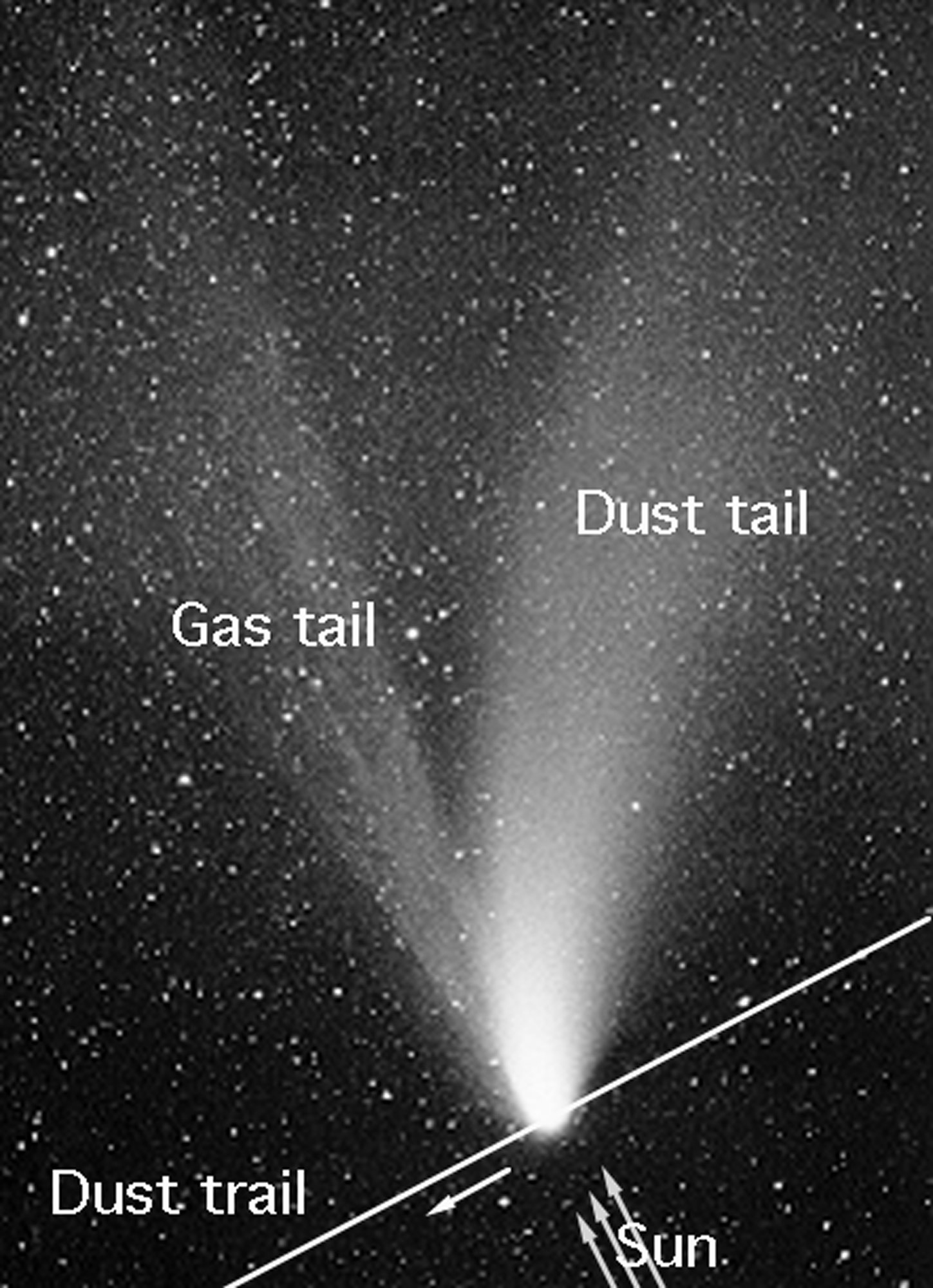
The tail adds to the drama, but it is often misunderstood. A comet’s tail does not simply trail behind it like smoke behind a moving train. Sunlight and the solar wind push material away from the Sun, so tails often point generally away from the Sun no matter which direction the comet is traveling. NASA notes that comets can have two tails: a dust tail and an ion tail. The dust tail is made of small solid particles reflecting sunlight, while the ion tail is made of electrically charged gas shaped by the solar wind.
That means a comet can look different from one return to the next. Its activity depends on distance from the Sun, surface changes, rotation, dust release, and viewing geometry from Earth. A comet may be easy to photograph during one apparition and disappointing during another. Predictions can estimate brightness, but comets are famous for refusing to behave like simple light bulbs on a schedule.
Short-Period and Long-Period Comets
Astronomers often separate comets by orbital period because the timing hints at where they came from and what shaped their paths. Short-period comets complete an orbit in less than 200 years. Many are linked to the Kuiper Belt, a distant region beyond Neptune filled with icy bodies. Over long spans of time, gravitational nudges can move some of those bodies inward, where they become easier to observe as active comets.
Long-period comets can take much longer to return. NASA describes many of them as coming from the Oort Cloud, a faraway reservoir of icy bodies thought to surround the solar system at enormous distances. A comet from that region may spend most of its life in deep cold, far beyond the planets, before a gravitational disturbance sends it sunward. Its visit may be spectacular, faint, or barely noticed, but its orbit can be so long that no one alive will see the next return.
The 200-year dividing line is useful, but it is not a wall in nature. It is a human-made classification that helps astronomers talk about families of orbits. What matters physically is the size and shape of the path, the object’s speed, and the gravitational pushes it receives. A comet can move from one category-like behavior to another if a planet changes its orbit enough.
This is also why comet names and numbers carry meaning. A numbered periodic comet has been observed well enough across returns for its orbit to be confirmed. The number 10P in 10P/Tempel 2 tells observers it is a recognized periodic comet, not just a newly spotted object with an uncertain future. The more observations astronomers collect across time, the better they can refine the path and predict future appearances.
What a Returning Comet Can Teach
Periodic comets are valuable because they let scientists compare the same object across multiple visits. Does the comet brighten at the same distance from the Sun? Does it release dust from the same active areas? Has its rotation changed? Has a close pass near Jupiter shifted the orbit? These questions turn a faint sky object into a long-running record of physical change.
They also connect ordinary skywatching with deep time. When someone looks for a comet through binoculars or a telescope, the object in view may have spent years traveling through darkness before returning to a warmer part of its orbit. Its material may preserve clues from the young solar system, while its current behavior shows how sunlight, gravity, and solar wind keep reshaping small worlds.
The return of a comet is predictable enough to put on a skywatching calendar, but uncertain enough to stay interesting. A periodic comet is not a clockwork ornament moving through empty space. It is an icy body losing material, responding to heat, and being tugged by planets as it follows the Sun’s gravity. That combination makes each return both familiar and new.
The next time a comet appears in a sky guide, the useful question is not only where to look. It is also how the comet got there again. Its path is a story written by gravity, cold storage in the outer solar system, bursts of sunlight-driven activity, and careful observation across generations. Periodic comets come back because they never truly left the Sun’s reach.